All About Mixtures
Mixtures, not just about power
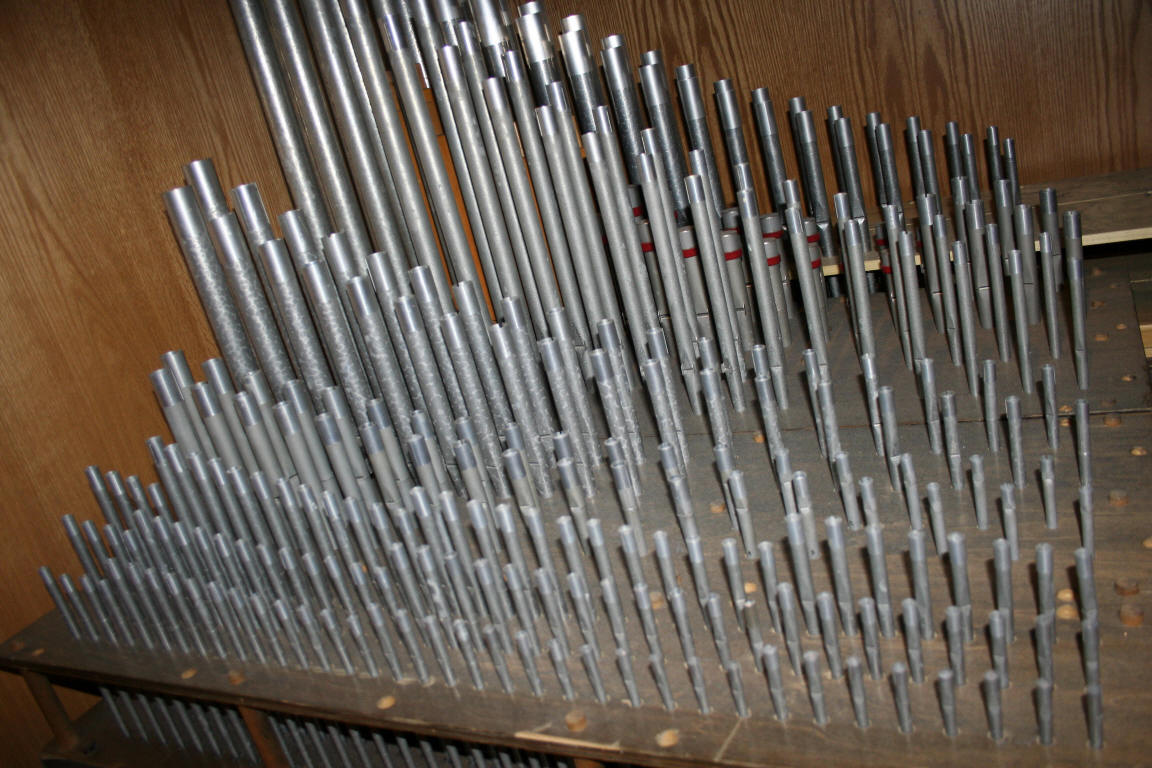
Adding a mixture to the chorus makes the chorus brighter and louder. But, depending on how the mixture is designed and voiced, and how it fits with the rest of the chorus, a mixture can add subtle vocal-like color. I don't mean to literally make the organ "speak" words. Instead, by mimicking the formant structure of vowels, mixtures can add a vowel color that has powerful musical effects.
Think of it this way: A choir is singing a complex canon. If everyone sings on "Mmm", you can't tell the parts apart. But if Sopranos sing "Ee", Altos "Ah", Tenors "Oh", and Basses "Oo", each voice is instantly distinguishable. (Think of the Swingle Singers). In the same way, a subtle vocal-like color from the mixtures clarifies the polyphony.
Not all mixtures add the subtle vocal-like color. It all depends on how the mixture is voiced, its composition, and how it fits in with the rest of the chorus. North German Baroque organs, such as Arp Schnitger's instruments frequently have a vocal quality. Whereas, Classical French organs, Romantic organs, and many modern organs may not.
Note: The english language has two different usages for the word 'mixture'. In this discussion:
- A 'm'ixture is a class of stops that have multiple ranks of pipes (e.g. Mixture, Scharf, Fourniture and Cymbale are all mixtures).
- A 'M'ixture is the stop name of a mixture stop, in the Baroque German Organ.
Vowels, what are they?
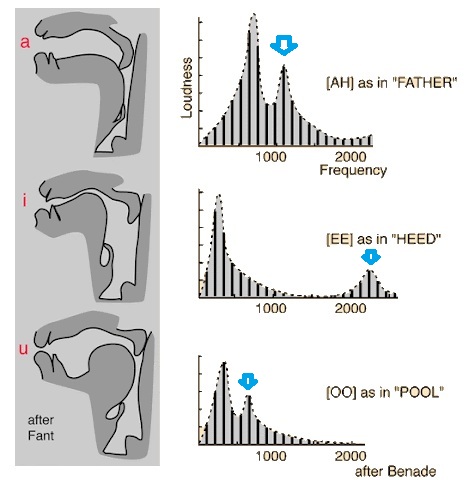
When you speak, your mouth emits a complex mix of sounds (vowels and consonants), which are assembled into syllables, words and finally speech. Vowels actually are made of two simultaneous tones (or more correctly, partials): a low pitched fundamental (about 250-500 hz), plus a higher pitched partial (900-2,300 hz). The blue arrow in the drawing to the right, points out the upper partial. (There are actually more than two partials, but we only need and care about the first two partials.)
It is the higher pitched partial that distinguishes the vowel, not fundamental pitch. The fundamental pitch is the note that you sing. Also, you should note tha a vowel upper partial is not an exact pitch; rather, it is the center of a band of sound.
Approximate center frequencies of vowel upper partial
- ~2250hz "see"
- ~1900hz "sit"
- ~1800hz "bed"
- ~1600hz "cat"
- ~1100hz "father"
- ~ 950hz "saw"
- ~ 900hz "too"
We can understand speech, because we all have a sort of "Perfect Pitch" ability. Under the right conditions, we hear sound combinations within certain frequency bands, as vowels. If you want to hear vowels using only the upper partial, try slowly whispering these vowels in this order: "U, O, A, E, I". You can hear the vowel, but you also hear a hiss-sound (the upper partial) rise in pitch. It's subtle, but it's all you brain needs translate the pitch to a vowel. Our brains are hard-wired for this.
Speech starts with fundamental sound from your vibrating vocal cords (about 250-500 hz), travelling up your vocal tract (throat and mouth cavity), and out your mouth. Of course the fundamental isn't a sine wave; it includes rich background broadband noise. Your vocal tract (throat, mouth cavity, lips and tongue) is a resonator which acoustically selects, filters and amplifies that sound. By moving our lips, jaw and tongue, we tune the vocal tract, selecting the partials of the vowel we want.
A mixture stop artificially creates a fixed set of reinforced harmonics, independent of which key you play. That is exactly what a formant does: a fixed frequency region that emphasizes certain harmonics of a variable fundamental. If you design a mixture to strongly reinforce harmonics around, say, 500 Hz and 1500 Hz, it will make any note played on it sound somewhat like a particular vowel, relative to that pitch. Your brain selects the mid-point of the four ranks of a mixture, to determine the vowel sound.
An Organ's Octave Band Analysis
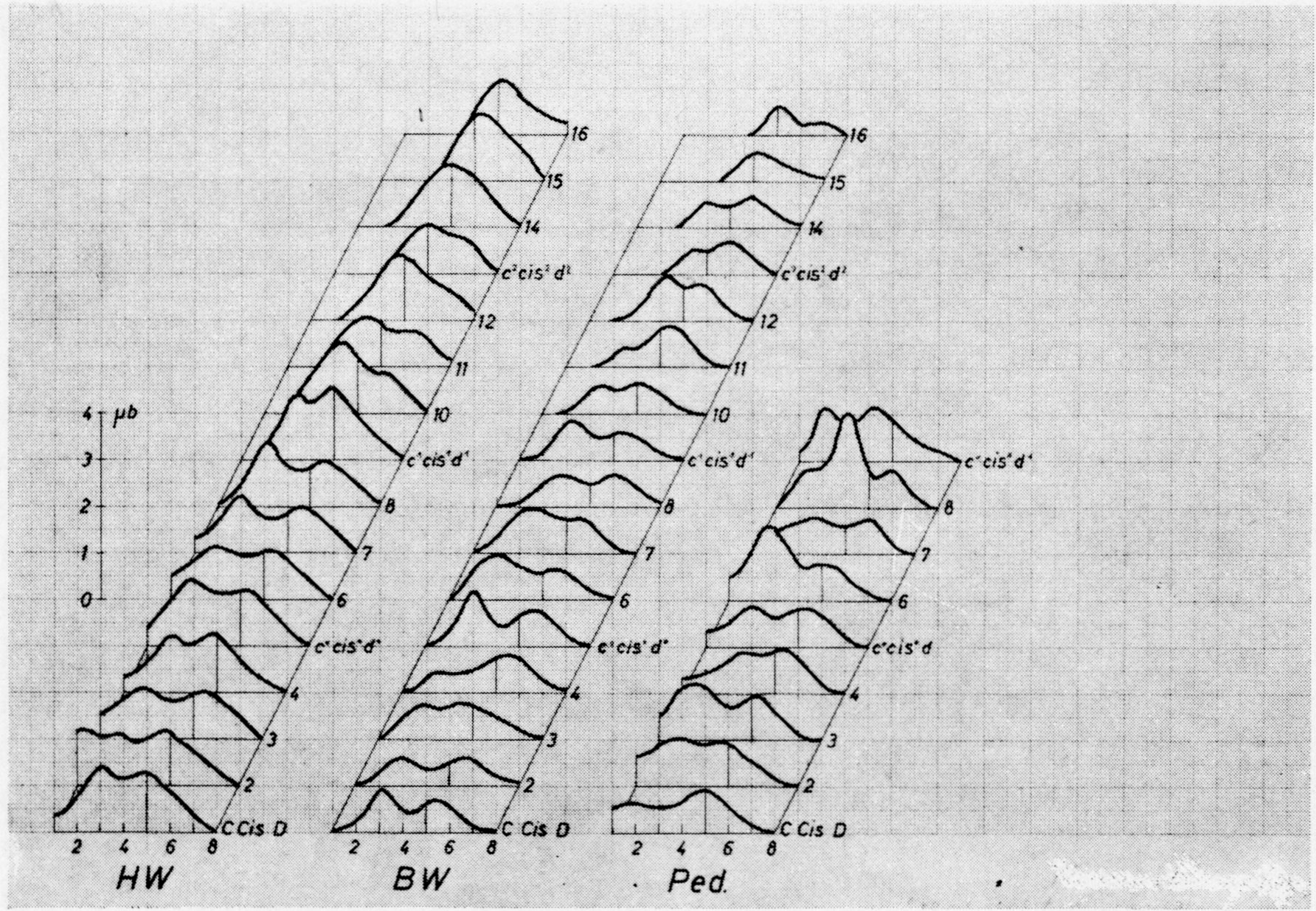
To understand mixtures, we need to see how they fit into the chorus of an organ. Fortunately Werner Lottermoser "Orgeln, Kirchen und Akustik" 1983, has made some octave band analyses for us. In the graph at the left of the page, we see his audio spectrums of the famous Schnitger organ in Steinkirchen, Stade. An audio spectrum, is the loudness of a pipe, as measured continuously over the entire frequency spectrum, from low to high frequencies.
You'll notice there are about 40 squiggly lines (spectrums), organized diagonally as divisions: Hw, Bw and Ped. He sampled three adjacent notes simultaneously, to average them out. The squiggly line is the spectrum of those three simultanious notes, summed. So there are 16 spectrums for the Hauptwerk, each consisting of three consecutive notes. He is sampling the principal chorus including the mixture, but without the Trumpet.
I know it may sound confusing, but all that really matters, is that when you look at any spectrum you'll see it is filled with broadband sound. But notice there are two humps. The first hump are the 8' stops, and the second hump is the mixture stop. The lower hump acts as a lower partial and the mixture acts like an upper partial. A strong 8' and a bold mixture make the partials more obvious.
The gap between the humps or partials is filled with the remaining stops, various overtones and other broadband noise. The gap isn't empty, its just a little restrained to allowing the two partial humps to stand out. The more obvious the partial humps, the more the vowel sound stands out. Usually (but not always), the mixture's frequency goes up as you play up the keyboard, and correspondingly we get higher pitched vowels.
To sum up, to get a vowel from a played organ note, you need two partials. The first is a bold 8' Principal for the lower partial. The second is a bold mixture for the second partial. It helps of the rest of the chorus is a little reticent.
In a classical French organ, the Plein Jeu is essentually a blockwerk deconstructed, with the spectrum filled with equally powered ranks, giving a homogeneous, bright sound. But without the humps in the spectrum, there isn't a vowel character. There are lots of modern organs that are vowelless for simular reasons.
To be clear, vowels are simply a way to describe what a chorus sounds like. When laying out his mixtures, Arp Schnitger had no idea about vowels. But Schnitger knew he wanted a brighter Positiv than the Hauptwerk, and wanted the brightest sound from the Brustwerk. He knew he could get that by his choice of the pitch ( 1-1/3", 2/3", etc) of the mixtures.
Vowels, Why are They Useful?
1. It Enhances Polyphonic Clarity
This is the most critical musical function in contrapuntal music (Bach, Buxtehude). When several independent melodies (voices) play at once in the same register, they blur together. An Ascending (see below) mixture solves this by giving each part of the keyboard a different harmonic fingerprint.
Think of it like this: A choir singing a complex canon. If everyone sings on "Mmm", you can't tell the parts apart. But if Sopranos sing "Ee", Altos "Ah", Tenors "Oh", and Basses "Oo", each voice is instantly distinguishable.
The organ mixture does this pitch-dependently. The left hand playing a low C will have its mixture reinforce harmonics around 1100 Hz (an "Ah" quality). The right hand playing high C on the same mixture stop will have its reinforced harmonics around 2,250 Hz (an "Ee" or hiss-like quality).
When you play a note on a mixture, 3 or 4 pipes may sound. Which pipe's frequency do you use? Well, you ear averages the group of pipes and selects the center fundamental frequency. Of course, the more pipes that are sounding, the muddier and harder it is to distinguish the vowel.
In summary: An Ascending mixture acts like an automatic intelligibility filter. It vocalizes each pitch range differently, so the listener's ear can effortlessly follow intertwining melodic lines simultaneously. Without this vowel-formant effect, complex fugues become muddy soup.
Because pipes in Blockwerks (and Renaissance organs) have the same scaling and voicing, and they do not break, the organ sounds almost the same as you play up the keyboard from bass to treble. The left hand sounds like it is playing on top of the right hand, muddying the polyphony.
2. Differentiation of several keyboards
The North German Baroque Hauptwerk was the main or "Great" keyboard of the organ. The Rückpositiv was an equal, but different, partner of the Hauptwerk. To emphasize this difference, the Germans used different pitched mixtures on each division.
For example the Hauptwerk would have a Mixture, and the Positiv a higher pitched Scharff or Cymbal. This created distinct, contrasting voices. Different mixtures in each division will have it's own distinctive pitch and vowel characteristic. For example:
- Pedal: "who'd" - (2', 1-1/3', 1')
- Great: "had" - (1-1/3', 1', 2/3', 1/2')
- Postv: "heed" - (2/3', 1/2', 1/3')
- Brust: "eye" - (2/3', 1/2')
Playing a chord in the middle of the Great keyboard will have a subtle "ah" sound, Pos an "eh", and Bw an "ee" sound. The vowels give each keyboard a characteristic sound, so a listener immediately recognizes a keyboard change. The mixtures are the most important stop for providing differentiation of character between the various keyboards. The mixtures make the Positiv brighter sound than the Great, and the Brustwerk sound the brightest.
In summary mixtures don't just make an organ louder. They can contribute a vowel character to the chorus that helps identify:
- 1) where on the keyboard you are playing, (Ascending Mixture)
- 2) which keyboard you are playing on, (Horizontal Mixture).
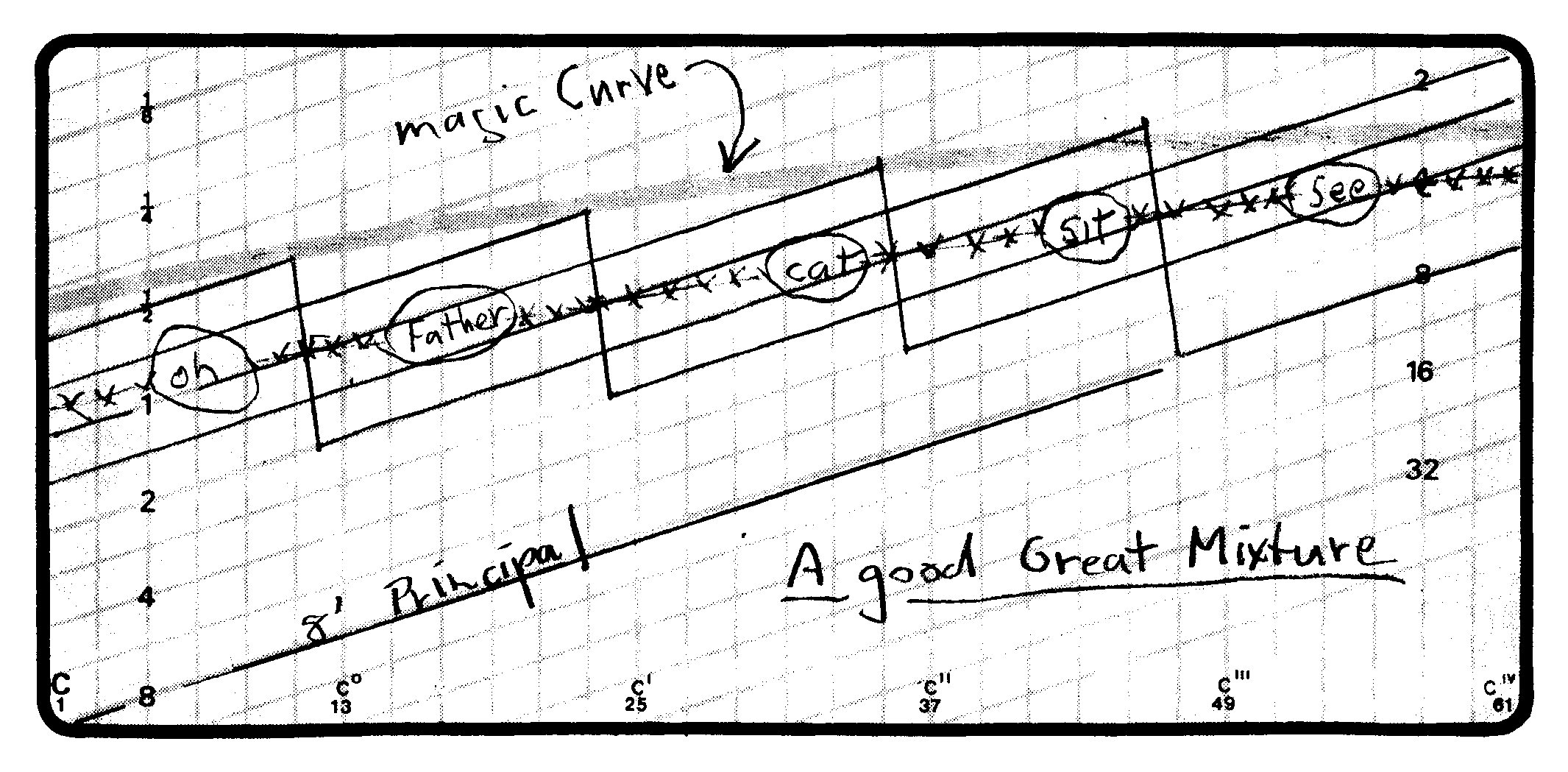
My Mixture Charts
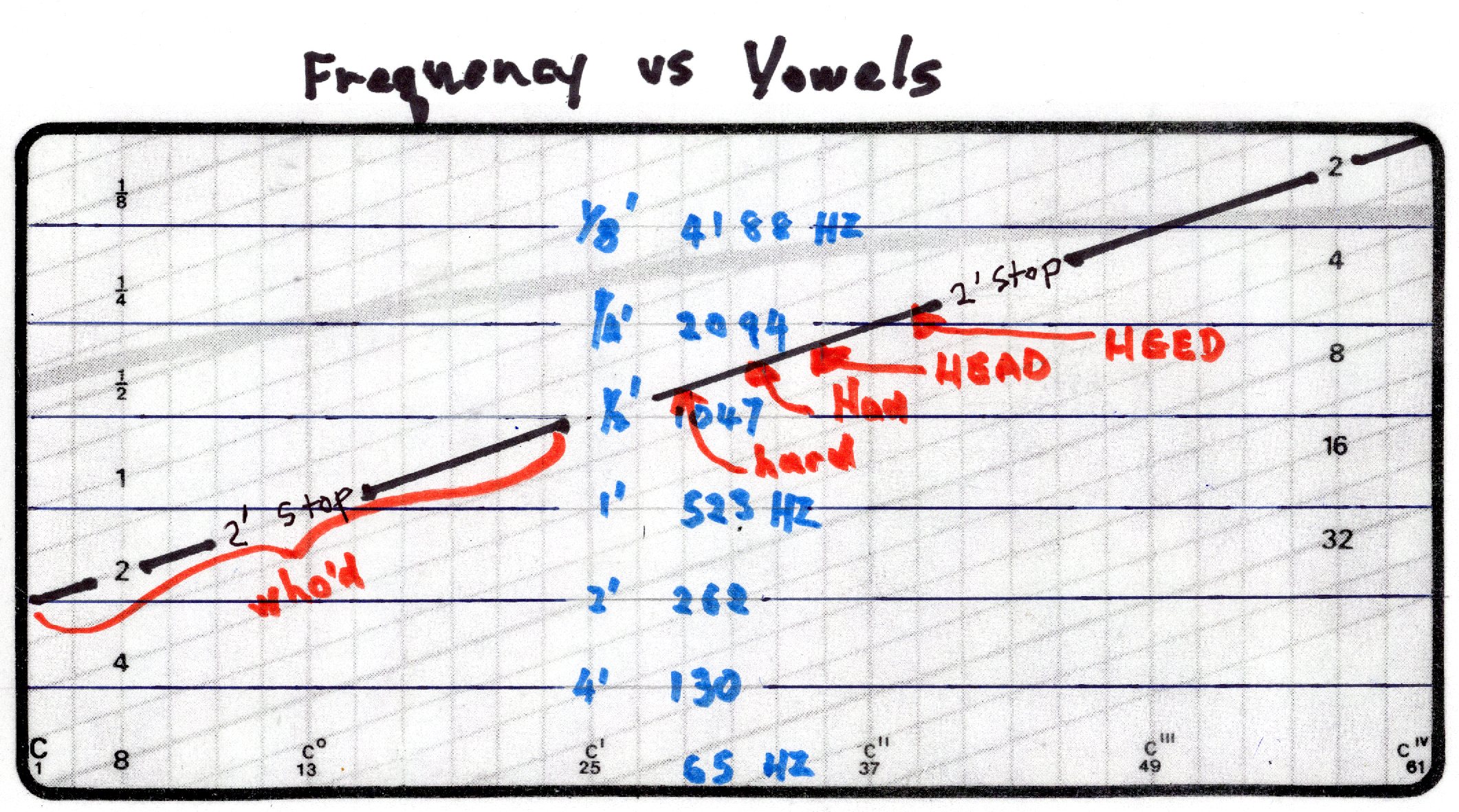
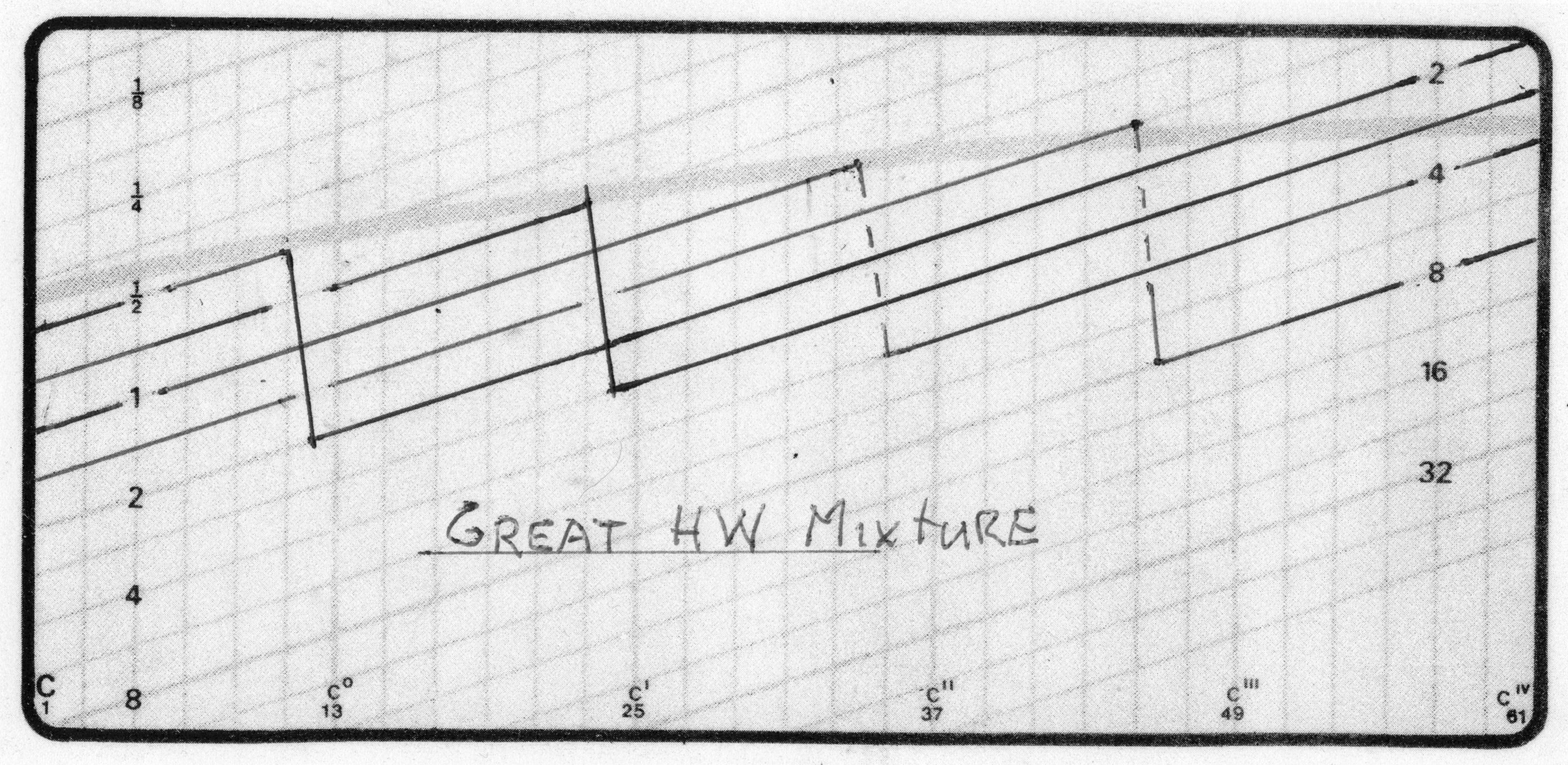
Now, mixture breaks can be difficult to visualize, so I'm going to share the chart of a typical Great mixture, shown on right. The horizontal scale, from left to right represents the notes of the keyboard, starting a C1 to C61. The vertical scale represents the actual pitch the pipe speaks. The diaginal lines represents each rank of pipes. (Click on the chart to enlarge, blank samples below).
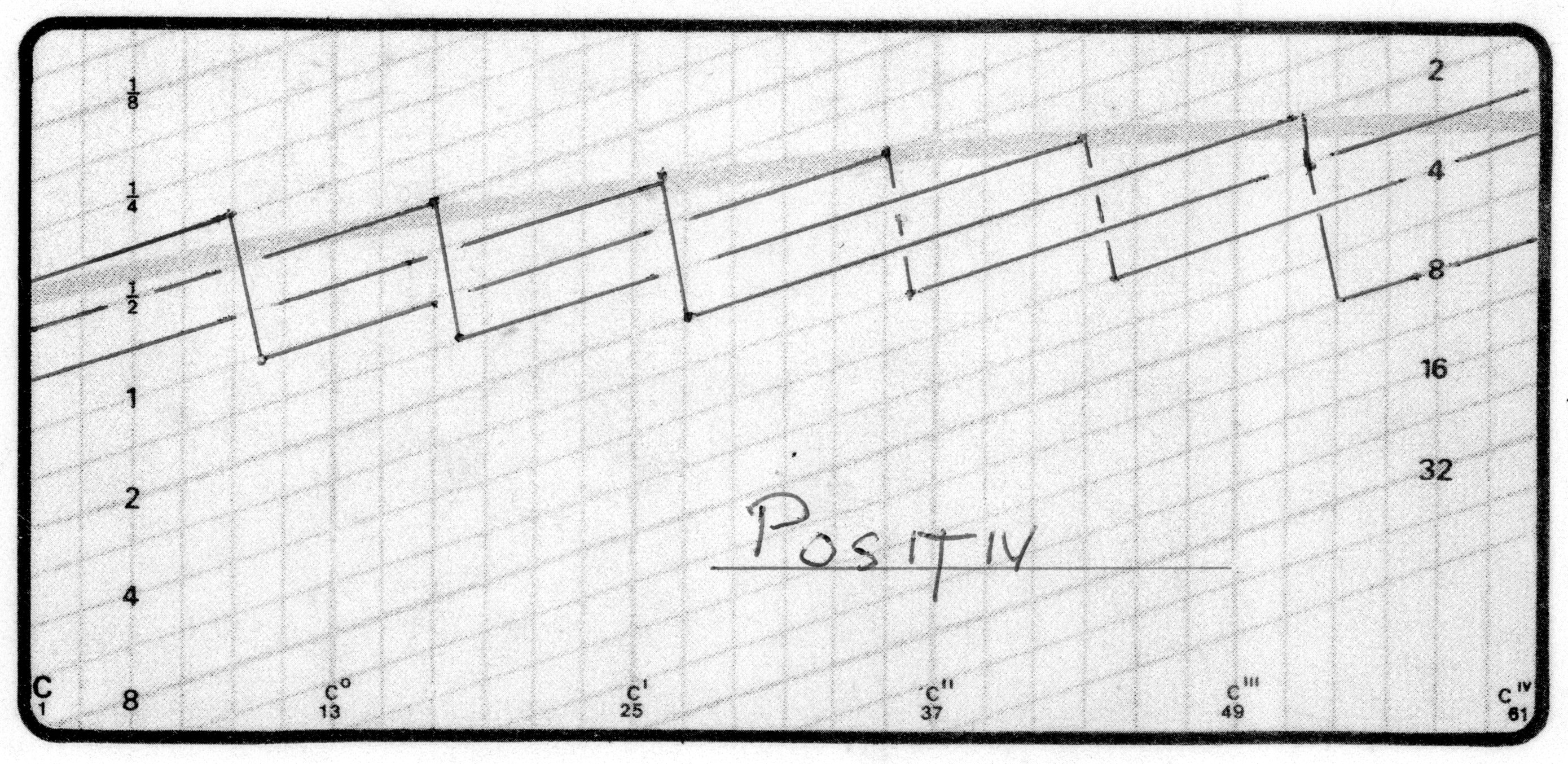
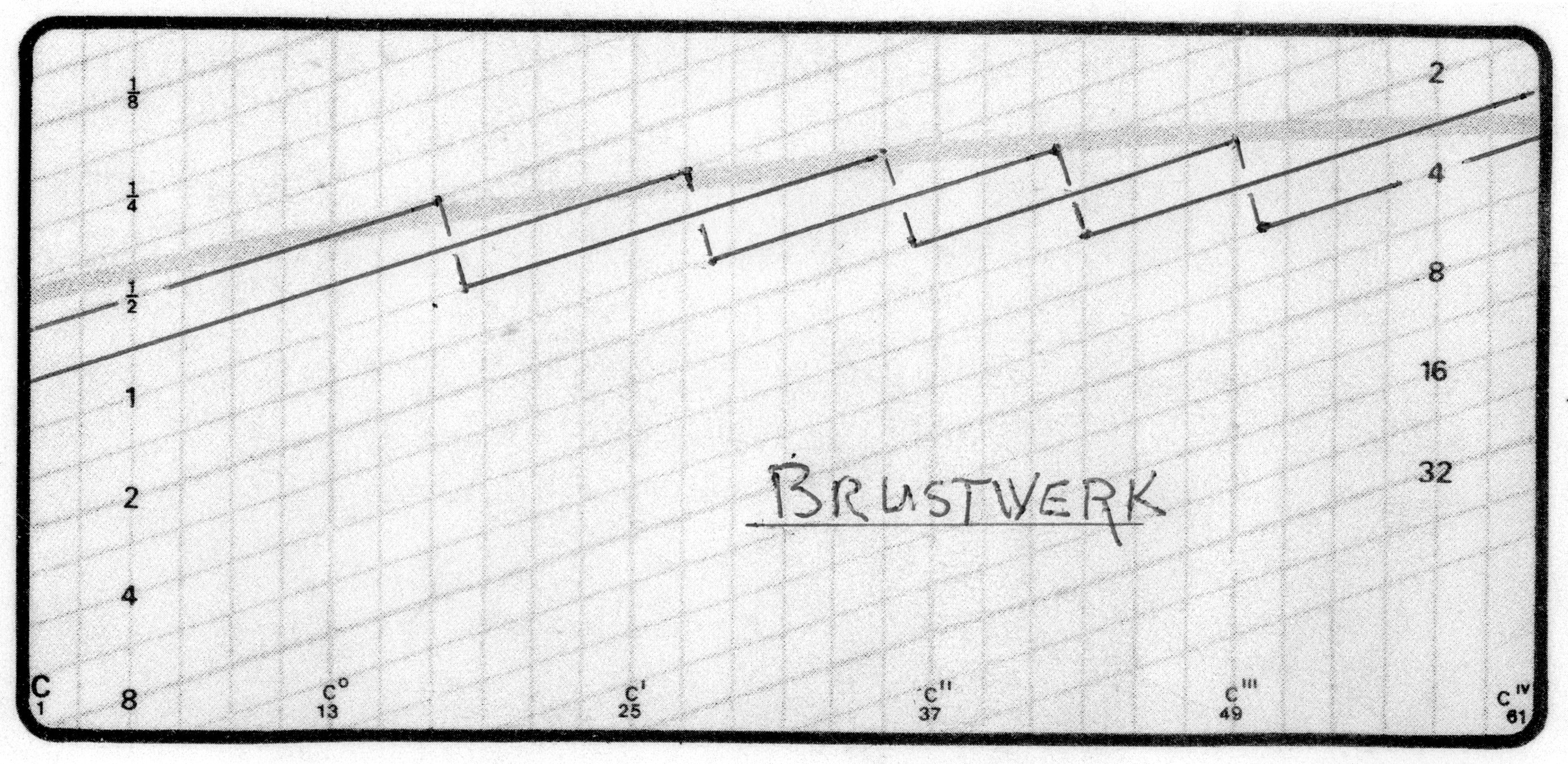
The "magic curve" on my mixture sheet is an arbitrary curve, on which the vowels spread out evenly, over the compass of the keyboard. A Great mixture will typically fall below and touch it, Positiv will be on it and Brustwerk be above it. If you draw an unknown mixture onto a blank mixture sheet, the magic line instantly tells you how the mixture compares.
When pipes of a mixture rank get too small, they jump back to a bigger size. That is called a break and is shown on the graph by jumping to a lower diaginal.
Mixtures have limits to their pitch range. For this Great mixture, at bottom "C" there would be no point going lower than 1-1/3'. That is because it would overlap the existing independant Superoctav 2'. The upper limit at top "c", is the top note of a 2' rank. Theat is because most organtuners can't tune any higher than that.
In practice the designer will select the mixture pitch range, to get the vowel effect he wants.
Mixture Files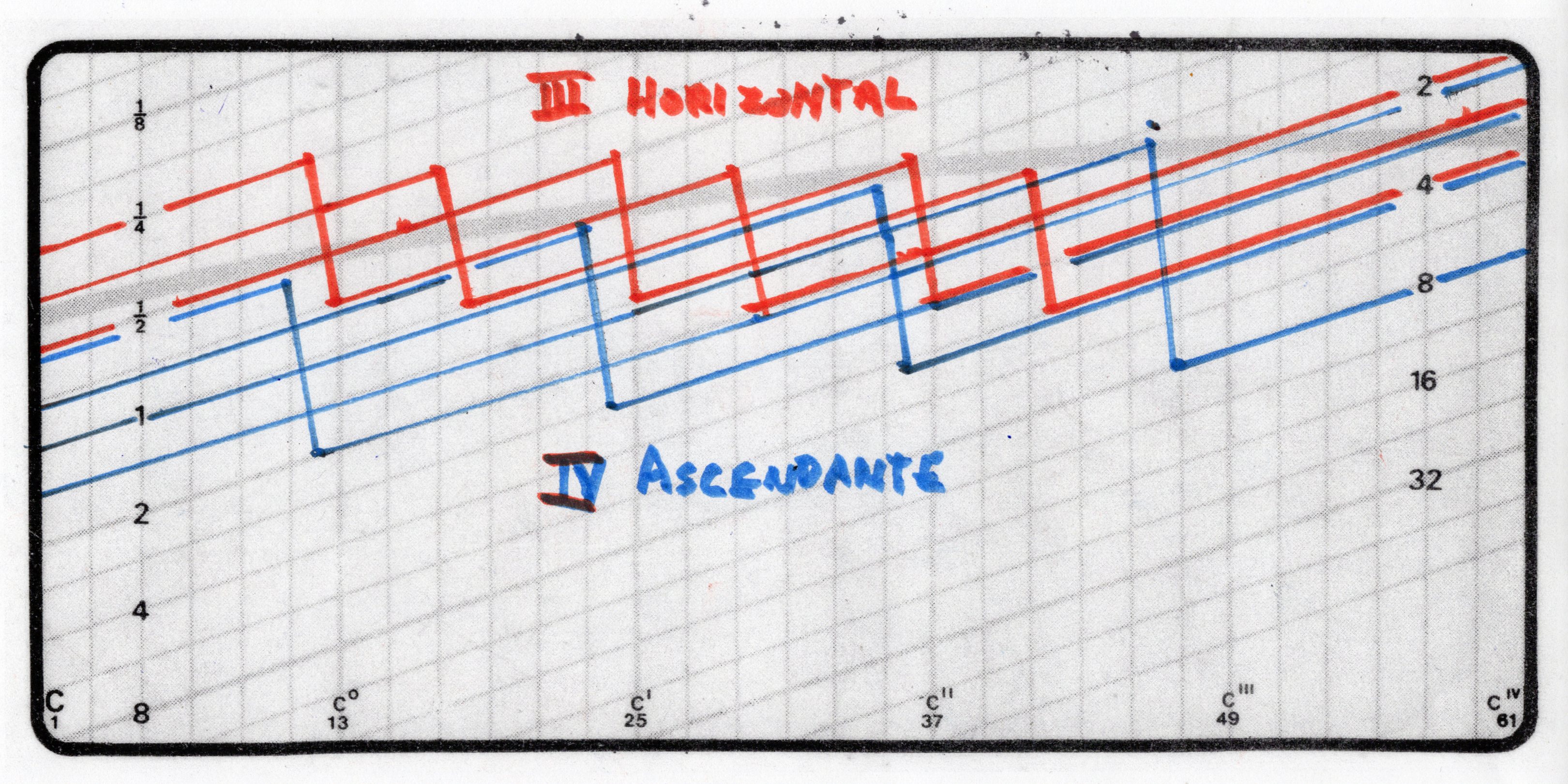
Mixtures Types, Ascending vs Horizontal
About forty years ago, I tried to understand mixtures. I scoured books and magazines and collected hundreds of mixture designs, and made graphs of them. I kept it all in a three ring binder, sorted by Country and builder. But mixture design didn't seem to have much sense.
Sure, mixtures made the organ chorus louder and brighter. But why were some mixtures pitched higher and others lower? Why did some have three breaks and others 6 breaks? How did they decide where to put the breaks? Why did different divisions have different mixtures. I found many different examples of mixtures, and there was some consistancy. But I couldn't find any explaination of the reasoning behind the choices.
It turns out that it is quite simple, there are only two kinds of Baroque chorus mixtures:
- There are low pitched, ascending mixtures (e.g. French Fourniture and German Mixture).
- There are higher pitched, horizontal mixtures (e.g. French Cymbale and German Scharff).
If you look at the above drawing, you will see the two mixtures drawn on it. You will see a typical Mixture (in Blue), and a Scharf (in red) is drawn on top of it. Notice how the Ascending Mixture (blue) ascends the graph, as the Mixture moves across the page. But the higher pitched Horizontal Scharf (red) crosses the Graph horizontally. They are separate in the bass, but the Mixture and Scharf overlap in the treble.
When a mixture (Ascending) breaks, it jumps to a lower pitch (usually down a 4th or 5th). A mixture may have only four breaks over its five octave span. So from bottom "C" to top "C", it may ascend only about two octaves. This keeps the pitch within the vocal frequency range.
However Scharfs and Cymbales are horizontal. They start at a higher pitch, and break more frequently, perhaps about six breaks. The frequent breaks prevent the Scharf from ascending in pitch.
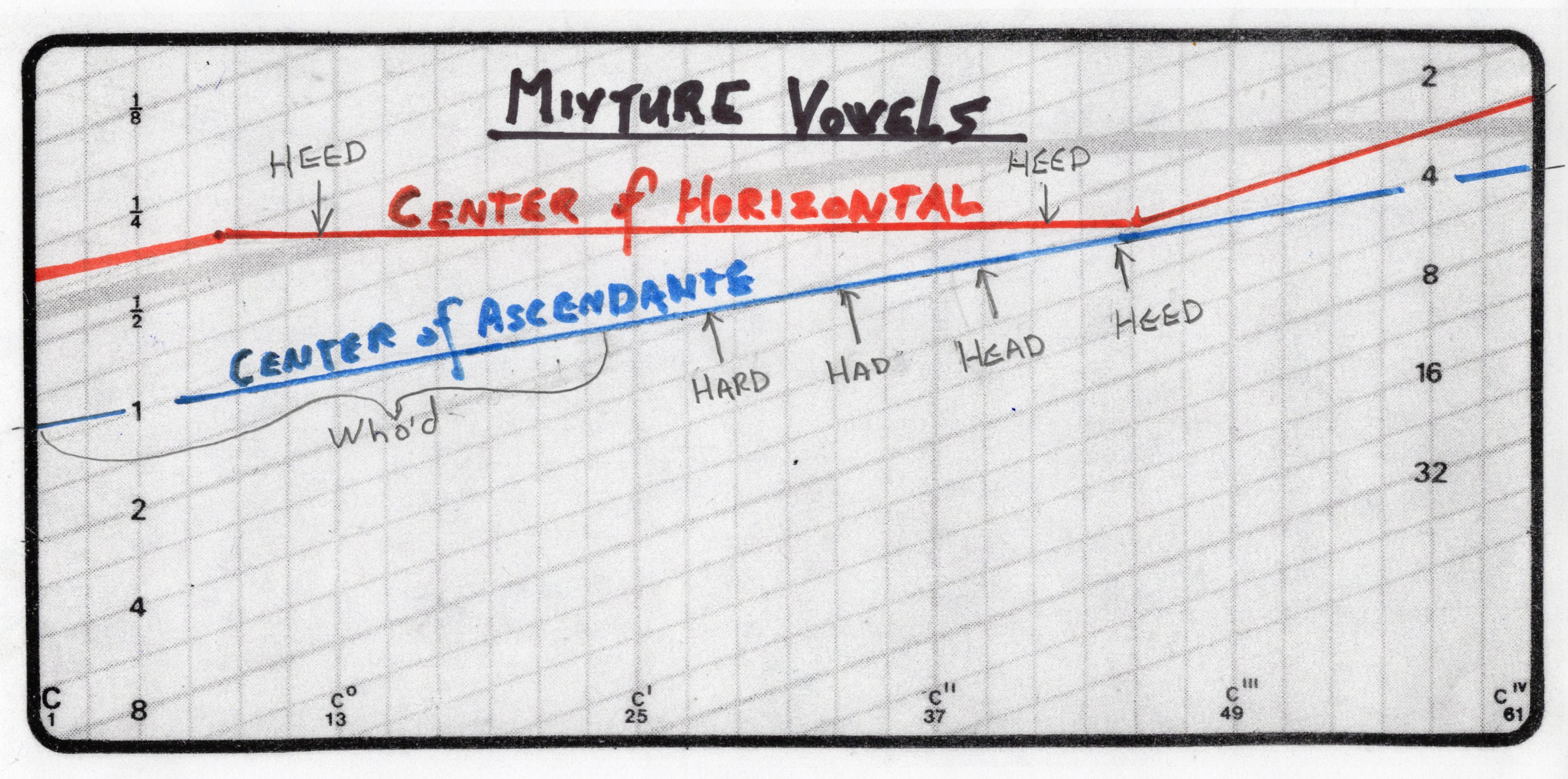
Your brain selects the mid-point of the four ranks of a mixture, to determine the vowel sound. In the graph above, the blue line represents the center frequency of the four ranks of the (Ascending) Mixture. The average center frequency of that mixture note determines the vowel. Notice how the frequency gradually rises as you play up the keyboard. Also notice the corresponding vowels rise in tone from "who'd" to "heed". So the vocal colour of the plenum changes, depending where you play on the keyboard.
ASCENDING mixtures excel at showing where on the keyboard you are playing, by presenting different vowel characteristics as you play up the keyboard. It is no coincidence that the typical Ascending 1-1/3' Gt Mixture, with a break each octave, tranverses all the vowels. Also not coincidently, it is also the area of maximum sensitivity of human hearing.
HORIZONTAL mixtures excel at showing which keyboard you are playing on. This is because the pitch of the mixture (and vowel character) stays the same over the entire compass of the keyboard.
Also the graph above, the red line represents the center frequency of the three ranks of the (horizontal) Scharf. Notice how the frequency stays the same as you play up the keyboard. Also notice the corresponding vowel remains the same "heed". Since the Scharf is on the second keyboard, it gives that keyboard a higher pitched vowel, contrasting with the main keyboard.
For this particular Scharf, (RED) the designer allows the bass end to descend in pitch to fill the gap with 8', 4' & 2' chorus Principals. He also allows the top octave top ascend; otherwise it's top would be lower pitched than the Mixture!
Mixture Loudness
Mixtures should be voiced so that they can be used all the time. If they are so loud that they can only be used at Easter for the last Hymn, they are a waste. I scale and voice the Mixture simular to the 2' Stop. Some people voice the mixture quints softer, or a pipe or two narrower, because they think it makes the mixture "silvery", but I've never found it necessary.
I sometimes get asked to fix a mixture that is too loud. I've often found that the problem is not that the mixture is too loud. The problem was the mixture was too shrill. Often the fix is raising the cutups, rather than closing toes. But raising cutups is like virginity, a one-way process. So you'd better know what you're doing...
In small rooms, keep it small, use small scales, 17th halving, closed toes and voice gently. Place the mixture at the back of the chest, so it gets blended and diffused by being obscured by the other pipes and distance. The worst thing you can do is place a mixture across the front of an exposed, Holtkamp-style windchest.
In huge dead buildings it can be difficult to get enough power. You can always get enough power from the bass. Big pipes will get loud enough, if you increase the scale, cutup and wind. But there is only so much you can get out of the small pipes of the mixture. You can use a treble Ascending scale and cut it up, but you can only increase the scale so much before it gets Cornetty.
Don't try adding more ranks of lower and higher pitch (i.e. 5-6 rank), which would obscure the vowel. A better approach is doubling the ranks: two pipes per rank. Because it is hard to tune more that four ranks at a time, I'd suggest grouping the doubled ranks in a second 3-rank mixture, pitched slightly higher than the main mixture.
Analysing Mixtures by Ear
Vowels are very useful when visiting organs.
- Put the plenum (8, 4, 3, 2, IV) on the Great, play a chord in the bass, and perhaps you hear a "AH" sound.
- Play a chord in the treble, and perhaps you hear an "ee" sound.
- Without a spectrum analyzer or measuring pipes, this tells you the Great Mixture is Ascending, and what its approximate pitch range is.
- Put the plenum on the Positiv, play a chord in the bass and perhaps you hear an "ee" sound.
- Play a chord in the treble, and you also hear an "ee" sound.
- That tells you the mixture is horizontal, and what the approximate pitch is.
All higher pitched mixtures must be horizontal. If they were Ascending they would soon rise above the range of hearing!
History of Mixtures, Gothic Organs >1400
We don't know much about the old Gothic organs. There exist no playing examples. There are a few written descriptions and paintings. There are some derelict, empty cases and perhaps a couple of old chests. A few ranks of pipes have been recycled into new Renaissance and Baroque organs.
We can only guess what they would have sound like. Even the biggest Gothic organs only had one casework, one division, one keyboard. The casework was high, wide and shallow, with a flat front and doors to shutter the organ for Lent. It was only played for prelude and postlude, before and after the service.
The pipes in a Gothic organ were all principals, with identical voicing and scale. Typically they were a chorus of 8', 4', 3', 2', 1-1/3', 1' and 1/2' ranks. There were never tierces. The treble was brilliant, because ranks continued all the way to the top, until they were too small to make. There were no breaks, but there could be rank doubling or even tripling. Because there was no stop control, all ranks spoke all the time. There were no mixtures; or rather, the entire chorus was one indivisible mixture. This made a powerful, brilliant sound that filled the room.
The ancient Blockwerk had some doubled ranks. In Renaissance rebuilds, perhaps the doubled 8' and 4' were cut down to make 16' and 8' Bourdons, when the blockwerk was recycled, as done at Oosthuizen, 1521.
There were no Bourdons, flutes or reeds. My guess is that the sound was a pure and brilliant chorus, with no vowel colouration. Vowels consist of a lower and upper partial with a gap between them. You need the humps, partials, to allow the vowel formant stand out. But the blockwerk always had all ranks speaking, there were no gaps, so no vowel effect.
History of Mixtures, Renaissance Organs 1475-1600
There exist few Renaissance organs, and they have suffered from repeated modification, rebuilding and revoicing. Renaissance was a time of experimentation and innovation, where new stop actions enabled breaking apart the Blockwerk. The 8', 4, 2-2/3' & 2' were given independance with their own stop knobs. The higher pitched ranks were gathered together to form a Hintersatz (blockwerk of upper pipes), simular to a mixture without breaks.
This was a period of experimentation and many new stops were invented: stopped and open flutes, regals and trumpets. New styles of music, and ways of playing developed, literally evolving into a new kind of organ. The Renaissance organ developed in different ways in different parts of the country. By the Baroque period we had clearly defined national organs, designed, used and sounding different from each other.
The organ casework was still wide and shallow, with a flat front. Occasionally you could get a simple tower or two, to provide a place to put the 8' Pincipal's big bass pipes.
But the Renaissance organ chorus with the Hintersatz, was still essentually a blockwerk decompose. It has a simular sound to the Gothic Blockwerk and just like the Blockwerk, and for the same reasons it had no vowel sounds.
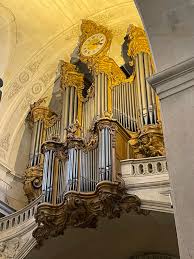
History of Mixtures, Classic French Organs, 1650-1790
With Baroque organs we've transitioned from archaic developmental organs, consolidating to familiar national designs, backed by compelling national repertoires. The design of chorus, mixtures and stoplists had become standarized.
Two important national traditions of organbuilding evolved out of the Renaissance (mid-15th to early-17th century). One was the Classic French organbuilding, as exemplified by the Paris school of builders (1650-1790): LA. & FH. Clicquot, Isnard, Dom Bédos, Thierry.
Photo is Paris, Eglise Saint Gervais & Saint Protais (François-Henri Clicquot, 1768).
The other great tradition of organbuilding was the Baroque North German/Dutch tradition, as exemplified by Arp Schnitger (1648–1719).
Both the French and German chorus originated from the Renaissance principal chorus of 8', 4', 2', and Hintersatz. Both the French and German builders divided the ancient Hintersatz into two mixtures. The French and German mixtures were quite similar, but the two traditions used them quite differently.
- Lower pitched (Ascending) mixture (Fr-Fourniture, Gr-Mixture).
- Higher pitched (Horizontal) mixtures (Fr-Cymbale, Gr-Scharff).
Classic French Organs
The French had essentially one plenum, the Grande Orgue Plein Jeu (full principal chorus, including both Fourniture and Cymbale, but without the 16' foundation, nor reeds). The French Positiv was a miniature Grand Orgue with it's own Plein Jeu, and its own Fourniture and Cymbale. The Fourniture and Cymbale were always used together, never separately, on a classical French organ. The French Positiv was used as the concertino of the French organ and had a smaller Plein Jeu, whose Fourniture and Cymbale was also only used together.
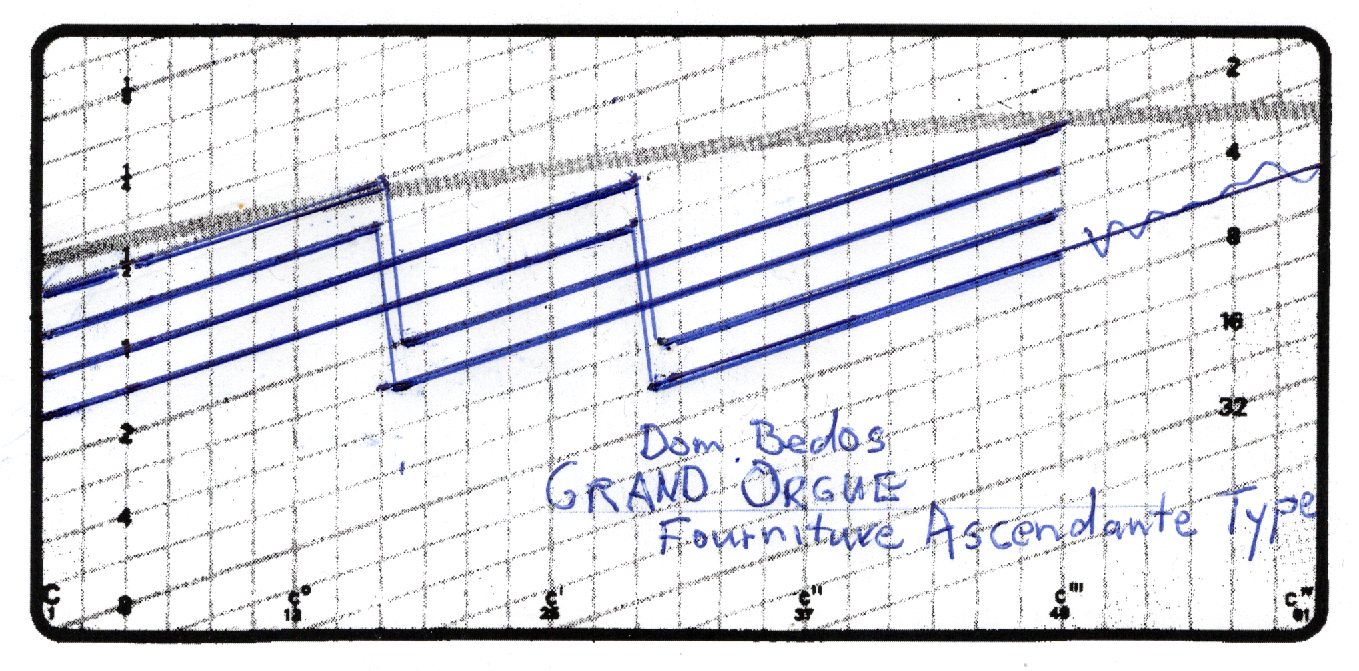
Two French Mixtures, Ascending
There are two kinds of mixtures in Baroque French organs; both examples are from Dom Bedos who give explicit instructions. With the lower pitched (Ascending) mixture, called The Fourniture, the tonal mass climbs upward from the bass to treble. This is done by:
- breaking only twice
- breaking two ranks at a time
- break jumps an entire octave lower
This is equivalent to the German practice of breaking back by 4ths and 5ths, about once per octave. But I find the Bedos method of making big jumps at the breaks, to be awkward and obvious.
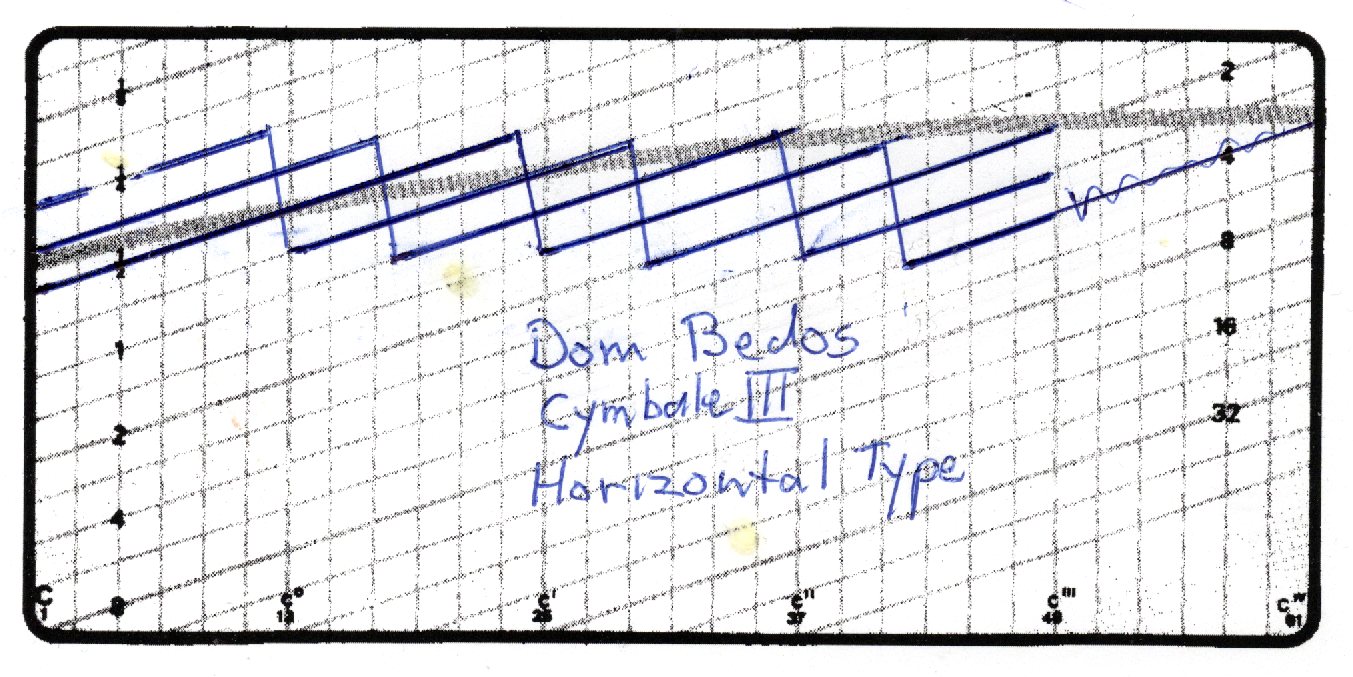
Two French Mixtures, Horizontal
The higher pitched (Horizontal) mixture, called The Cymbal, stays in a strictly delimited acoustical range, by using frequent breaks. This is typically done by breaking back by 4ths and 5th, about twice per octave. Classical Cymbales are always Horizontal. Used together with the Fourniture, they fill the lower spectrum and fuse with the 8' and 4'.
Because the Plein Jeu always included the Fourniture and Cymbale, the large numbers of ranks filled the spectrum from 16' to 1/8' with no gaps, it was essentually a Blockwerk! This providing the brilliance needed to fill large stone buildings. But this “filling of the spectrum” obscured the formation of vowel formats.
Also, these "the large numbers of ranks filled the spectrum" meant that when playing, the left-hand sounded a lot like the right-hand, obscuring polyphonic music. For vowels, we have to wait for the Baroque Dutch and North/Central German organs.
Here are Dom Bedos' Mixture Rules
- The Fourniture and Cymbale were never used apart.
- The Fourniture has 3 breaks, in octave jumps, usually at f0 and f’.
- the Cymbale has seven breaks, in 4ths and 5ths.
- The number of ranks depends upon the depth of the pitch of the montres (16', 8'):
- - Fourniture, 16' organ gets 5 ranks, 8' organ 4 ranks, 4' organ gets 3 ranks
- - The Cymbale, 16' organ gets 4 ranks, 8' organ 3 ranks, 4' organ gets 2 ranks
- In 16' organs, Mixtures often ran into the 16' and 32' series (5-1/3' and 10-2/3'), and the 2-2/3' entered quite low, often in the bottom or tenor octave.
- Fournitures and Cymbales overlapped to a great degree, resulting in doubled ranks.
- Tierces are never part of mixtures.
- There are typically equal numbers of quints and octaves, or one more octave than the quint.
Plafond is the pitch limit reached by the highest pitch rank of a repeating mixture, at the points of repetition. The typical upper limits were: Fourniture at 1/6', Cymbal at 1/8', and Plein Jeu at 1/8'.
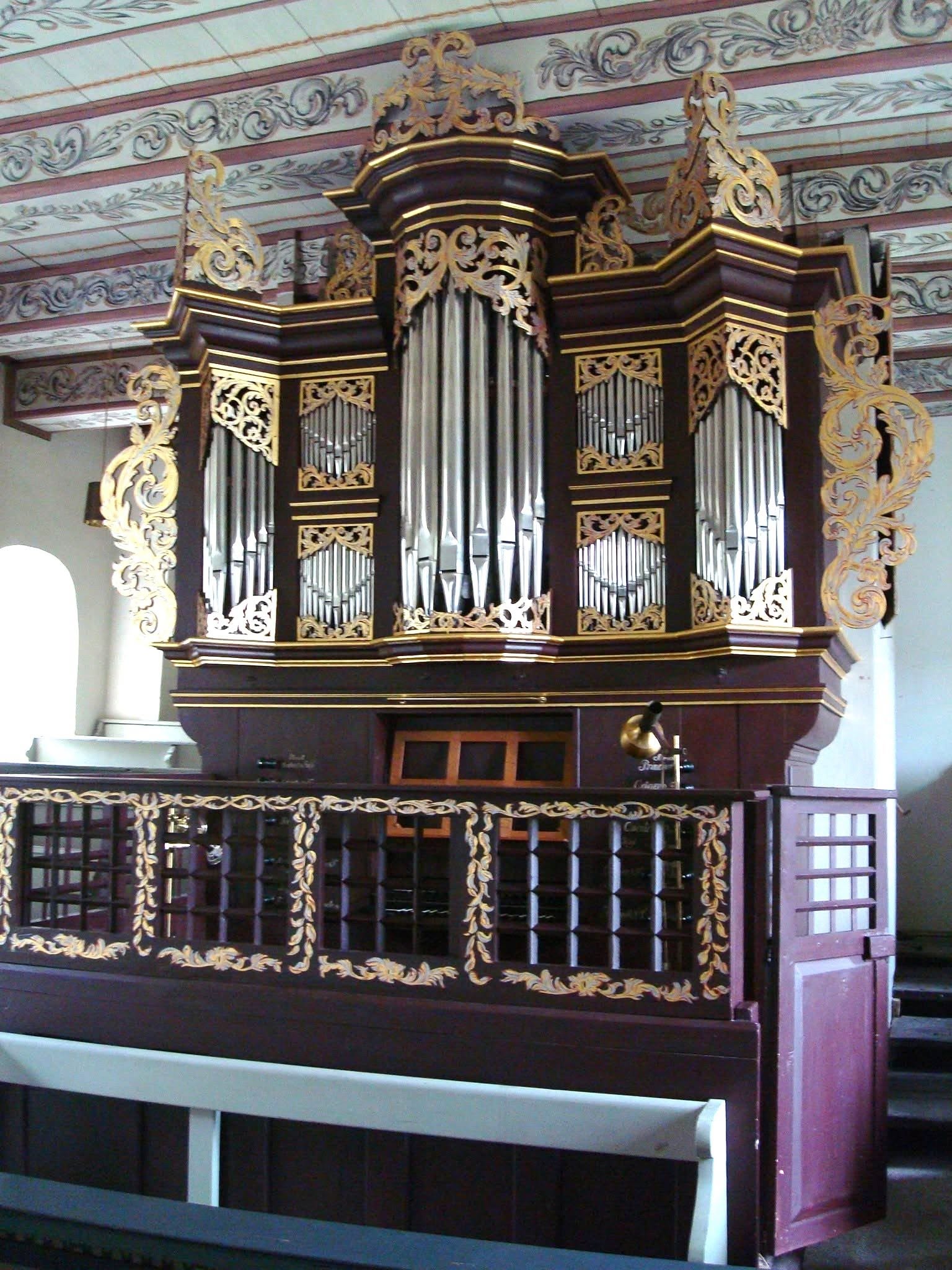
History of Mixtures, Baroque North German Organs, 1600-1750
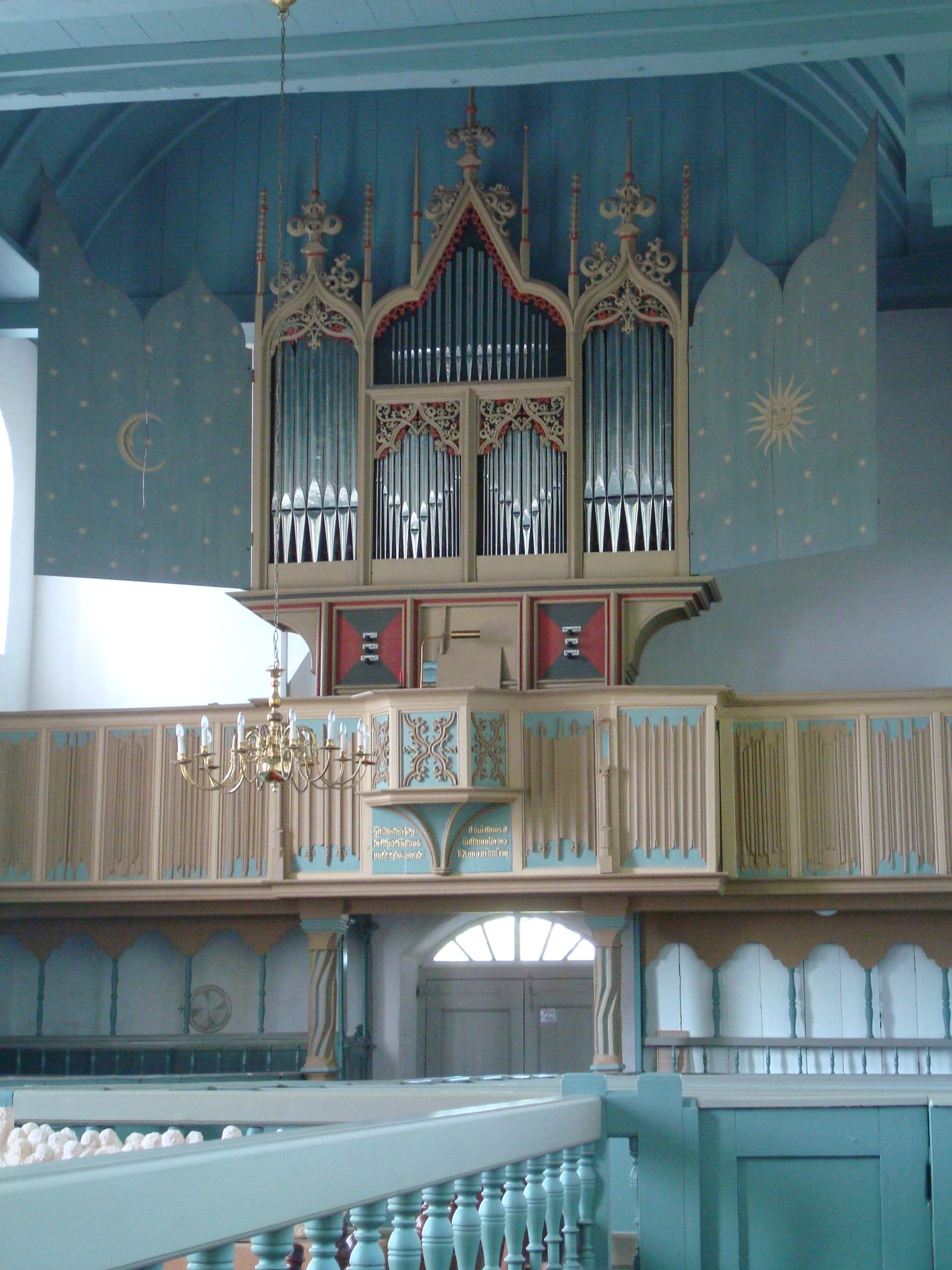
With French organs, the Fourniture and Cymbale were never used apart. But in the German organ they where never used together. The (Ascending) Mixture was reserved for the Hauptwerk, and the (Horizontal) Scharf was reserved for the Positiv. Because the German organ Rückpositiv was a equal, but different, partner of the Hauptwerk one of the things that differentiated them where the mixtures. Photo: Dedesdorf, Germany (Niedersachsen) - Sankt Laurentius. Arp Schnitger, 1698.
The Hauptwerk Mixture is an Ascending mixture, which enhances polyphonic clarity in contrapuntal music (Bach, Buxtehude). It vocalizes each pitch range differently, so you can effortlessly follow intertwining melodic lines simultaneously. If you play chromantically up the scale, the "brightness" of the tone rises (ascends) gradually, spreading out the transition from one vowel to the next.
North German Baroque Organs generally follow the Werkprinzip design; they have their divisions defined by the lowest-pitched Principal stop. For example, in a typical organ, the Pedal might be based on a 16' Principal, the Hauptwerk on an 8', and the Rückpositiv on a 4'. This creates distinct, contrasting voices.
The contrast between divisions in amplified by the use of horizontal mixtures on the Positiv and Brustwerk. With different pitch levels, the mixture in each division will have it's own distinctive pitch and vowel characteristic. For example:
- Pedal: "who'd" - (2', 1-1/3', 1')
- Great: "had" - (1-1/3', 1', 2/3', 1/2')
- Postv: "heed" - (2/3', 1/2', 1/3')
- Brust: "eye" - (2/3', 1/2')
Playing a chord in the middle of the Great keyboard will have a subtle "ah" sound, Pos an "eh", and Bw an "ee" sound. The vowels give each keyboard a characteristic sound, so a listener immediately recognizes a keyboard change. The mixtures are the most important stop for providing differentiation of character between the various keyboards. The mixtures make the Positiv brighter sound than the Great, and the Brustwerk sound the brightest.
You will notice that by going from Mixture/Scharf/Zimbel, the center of each type of mixture is about a half-octave higher than the previous, so you will hear the next higher vowel.
Tierces in Mixtures
Classic French organs never used tierces in their chorus mixtures. North German Baroque organ mixture designs where less consistent than the French, and would occasionally include a tierce in their larger mixtures. Central and south German organs included terces even more regularily. The early Baroque German organs were tuned in Meantone which had pure thirds, which didn't clash with tierce ranks.
A special exception was a favourite of Schnitger, the Sesquialtera II which consisted of a tierce and quint (1-3/5' & 2-2/3"), of principal pipes. The Sesquialtera was not a standard ensemble stop. It was used for both solo color and as part of a full, brilliant chorus. Its construction sometimes included a "bass/treble" split, where the bass part of the keyboard only played the twelfth rank. This design mades it's solo usage obvious.
Baroque German mixture breaks are very simular in design to the Classical French stops. But they do lack consistancy in their design of the pitch level and breaks. Instead, I'll show some modern mixtures, as used by the best builders today.
Mixtures, Contemporary examples
I've got a 3-ring binder of several hundred mixture-break graphs. The variety of design seems endless. I've multiple mixtures from various vintages and schools of organbuilding. There are some bizarre mixture designs, but the most successful mixtures follow simular design. Fortunately, even if you don't understand about mixtures, it is easy to copy someone who does.
My examples are based upon traditional Northern/Central German Baroque designs, and are simular to the work of good modern builders.
Mixtures, for Great, Hauptwerk
At bottom C1, Great Mixtures usually consist of 4 ranks (1-1/3', 1', 2/3', 1/2'). Never use a Tierce rank unless you're using a meantone temperment, because the pure Tierce notes will clash with the tempered ones. Four evenly spaced breaks get you from the bottom of the keyboard to the top.
Since pipes smaller than the top note of a 2' aren't practical, the top ranks of a Mixture are usually 8', 4' 2-2/3' and 2'. Don't use a 5-1/3' or you'll create a 16' resultant. Four evenly spaced breaks get you from the bottom of the keyboard to the top.
For a smaller Great, try a three rank Mixture. Just eliminate the bottom (1-1/3') rank.
Variants
Some people don't like a break between middle "c" and treble "e", because it disturbs the melody. Other people don't like a break in the first 20 notes of the Gt Mixture, as believe the break disturbs the pedal line, when heard thru the Gt-Ped coupler. But these haven't bothered me. You can soften the first and last couple of pipes of every break, to obscure the break.
Mixtures, for Positiv
The center of the Scharf starts about an octave higher in pitch than the Great Mixture, but has six breaks, so that it ends up at the same place as the Great at the top of the keyboard. For a small organ, you can use the Scharf for the Great and the Zimbel for the Positiv.
Mixtures, for Brustwerk
This 2/3' Zimbel II (Cymbal) should not to be confused with the very high pitched 1/4' Zimbel. It starts at same pitch as the Positiv mixture so it blends better with the BW chorus. But it skips the first break so it's center becomes an octave higher than the Positiv, resulting in a brighter vowel. Like all mixtures, it ends up at the same place as the Great at the top of the keyboard.
There are different types of Brustwerks. Because the Brustwerk pipework is only a couple of feet from the organist's head, the BW can be treated as a miniature division. You could consider it like a box organ, with small scales gently voiced. A single rank Quint 1-1/3' would suffice for mixture. Break the first octave up to 2/3' so it blends better, and break the top octave down to 2-2/3' so it is tuneable.
An alternative is to treat the BW as a Cornet décomposé, which has no use for a mixture.
In a large organ, the builder may chose to put a small Positiv in the BW position. Sometimes it may even get shutters and strings! Then it may get a Zimbel, and hopefully a detached console...
Other Mixtures, Romantic Swells
Romantic Swell Mixture
Normally, on a small organ, I would treat the Swell as a Positive division. But I would add a string, Celeste and appropriate Swell reeds as a nod towards Romance.
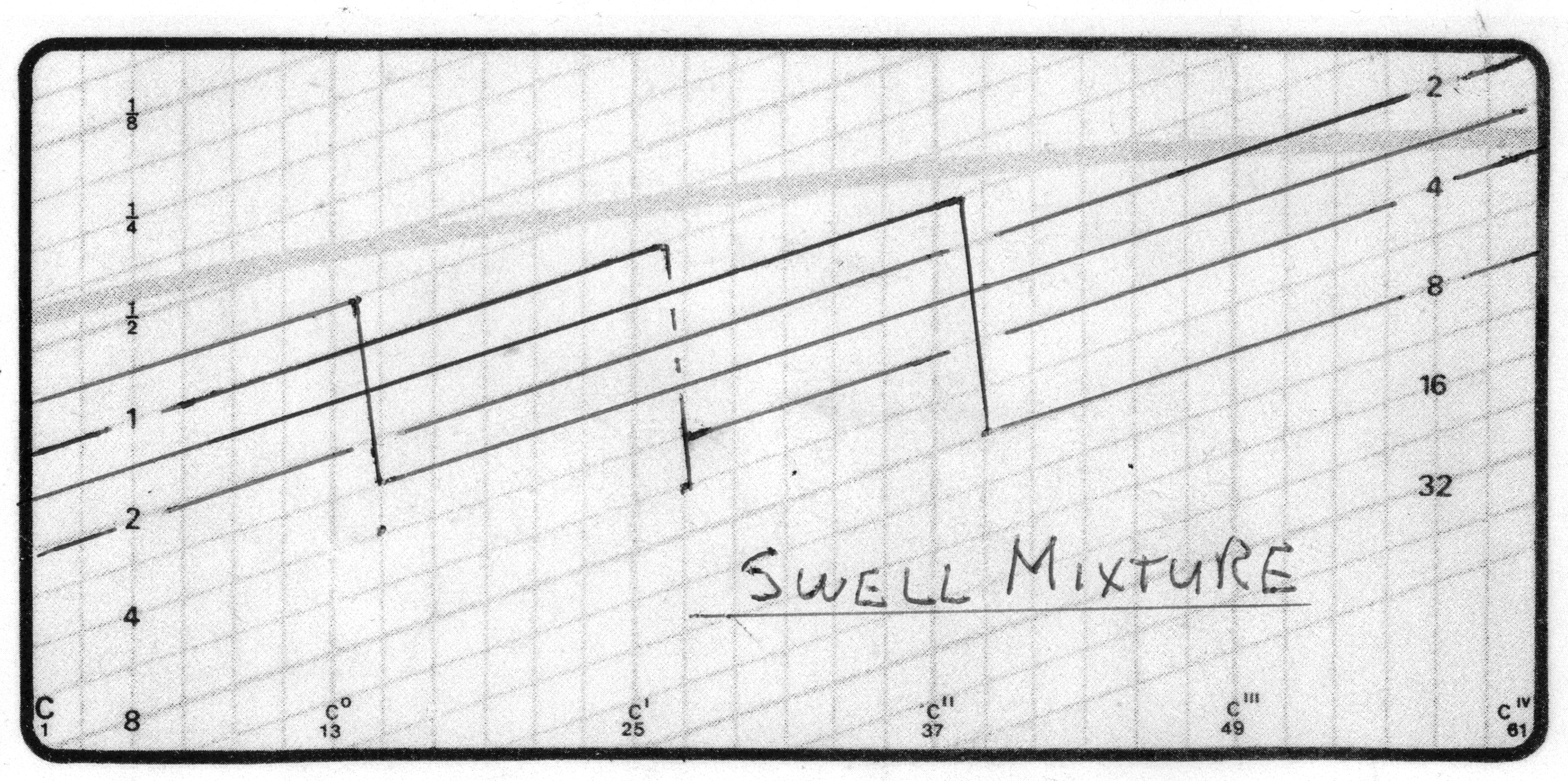
What about romantic Swells? In larger organs, especially when rebuilding older romantic organs, I let it stand as a Romantic Swell, without Positiv ambitions. I let it have an 8' chorus (like a Great) with a low pitched Mixture.
A typical Swell has a Flute chorus, plus strings and reeds. Often the only principal is an 8' Geigen. A low pitched 2' Mixture will help fill in missing parts of the principal chorus. See chart on upper left.
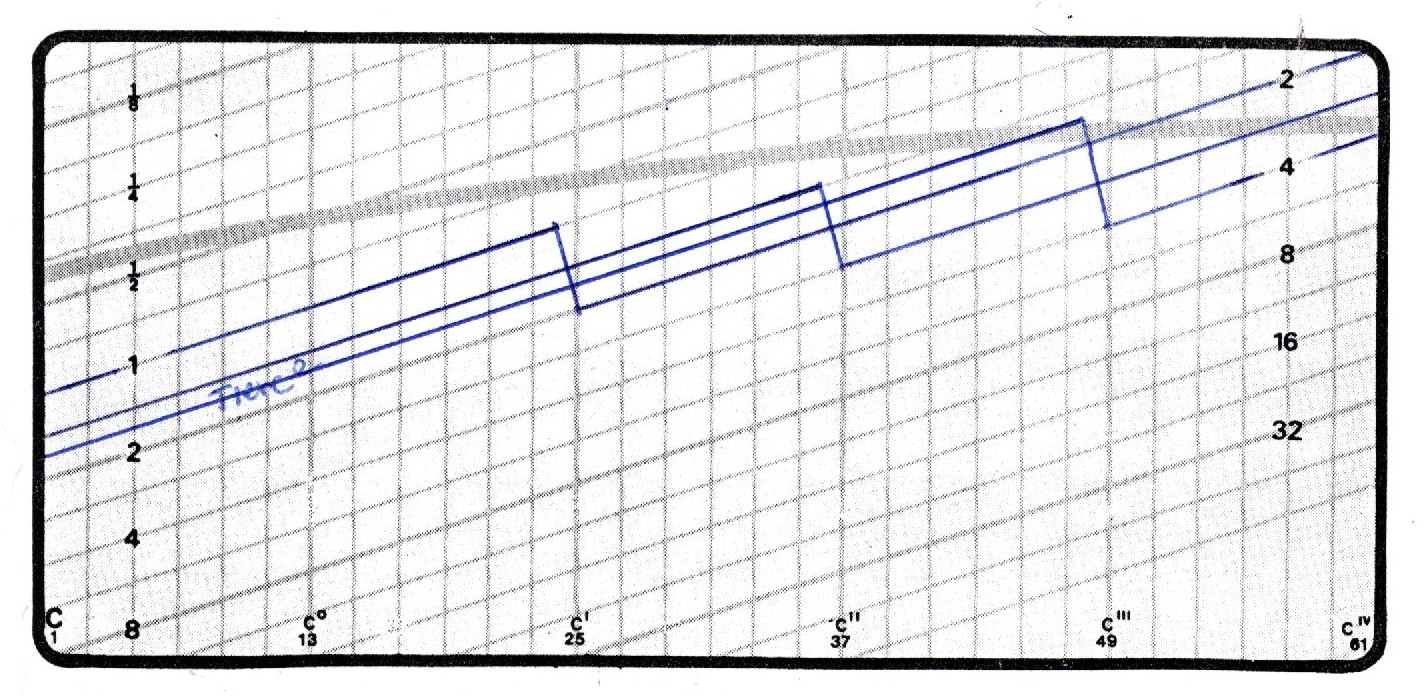
Swell Harmonics
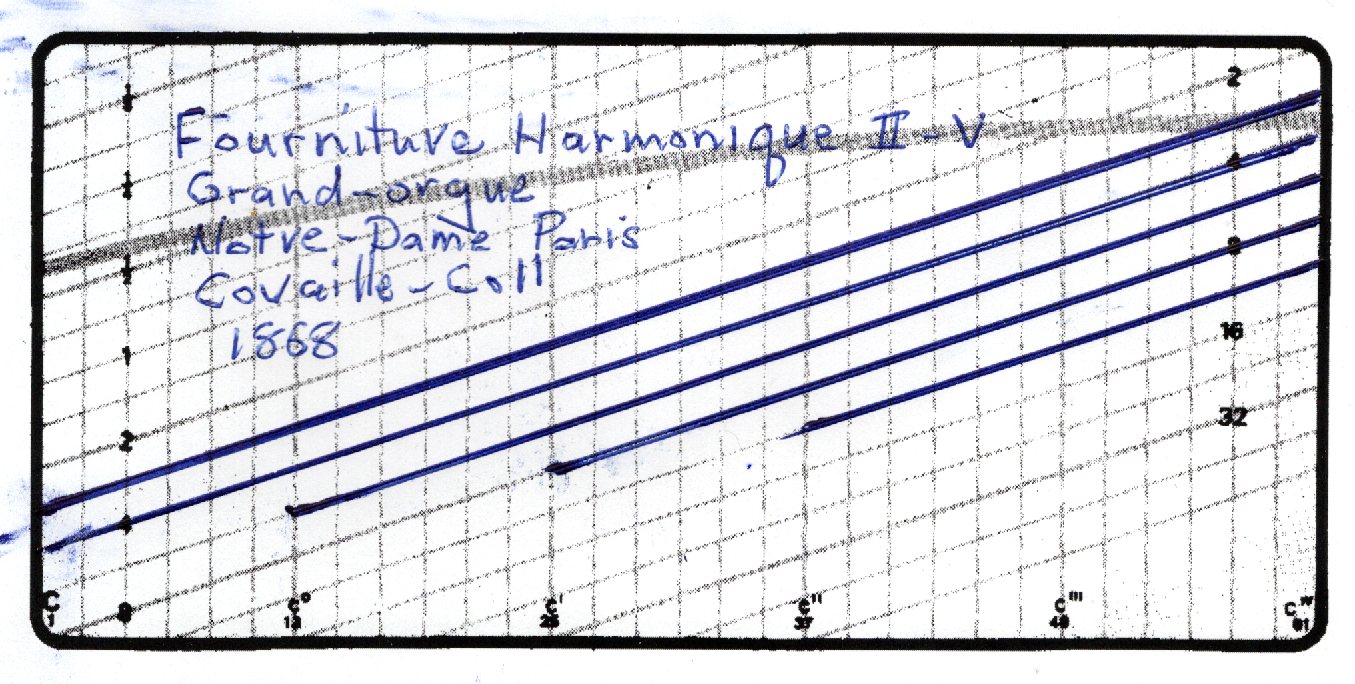
An Edwardian English stop I like to use, as a second mixture in a big Swell, is the Harmonics III. I call it "Harmonics" to emphasize that it is not a chorus mixture; it is used only to reinforce the reed chorus (though the English may also call it "Mixture").
It is basically a Tierce, which meshes well with the strong thirds found in reeds. Plus some additional ranks around it, to support it. This is bold, with generous cutups to blend with the reeds.
Shown here is the new Harmonics, added by Mander, to their 1998 rebuild of the huge Skinner at Christ Church, Cranbrook, near Detroit, Mi. In the Mander example, all ranks had the same scale, halving on the 18th.
Other Mixtures, Cavaillé-Coll
Progression Harmonique
By the Romantic French organ period, the universal adaption of homophonic music ended the desire for mixtures to delineate polyphony. So mixtures were largely abandoned, except for the largest organs. The chest space was needed for more 8' stops.
Besides the traditional mixtures, Cavaillé-Coll (1811-1899) devised an extremely Ascending mixture called the Progression Harmonique. It was break-free mixture, simular to a blockwerk! The Progression Harmonique was intended to be used with the Cymbale Harmonique to create a Gawd-awful noise in his biggest organs. This stop is described as a fairly standard type of "harmonic progression" mixture of the time.
Indeed, some of the best sounding Cavaillé-Colls were rebuilds that retained its classical choruses and mixtures.
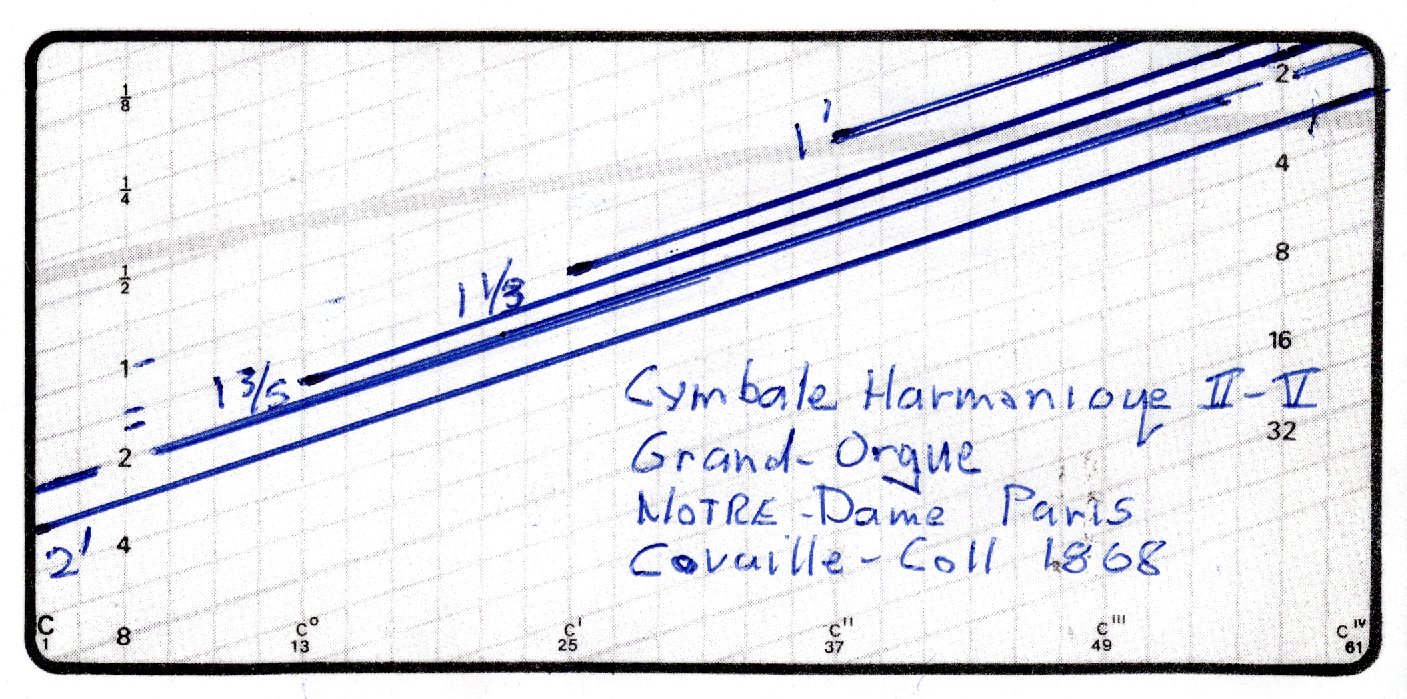
Cymbale Harmonique
This stop is far more unusual and was a unique experimental creation by Cavaillé-Coll. It is a "progression" that adds ranks as you ascend, but its composition is notable for introducing a tierce (1-3/5') rank in the treble, an element generally avoided in traditional French mixtures at the time.
Fortunately the Progression Harmonique never really caught on, and even Cavaillé-Coll frequently reverted to classical mixtures.
Cavaillé-Coll's Plein Jeu
In the romantic French period, "Plein Jeu" was a stop name. It was the Fourniture and Cymbale on one draw, though both always keeping separate toeboards. Sometimes the Fourniture is erroneously called a Plein Jeu.
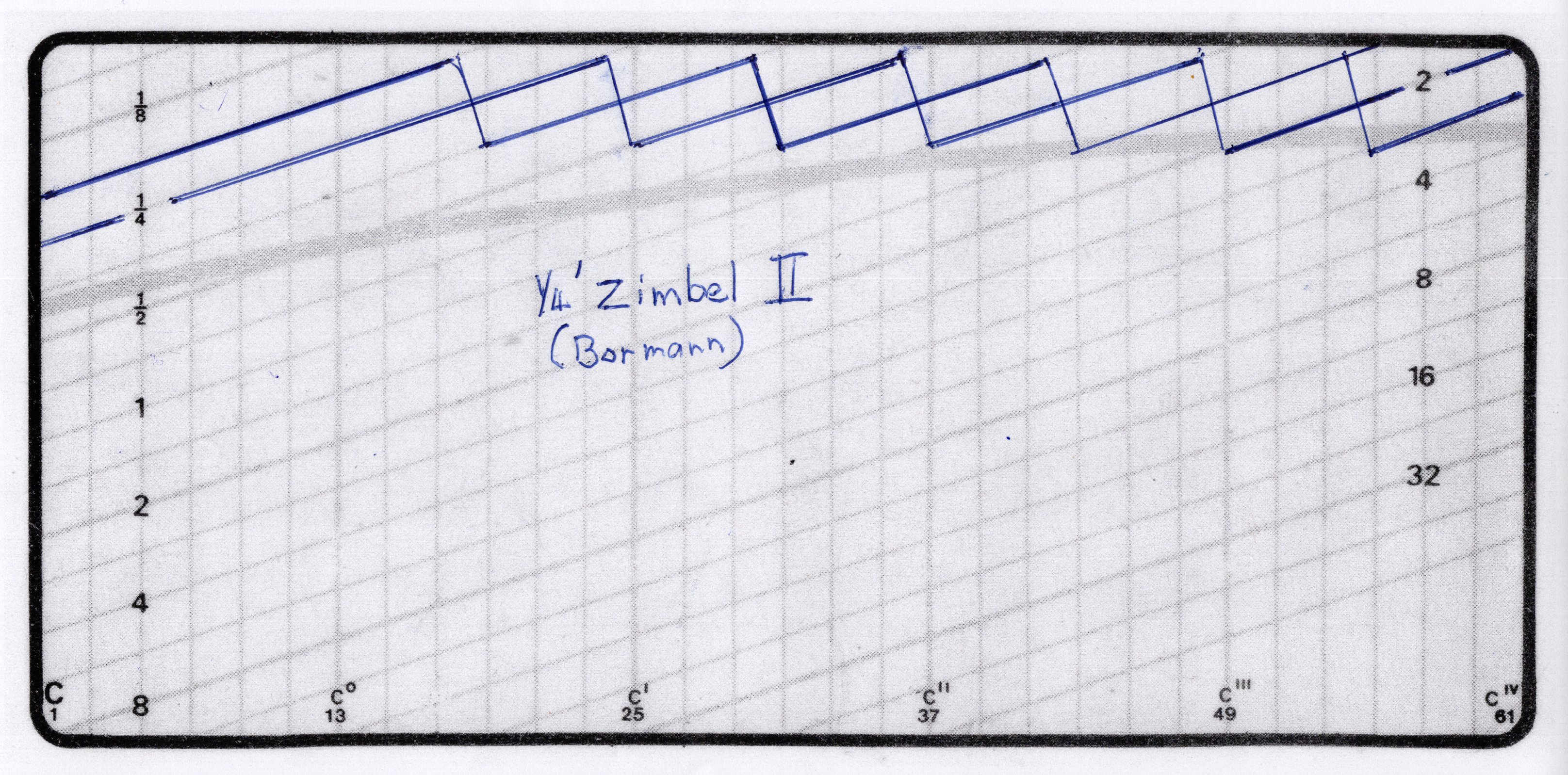
Other Mixtures, Ultra-pitched Zimbels
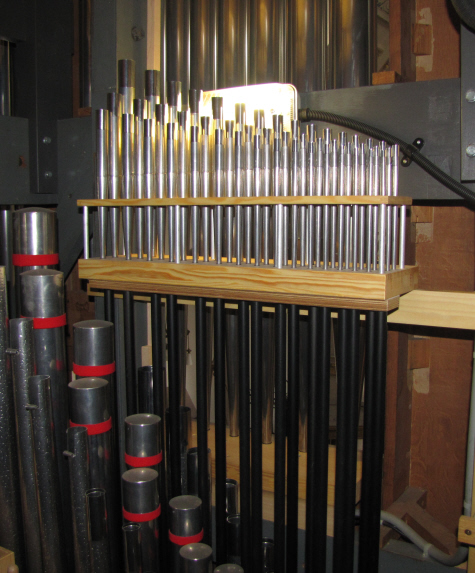
The 1/4' Zimbel (or Cymbel) is not to be confused with the lower pitched Cymbal 2/3'. The Zimbel 1/4' is sometimes found in ill-informed Neobaroque Brustwerks. I suppose it is technically a mixture, because it is a breaking, compound stop of principal pipes. It is made-up of pipes from the top octave of the 2' for most of its compass, so has an exceptionally high pitch, and is an absolute bitch to tune.
I suppose that in a large organ you could use a Zimbel as a final "ultra-brilliant" addition to "cap off" the full organ chorus. I suppose that with it, you fill every inch of the spectrum. Personally, I find that using a Zimbel that way confuses the balance of the chorus.
The stop probably originated from the central German Renaissance organ. It wasn't intended for the core of the chorus, but rather serves to create a novelty tinkling bell-like effect. A third is often included in the Zimbel to improve the bell effect in the Brustwerk. I suppose an effect like the mechanical Zimbelstern. A toy stop...
Not Mixtures, but seem like one
Cornets
I love Cornets. But they are not a mixture, they are compound stop that creates a bright, piercing, and almost vocal solo sound. They are made up of a collection of open flute ranks that are harmonically related: 4', 2-2/3', 2', and 1-3/5', plus a Bourdon 8'.
The Tierce 1-3/5', combined with the Nasard 2-2/3', gives the Cornet its distinctive, vocal, reedy edge. The fat, open pipes are voiced loud and treble Ascending. The Cornet V is used to reinforce the treble falloff of the Trumpets, and as a stand-alone solo voice.
It is a treble only stop, typically starting about middle C. Historically, cornets were often "mounted" on their own raised soundboard so the sound could project clearly into the room for its solo role. The long tubes related to the mounting contribute to the Cornet's characteristic attack and release.
Classic French Cornet scales, of course, are excellent. But Classic French Cornets only went up to about the keyboard C49. If you continue the same scale up to a modern compass of C61, the treble pipes won't speak because the scale is too big. Pipes cannot speak if its diameter approaches its speaking length. The solution is simple, just narrow the scale down at the extreme treble.
The Bourdon 8' of the Cornet doesn't need to have as big a scale as you'd expect. That's the upper four pipes of the note (4', 2-2/3', 2', and 1-3/5') throw down a strong resultant, reinforcing the 8' Bourdon.
Sesquialtera
The Sesquialtera is a full compass, two rank pairing of 2-2/3' and 1-3/5' principals. Full compass suggest that it was used in the chorus, rather than for solos like the treble compass Cornet. It was popular in the meantone Northern German baroque, but avoided now because of the temperment difficulties of the Tierce. Because of its reedy quality in equal temperment, I don't see it as a substitute for a mixture.
I've heard Sesquialteras being used like a solo Cornet. But if that's how you want to use it, put in a real Cornet (even if only II or III), it works so much better...
There are mixtures with tierce ranks, originally intended for Victorian English Meantone organs with pure thirds. I don't recommend using tierce ranks in equally tempered chorus mixtures. Its tuning clashes with tempered thirds, muddying the chorus. Tierces should only be used in solo combinations (like Cornets), so they don't clash with the temperment.