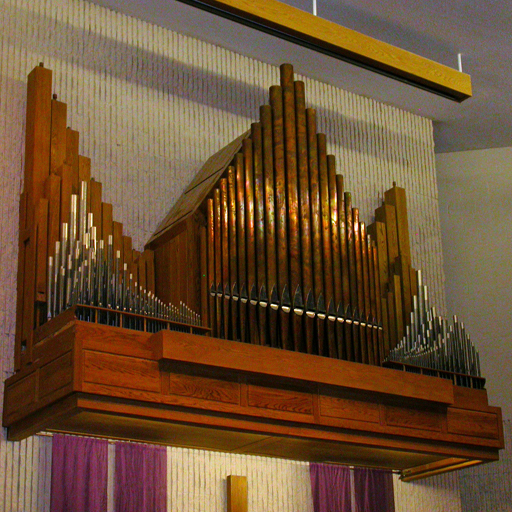
Bethel CRC Waterdown
The Stops
GREAT ORGAN
- Principal 8
- Bourdon 8
- Gemshorn (swell) 8
- Octave 4
- Rohrflute 4
- Quint 2 2/3
- Octave 2
- Flute 2
- Mixture IV 1 1/3'
- Cornet V
SWELL 0RGAN
- Rohrflute 8
- Gemshorn 8
- Gemshorn Celeste t.c. 8
- Principal 4
- Bourdon 4
- Nasard 2 2/3
- Octave 2
- Blockflute 2
- Tierce 1 3/5
- Trumpet 8
- Clarion 4
PEDAL
- Subbass 16
- Principal 8
- Bourdon 8
- Choral Bass 4
- Mixture III 2-2/3
- Trumpet 16
- Trumpet 8
COUPLERS
- Swell to Great
- Swell to Pedal
- Great to Pedal
The Organ
This is the first organ I built under my own name. It is all new. We built the console, keyboards, pedalboards, chests, bellows, all the wood pipes, and all the metal pipes except the mixture.
This two manual organ has direct electric action. We built the chests, casework pipes (except the copper facade), console, keyboards and pedalboard and bellows; almost everything. It has some judicous unification, but the main choruses remain straight.
The Console
The console has a transposer switch, and a combination action with a total of 30 pistons, three reversible pistons and four memories. The Full organ piston, and the crescendo pedal are fully programmable by the organist. So they are reliable, the electrical contacts are either gold plated, or sealed reed switches.
The organ is controlled by two computers. One computer is in the console, and controls the key, stop and combination action. The other computer is up in the chamber, controlling the pipes. The two computers talk to each other thru a thin cable of only 5 pairs of wires. The console is equipped with MIDI (Musical Instrument Digital Interface). This allows the organ to be plugged into a Sequencer, which is a recording and playback device. The sequencer allows the organ to act similar to a player piano, but using computer disks instead of paper rolls. Through MIDI, the organ also can play, or be played by, other electronic musical instruments.
The console shell, pedalboard frame, and bench are of solid oak. The keyboard naturals are covered with cowbone, the sharps are ebony. The pedal key naturals are of hard maple.
Mechanical Design
There are three keyboards: Swell (upper), Great (lower) and Pedal. The pipes for the Great and Pedal keyboards are located to the left and right sides of the copper pipes. The Swell pipes are inside the oak casework located behind the copper pipes. This casework containing the swell pipes has louvers at the front. By opening and closing the louvers with a foot pedal at the console, the organist can control the loudness of the Swell pipes.
The organ bellows is fed by a 1/2 h.p. electric blower. From the bellows, the wind goes to the windchests, which the pipes sit on. Each of three windchests is equipped with a schwimmer or air pressure regulator. The swell box and casework are made of solid oak. Windchests are of oak and poplar.
Tonal Design
The organ has an eclectic design, to play the variety of organ literature needed for a church service. The basic choruses (principal, octaves and mixture) are of the Schnitger school of organbuilding, as found in North Holland. They give the solid tone for congregational singing.
The Principal 8', the copper pipes, is the foundation stop of the organ. All the other pipes are voiced in reference to the Principal. The Trumpet has a French character. It was built with French shallots for power and brilliance, and double blocks for mechanical stability. The Swell mutations (2-2/3', 1-3/5') are of the southern Dutch/French style. They add color to solo lines, giving a clear, bright, fluty sound. The organ also has a Gemshorn and Celeste, to provide the warmth that is so useful in music of the Romantic era.
To improve the blend of the Tierce and Quinte ranks, the organ is tuned in an unequal temperament, after Kirnberger. Though useful for pianos, equal temperament is usually a poor choice for organs, because it leaves the third intervals so badly out of tune.
The Pipes
Many of the pipes were made by the builder. The metal was cast in Simcoe, then hand scraped, cut to size, mouths cut in, rounded into pipes and soldered. Most pipes are either spotted metal, or common metal. The swell Flute was made of hammered lead, which gives it a mellower tone. The copper front pipes, the trumpet and some of smaller pipes were made by Geisecke and Sons, of Germany. The wooden pipes were made in Simcoe, of solid oak.
The organ is prepared for a Trumpet 16' extension to be added to the Swell and Pedal. There is also room to add another stop on the Great.
Builders of the Organ
- Blair Batty: design, scaling, tonal finishing, pipemaking
- Richard Batty: casework, wiring, pipemaking
- Ben Dekraker: console shell, keyboards, wind chests
- Greg Smith: wood pipes, voicing, bellows
- Scott Walker: casework, wiring, swell box