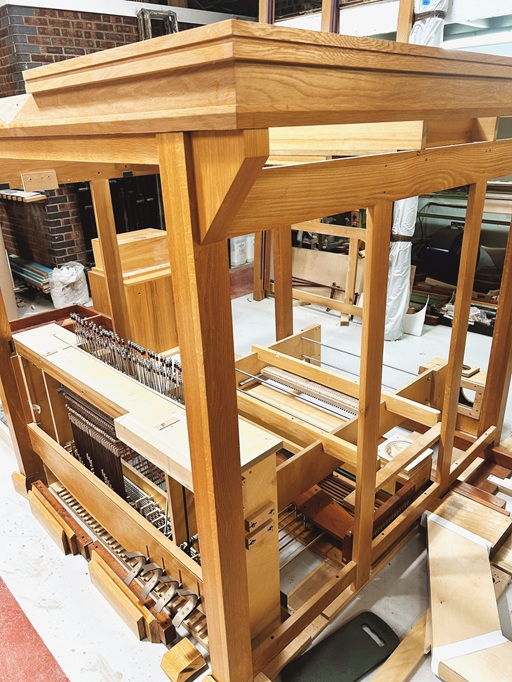
Organbuilding how to do it...
I've worked in organbuilding for 55 years; as a cabinetmaker, pipemaker, draftsman, tuner/serviceman and voicer/tonal finisher. For the last 40 years I ran my own business, which built complete organs: direct electric, electropneumatic and sliderchest/tracker. With a crew of six, we built the chests, bellows, consoles, keyboards, pedalboards, benches, wooden pipes and caswork.
I also had my own pipeshop were we cast own pipe metal and made all our own metal pipes, except for zinc pipes from OSI. I bought the reeds, unvoiced, from Gesecke, but voiced and curved the tongues myself.
Besides what I learned working for other builders, I also paid careful attention to the work of past builders, to learn from them. I had a special interest in voicing and scaling. I have measured the pipes in dozens of organs, to learn why they sound that way. So I have accumulated a lot of experiance a knowledge of organbuilding.
Which is to say, that I have a lot of experiance could be useful to someone else. As I'm 74 years old (2025) and becoming ancient and decrepid, I decided to build this website to share what I know, before I forget it all...
On this page, I'm going to share things: notes, blueprints, charts, plans, wiring diagrams, drilling charts, and other information, about organbuilding. Nothing here is experimental; I've used this stuff daily, building organs. I'll disclose sources, if known, though ocassionally I must be descreet about who's ideas I stole.
Please understand, a lot of this info isn't mine; I've just collected it over the years. There is very little that is new, under the sun. But if it's here, I've used it and it works. This is a work in progress, it will take years to build, so keep coming back. Suggestions, improvements, criticism and advice welcomed. Lots of stuff is found by clicking the Blue text, or by clicking pictures.
Index: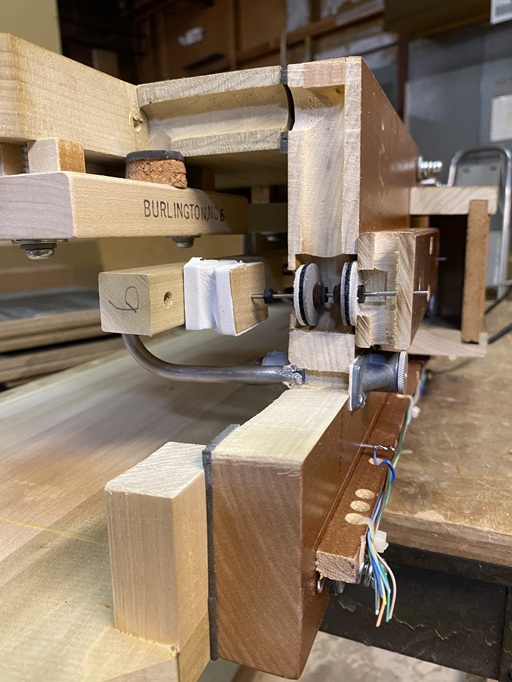
Windchests How to:
The windchest is the heart of the instrument. It is the structure that the pipes stand on, and has the mechanism that turns the pipes on and off.
Index of Windchest Ideas
Drafting your designs
I was lucky enough to get two years of high school drafting classes. It was old school drawing with pencils and T-squares. But once personal computers got powerful enough, I got my first copy of Autocad. But Autocad required a new way to doing drafting. I had to take a community college summer course to understand and use.
Autocad is the standard that every serious person uses, even though its outragiously expensive, Don't waste you time with hobby drafting software. You are going to invest thousands of hours drafting, over a lifetime. Invest in professional tools.
I include a bunch of blueprints here to show what we do, and give examples of pipe organ drafting. Autocad also allow you to write extensions to the program in the Autolisp language (you must have the professional version of software).
My Custom Autolisp software- Generates templates of metal pipes for chest design.
- Generates templates of wood pipes for chest design.
- Helps you place the templates into a chest drawing.
- (load "Make metal pipe templates.lsp")
- (load "Make wood pipe templates.lsp")
- (load "Place pipe template.lsp")
Schwimmer Wind regulators
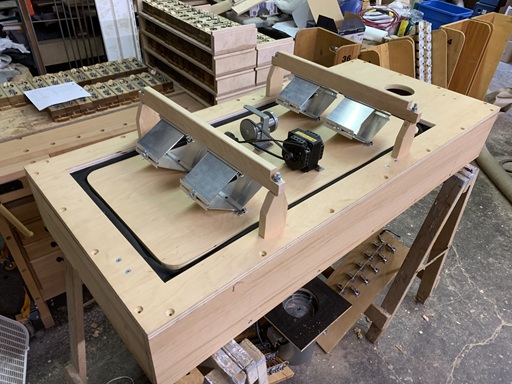
I prefer the gentle wind of large, ribbed, weighted bellows. However, sometimes you just don't have the room for one. A well made schwimmer can give perfect wind. I saw my first schwimmer in a Casavant organ back about 1964, and was immediately impressed by how steady the wind was, and compact it was.
I made and used the following drawings and instructions to make many schwimmers, and they've never given me a problem. The plans were developed by measuring schwimmers I've seen over the years, plus advice and drawings from various sources. My friend, Matteo Spadafora, recently built a schwimmer using my plans; the photos are of his effort. He made notes of his progress, which he kindly shared with us below.
The first thing you need to do is a calculation of Schwimmer Size. The second thing you need to do is a calculation of Valve Size. If the valve is too small, you'll have wind robbing; too large and the schwimmer will think it is a tremulant and will oscillate. Schwimmer valve size depends on the size of the schwimmer's moving plate, and the wind back-pressure. If the back-pressure exceeds about 1", the wind can force itself past the valve the the windpressure will creep higher.
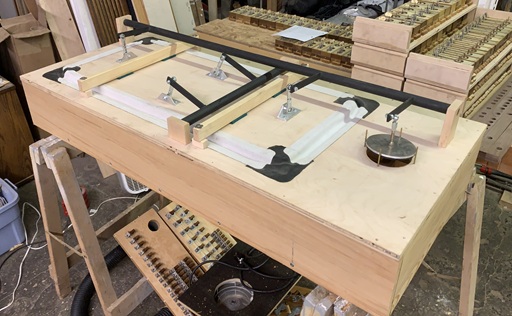
The valve moves in a 1:1 ratio with the schwimmer plate. The rollers keep the schwimmer plate flat and parallel and also control the valve.
The panograph springs from OSI work very well, though I have used ordinary bellows compass springs. With the Panograph springs it is important to use the same installed dimensions as in my drawings. It is designed to give a 10% increase in pressure under load, so when playing loudly the organ will get (almost inperceptibly) louder and sharper, just like every other musical instrument (except for some organs that windsag...). Properly designed ribbed bellows also increase pressure under load, hence the invention of double-rise bellows (w/inverted).
Schwimmer Plans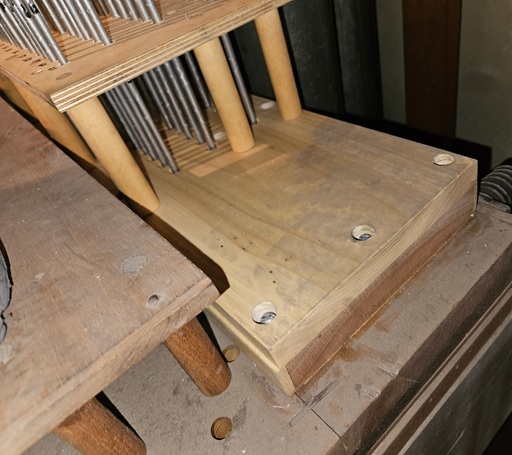
Mixture Toeboards How to:
For windchests that have a table that the pipes sit on, I prefer a false toeboard that sits on the table and distributes the wind to the pipes of the mixture note. The pipes will stand in a rackboard and sit in the false toeboard. Windchests (e.g. Slider) that already have separate toeboards, those toebds can be built in a simular manner. Click the button for info.
Pipemaking an essential skill
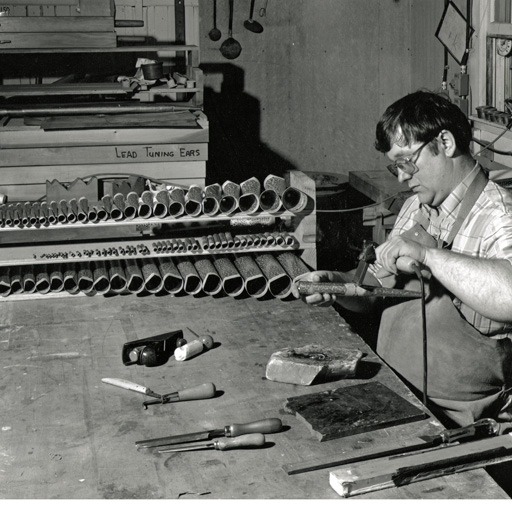
Pipes make the music, all the other parts of the organ exist simply to help the pipes speak. I believe even a small organbuilder should have the ability to work on pipework. I was fortunate to learn pipemaking with several fine builders and built up my own well equipped pipeshop.
Besides making new stops, having pipemaker (as well as a knowledge of scaling and voicing) means you can, for example:
- Miter pipes to fit available space.
- Repair damaged or missing pipes.
- Repair/replace torn tuning scrolls, smashed cone tuning; perhaps add tuning sleeves.
- Replace wooden stoppers in metal bourdons with new metal caps.
- Add chimneys to bourdon.
- Solder shut trumpet regulators and cut dead to length.
- Increase scale of treble by making and adding pipes.
- Turn #1 Open 8' into Gedackt 16' by making caps and cutting up.
- Turn harmonic flue into Rohrflute by cutting in half and making chimney'd caps.
- Turn old Vox Humana into a clarinet by making new resonators.
- Lower cutups and de-nick pipes by cutting pipe in half at the mouth and rebuilding.
- Lower cutups and de-nick pipes - smaller than 1' - just make new pipes...
- Turn (some) strings into 2-2/3' by rescaling and cutting down.