
So you wanna be a Tonal Director
In the typical organ company, the Tonal Director is someone who is head of sales, and draws up stoplists according to what the market will bear. However, there are other important things to consider.
The organ should be tonally planned to serve the musical needs of the church. Besides service playing, the organ should be able to play the repertoire. So a tonal director should be an organist and understand traditional French, German and English organs and their music. Not to build historic copies, but so he is able to build his organs so that music works on them. He should visit traditional organs, or at least listen to authentic recordings of them, and study their construction, scales and voicing.
The organ's loudness should match the church. It must be capable of leading full congregational singing, even if the building is large and acoustically dead. But it shouldn't overwhelm the room, scaring the old ladies. The organ also needs some softer voices to balance a timid singer, or quiet parts of the service. He needs to know how to measure the room and it's acoustics, to determine the loudness needed. A good tonal director knows how to set appropiate wind pressures, and scale and voice the pipes, to get the loudness right.
I'm not a Tonal Director. But I have worked for several good builders, and had my own workshop for about 40 years. I've worked on a lot of organs and voiced and tonally finished new organs, and rebuilt/revoiced a bunch. I've developed with some ideas and tools that could be useful to you. And I have a large library of historic and contemporary pipe scales. This website is a work in progress. I have a lot of material, which is constantly being added, so keep checking back. I'm not a scholar or historian. These are just my personal notes, gathered over a lifetime; so don't expect them to be properly referenced or attributed.
Contemporary organbuilding is profoundly influenced by three schools of organbuilding: The German Baroque school, The French Romantic School, and the English Romantic School. Of course, each school influenced the others. As North America was an English colony, North American organbuilding was based on English traditions. But modern builders use choruses based on German Baroque methods. They borrow mutations, cornets and reeds from the Classical French. The French Symphonic school contributes excellent strings, Harmonic Flutes and new ways of building choruses.
I'm not advocating eclectic organs, assembled from a Potpourri of stops. The most successful instruments embrace one style, though they may judiciously poach good ideas from other schools.
I start with an "Introduction to Scaling", a small booklet describing how pipes work, what scales are, their history, how to lay them out, how to plot them on a graph, and about Topfer. Then we look at how to measure and adjust the loudness of organs, to match the size and acoustics of the church. Next we look at some specialised organs: box organs, miniature organs and practice machines, which require special scales and voicing. Finally, we look at a bunch of German, French and English historical and modern organs, giving some scales and voicing measurements. Finally, we look at some suggestions for rebuilding and revoicing existing organs.
A list of topics:- Introduction to Pipe Scales: history, measuring, graphing and usage
- Acoustics and loudness - measuring the room
- Wind Pressure
- Specialised small organs & scales: miniature, box organs, practice machines
- Schools of Organbuilding - A Brief History of the Organ
- Gothic organs
- Renaissance organs
- Gothic/Renaissance/Baroque Organs, What's the Difference?
- North German Organs: Arp Schnitger
- French Organs, My Book and Classical
- French Organs, Andreas Silberman
- Central German Organs: Gottfried Silbermann
- French Organs, Cavaille-Coll
- English Organs, History and scales
- Contemporary organs
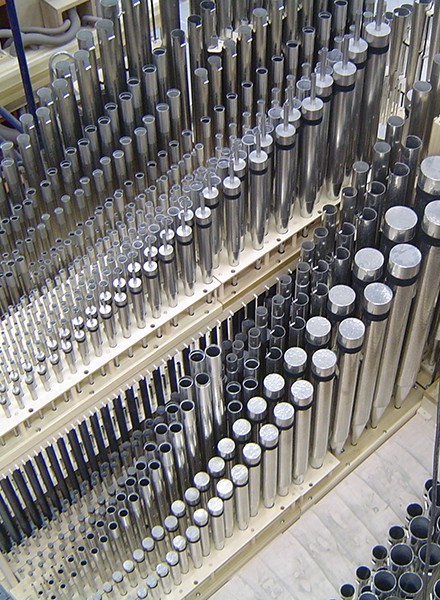
Introduction to Scaling my book
This PDF is some of my personal notes about the measurements of organ pipes. Bigger pipes are louder and duller. If you know the size of the pipes you can understand what they sound like, and use those measurements to make similar pipes.
I describe the history of pipe scales and the ways they can be laid out. I also describe how you can represent them on graph paper and analyze what they must sound like. I also go into the theory of how pipes work.
There are many excellent experiments and research into the physics of organ pipes (see below). Unfortunately, when the earliest researchers described what they think is going on, they got some of it wrong. Then later researchers cling to past ideas; there are hazards to conducting liturature searches.
So, how do pipes actually work? There are a number of theories. The original theory of Vortexes has been mostly rejected. The difficulty for most theories, is the theory's inability to explain how the cutup affects the tone. I would suggest Colin Pykett's ideas are a good place to start.
- Boner, C.P. - Acoustic Spectra of Organ Pipes, 1937 (I don't have...)
- Meyer, Jürgen - Resonanz and Einschwingvorgange Labialer Orgelpfeifen, 1960 (I don't have...)
- Nolle, A.W. - Some Voicing adjustments of flue organ pipes, 1979 (I don't have...)
- Sundberg, Av Johan - Mensurens betydelse i oppna labialpipor, 1966 w/english summary (I don't have...)
- Coltman - Sounding Mechanism of Flute and organ pipes, 1968
- Ising, Dr Ing. - Erforschung und Planung des Orgelklanges (Exploration and planning of organ sound) - Walcker Hausmitteilung Nr. 42, 1971
- Coltman - Jet drive mechanism in edge tones and organ pipes, 1976
- Fletcher, Neville - The Physics of Organ Pipes, 1983
- Fletcher, Neville - The Physics of Musical Instruments - Ch 17, Pipe Organs 1991
- Rioux, Vincent - Sound Quality of Flue Organ Pipes, 2001
- Steenbrugge - Aerodynamics of flue organ pipe voicing, 2010
- Angster, Judit - Acoustics of Organ Pipes and Future Trends in the Research, 2017
- Yoshikawa - Vortices on Sound Generation and Dissipation in Musical Flue Instruments, 2019
- Díaz, Óscar Martínez - Aeroacoustic characterization of a 3D organ pipe, 2022
- Liljencrants, John - End Correction at a Flue Pipe Mouth, 2006
- Pykett, Colin - How the Flue Pipe Speaks - 2001
- Saenger, Katherine L. - Chimneys on Organ Pipes - 2022
- Angster, Judit - An improved scaling Method for wooden Flue Organ Pipes, 2023
Acoustics & Loudness, measuring the room
Organbuilders and musicians love reverberation, for its rich, warm sense of fullness and space. The architecture and furnishings of a church affect the acoustics of the room, but there is little the organbuilder can do to improve the acoustics, unless he can perhaps talk the church into removing some carpet...
But there are some things the organbuilder can do. He can locate the pipes centrally and high in the room so that the music projects into every corner of the room. Proper encasement of the pipes, will improve blend and projection of the sound. Locating the choir and organist close to the pipes improves their intimacy, interacting together.
Room Volume
Each room has it's own size or volume, which affects the organ. As sound travels through the air, some of it's acoustic energy is lost as heat. The bigger the room is, the further the sound travels, the greater the loss, and quieter the organ gets. So big rooms require louder organs to fill them. Sound loses energy as it travels away from the source (the organ). Over distance, sound also gets duller, as distance absorbs the higher pitches. Think of lightning: a near strike has a sharp crack, but distant thunder is a low frequency rumble.
Reverberation
We must also consider reverberation. Direct sound travels until it hits and bounces off the walls, the ceiling and other hard surfaces of the room. This reflected sound can continue bouncing around for several seconds, forming a reverberant diffuse sound field. This reflected sound loses energy as it bounces off of surfaces, until there is nothing left. This decay is measured in the seconds, the time it takes for a sound's reverberation to decay to nothing.
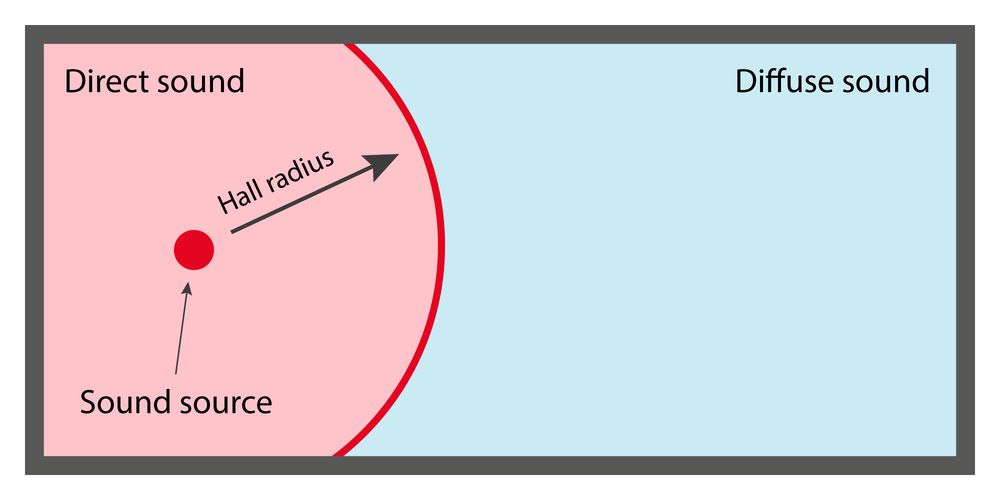
As sound travels from the source, fairly quickly the direct sound loudness falls to the same loudness level as the reverberant diffuse sound field. That point is called the Hall Radius. Once past the Hall Radius, the loudness of the organ will stay about the same strength throughout all of the diffuse field. The diffuse field is quite large, typically 2/3 to 3/4 the volume of the room. The diffuse field is filled with all the reverberant sound bouncing off the walls.
I've been told that the Hall Radius is the ideal place for microphones, when recording organ music. It has an ideal balance of direct sound to diffuse sound.
There is another important consideration. Reverberation is rarely consistant over frequency. A church with a reverberant bass, but dry higher frequencies will require an organ with a softer pedal, but loudened treble. So we must account for the reverberation time at each octave.
Acoustic Room Analysis
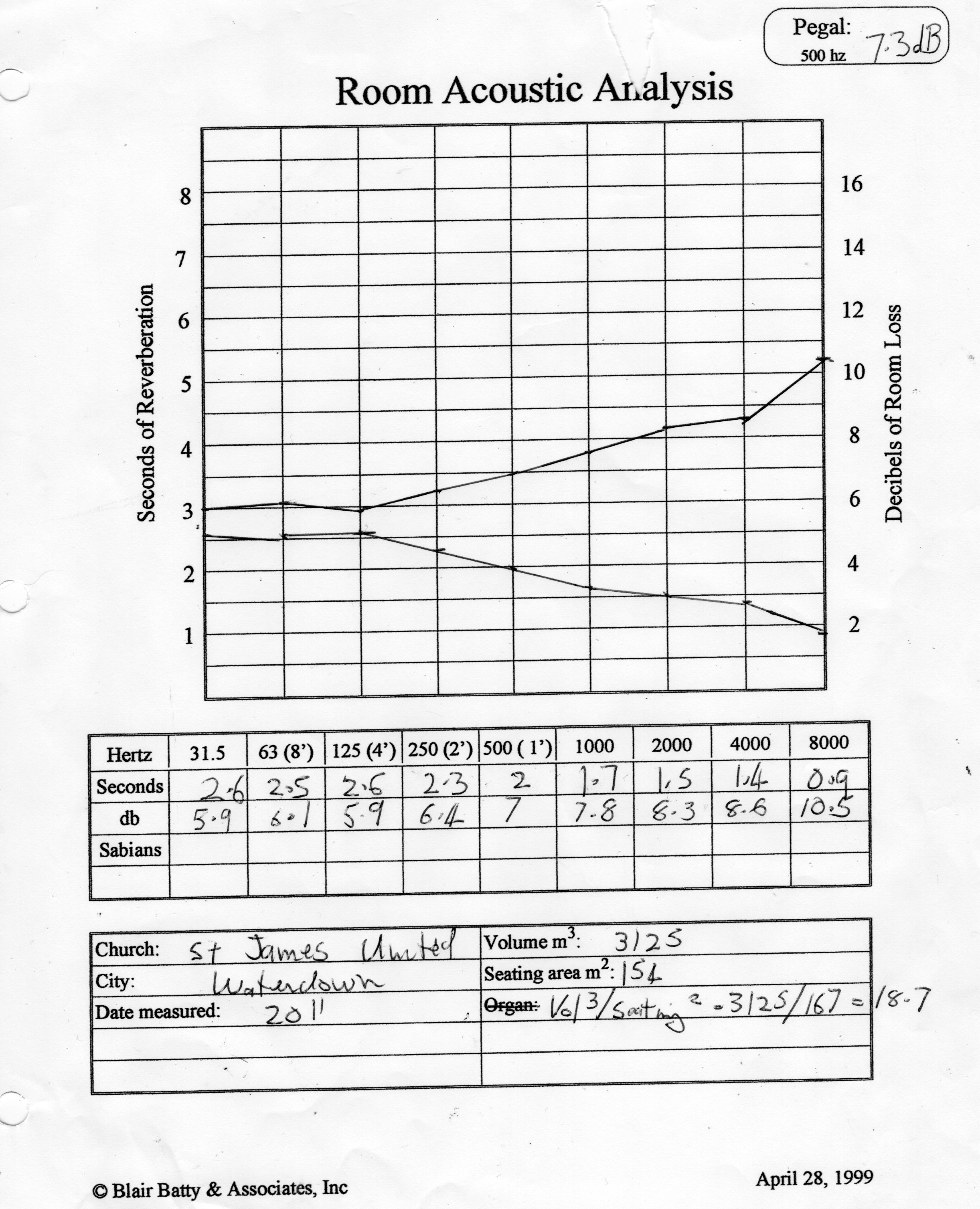
As an organbuilder, we need a way to measure the church acoustics. We are interested in how much acoustical power is lost between the source (the organ) and the listener. More exactly, We want to know the decibel loss between the source (near field) and the Hall Radius. Its actually quite easy to quantify, its only physics; all you need is a measuring tape, smart phone and a spreadsheet.
Data Collection
First thing you need is the volume of the room in cubic meters; length by width by height. Imagine it as if you were filling the church full of water; how many cubic meters would you need? The bigger the volume, the more sound you need to fill it.
The other thing you need is the building reverberation curve. You can buy an app for your smartphone that will do this for you. My iPhone uses "Audiotools". Plug the numbers into the spreadsheet and you will get output like in the photo to the left. I got this formula 40 years ago from Gerhard Brunzema and I have been using it ever since to quantify any room, and to help me layout scales and windpressures.
I should caution that most cellphone microphones have a bass-blocking filter, to remove wind noise and rumble when making a phonecall. This will block your phone from making 16' measurements. If that matters, you can buy a calibrated microphone that plugs into your phone.
Analysis
If you look at the "Room Acoustic Analysis" example (photo to the left, click on it), you can see how the reverberation starts out at 2.6 seconds at 31.6 Hz (16') which is very good. But at 4' pitch the reverberation starts dropping so at 8 khz it is less than one second, which is very poor. Notice how the the dB-loudness-loss is six decibels of loss at 16', but grows to 10.5 dBs at the top note, inversely mirroring the reverberation. It is very common for reverberation to fall off in the treble of larger rooms. That's why scales that grow into the treble (e.g. 18th pipe) work better in such rooms.
Matching Room and Loudness, Question of Scale
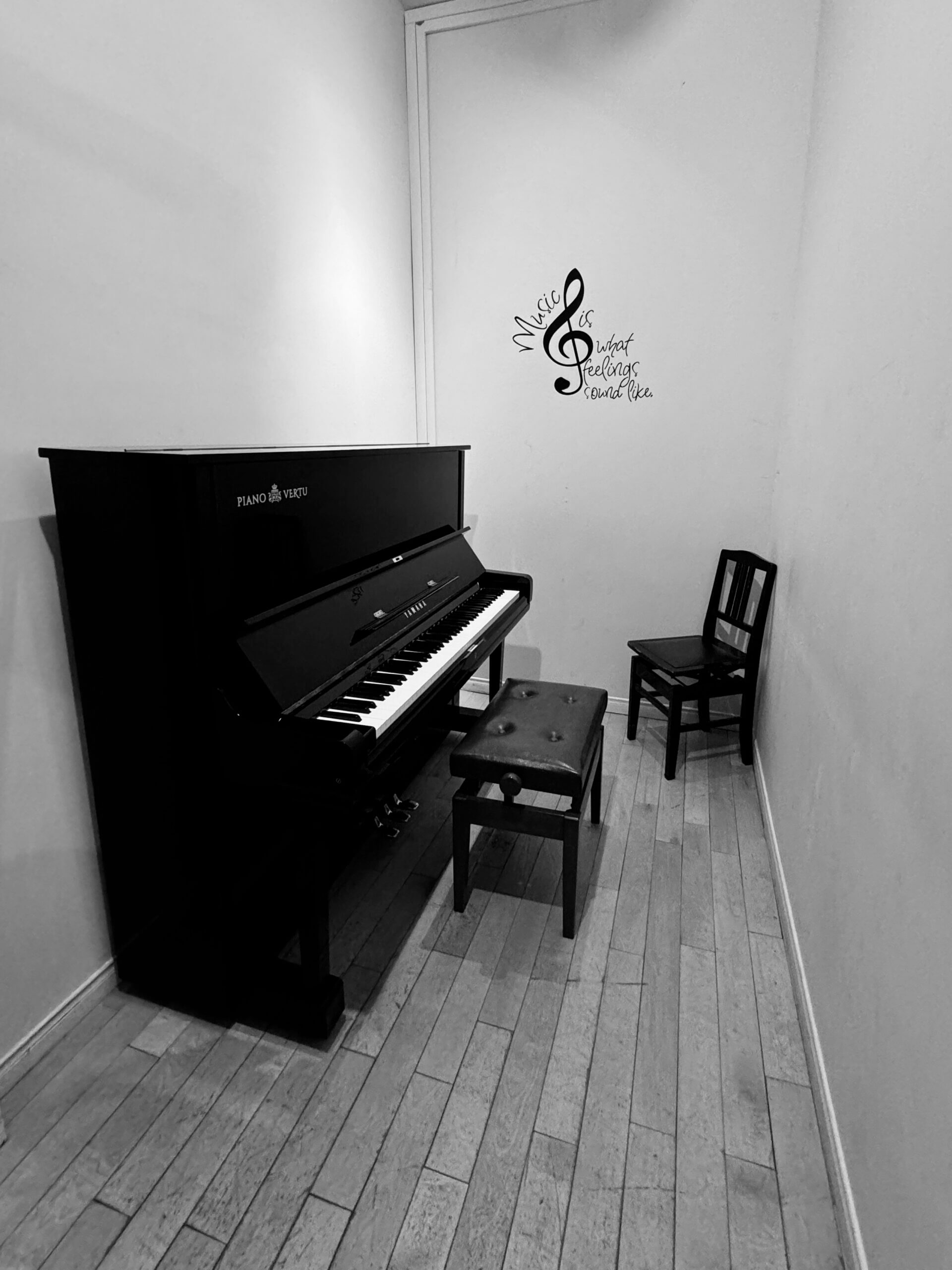
Let's consider pianos. You wouldn't put a grand piano into a small practice room. Even if you could shoe-horn it into the room, it's loudness would overwhelm the space and practicing would soon become tiring. On the other hand, a small spinet piano would fit the space perfectly. The smaller strings would have a lighter, brighter sound that would fill the room without overwhelming the player. And the keyboard's lighter, responsive action is an ideal touch for practice.
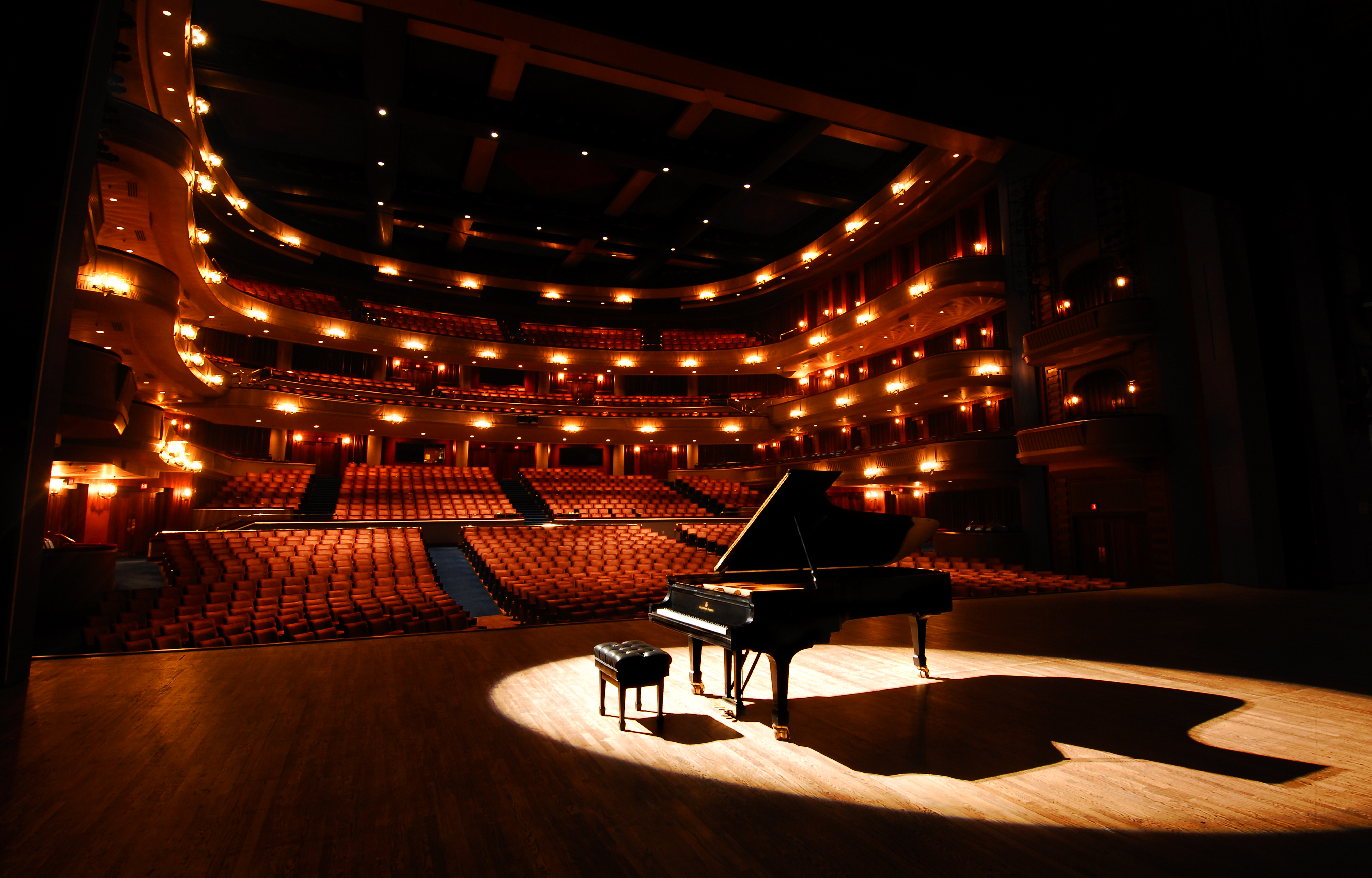
On the other hand, a spinet on stage would look ridiculous. A large grand piano would command the stage, whereas a spinet would be lost among the instruments. The grand, with it's long, fat bass strings and massive soundboard can project a powerful, deep, resonant tone into the big room. It's called a "Grand" piano for a reason. And it's firm, commanding key touch give excellent control over the powerful instrument.
In either case, spinet & practice room, or grand & concert hall, the scale of the instrument matches the scale of the room. They look and sound appropriate.
But What About Loudness: Decibels?
A typical practice room might have a room loss of about 1 or 2 decibels. A typical concert hall with good acoustics, like Boston Symphany Hall, has a decibel loss of about 16 dB. (Room loss is the decibel difference between the piano (near field) and the Hall Radius). That's a difference of (16 db - 1 dB) 15 decibels.
There is no possible way to make an acoustic piano 15 decibels louder, no matter how you big you make it, or how heavily you bang on the keyboard. The grand piano will sound softer from the seats in the Hall, than the spinet in the practice room! Fortunately, humans aren't stupid (at least, most of the ones who attend classical concerts). We see the size of the hall and the distances from the stage, and our brain automatically compensates for what we hear. Also, all the other instruments are simularily attenuated, so everything balances. And concerts usually use lots of loud instruments; chamber music usually use smaller venues.
What About Pipe Organs?
You cannot make a pipe organ 15 decibels louder; that is about 32 times more powerful; (decibel is logarithmic). Sure, you could use 100 inches of wind, and monster, freak pipe scales. But then it wouldn't be a pipe organ any more, just some kind of Frankenstein Calliope. What I do, is try to make the pipe organ about 1 decibel louder for every 3 decibels of room loss. This is an arbitrary decision, with no scientific basis. Therefore, I would try to make the Boston Hall organ (15 dB loss) about 5 decibels louder. How do you make an organ louder?
- Higher wind pressures
- Bigger scales
- Louder voicing (bigger toes, cutups, windways...)
- More pipes
Synthesis
So how do we compensate for the room? First: select the correct wind pressure for the dB-loss of the room. Second: adjust the scales to mirror the room decibel loss. In very simplistic terms, scaling and voicing can be described in this way:
- Diameter determine the loudness of the fundamental of the pipe.
- Cutup fine-tunes the harmonic content.
- Wind pressure/toehole/mouthwidth/windway fine-tunes the loudness.
You could make pipes louder by opening the toe and cutting up the mouth, but the proper and most efficient way is by making the scale larger. It is the strength of the pipe fundamental that fills the room. The scale of the pipe also determines the rank's tone and character, so you must select the correct scale for the character and power you need. In the example shown in the photo, you will want to adjust the scale so it grows into the treble, mirroring and compensating for the room treble dropoff. Finally, the voicer will likely open the toes and raise the cutups of the treble.
In other words, to match an organ to the room, you adjust everything. If you need it louder, you raise the wind a little, increase the scale a little, open the toes a little and raise the cutups a little.
Wind, the driving force
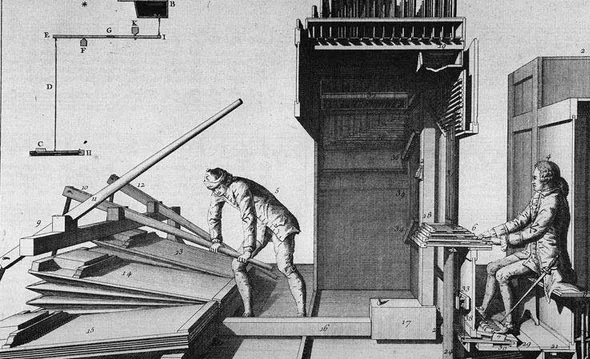
Organs are wind blown instruments; The pipes are just whistles. In the past, people pumped large bellows to build up the wind pressure. But today we use electric blowers. Wind pressure is normally measured in inches (water column) although often expressed in millimeters wc. In calculations, it is often converted into pascals, which is the standard unit for engineers.
To put it in context, a typical party balloon is 2 to 3 inches pressure, and a human can blow a maximum of about 16 inches. Small pipe organs are typically about 2 1/2", and typical organs are about 3 1/2". Four inches of wind is about the maximum for an organ, otherwise the keytouch becomes unplayably heavy. Organbuilders choose the pressure for the loudness they require. The higher the pressure, the louder the organ.
Exceptionally higher wind pressures (4-6") were used during the romantic era, because the new early pneumatic and electrical windchests needed higher pressures to function reliably. Also, it suited romantic voicing with its huge windways and sluggish speech. Some new romantic stops, like the Solo wooden Grosse Flute 8' and smooth-toned English trumpets really need 7" to sound right, and a good English Tuba really wants at least 14" (it has to do with very thick tongues, heavy tongue weights and huge tongue curves). For example, Father Willis used 3" for the Choir, 3 1/2" for the Great and Swell, 7" for the chorus Trumpets and 14" for the Tuba (Union Chapel, Greater London, Islington - 1877).
The foot of an organ pipe is a complex wind system. It is a conical tube, with a constriction at either end. The bottom is constricted by the toe hole, which slows the airflow into the foot. But the airflow is also constricted at the top exit of the foot, at the windway. The windway constriction causes a back pressure buildup, called the foot pressure. The voicer manipulates the toehole and the flue width to adjust the foot pressure, which in turn, changes the loudness of the pipe. The pipe doesn't care what the windchest wind pressure is, it only cares about the pressure inside the foot of the pipe.
There are two ways to make a pipe louder, raise the windpressure in the wind chest, or open the pipe toe hole to allow more wind into the pipe. Normally, you would change the windpressure to affect the whole chest, but change the toehole to affect just one pipe. Pipe loudness is a balancing act between the foot hole size, and the wind chest wind pressure. You could have a higher chest pressure and small toeholes, or you could have a lower chest pressure and open toes, and get a simular loudness.
My Standard Pressures
Everyone has their own way of doing things, I'm just going to describe my practice and the rational behind it. I prefer the toes to be more open and the windways narrower than the romantic practice (but not neobaroque!) because the pipes are more efficient and prompt. My usual pressures range from 2" (50mm) to 4" (100mm), depending on how loud the organ must be. Much lower than 2" and there isn't enough energy in the wind to drive the pipe properly. I haven't found a situation where 4" was inadequate to make the pipes speak loud enough.
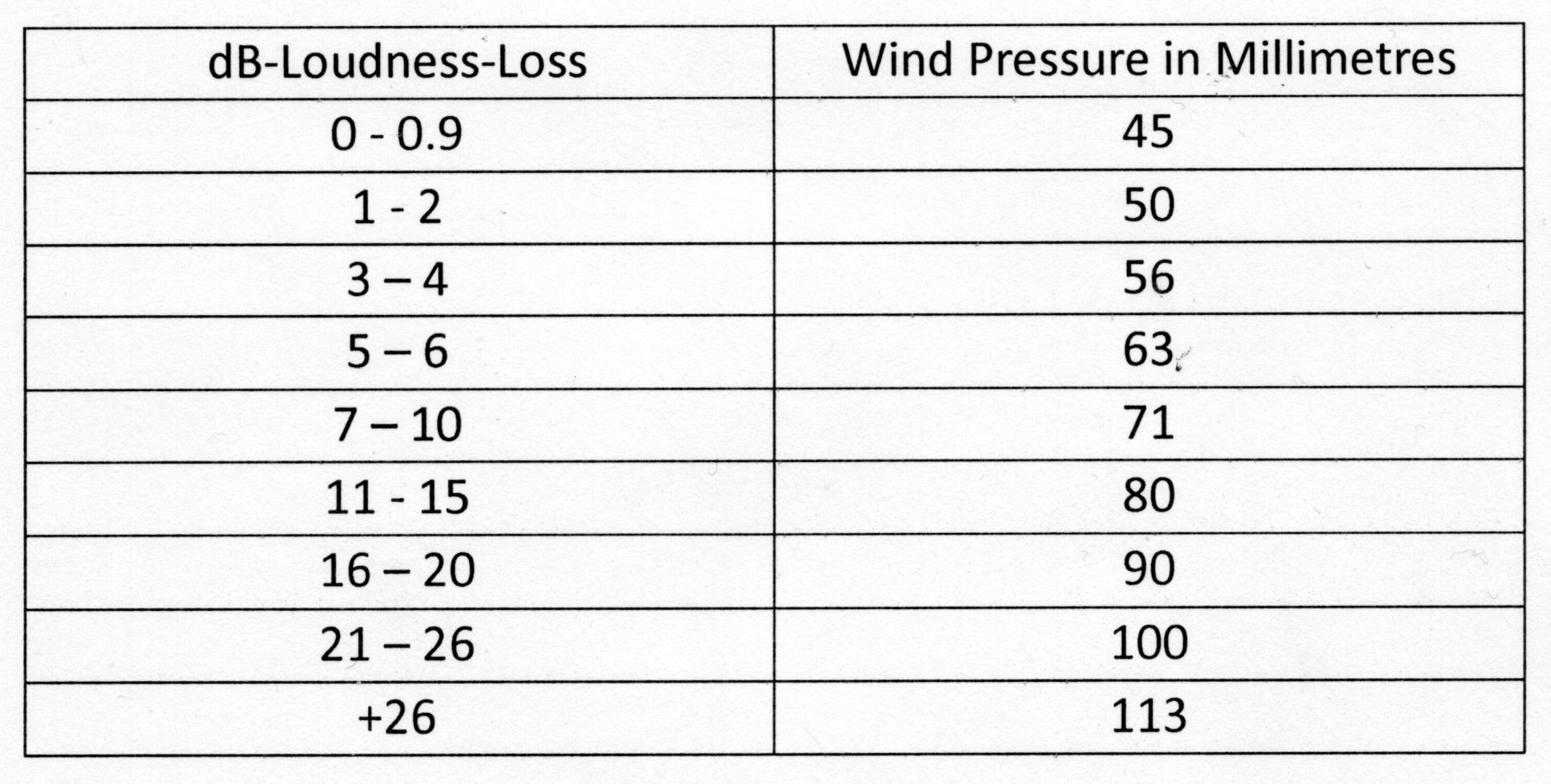
Going from 2" (50mm) wind to 4" (100mm) wind is a doubling of pressure. If you double the pressure, the pipes become six decibels louder. My standard pressures are shown below.
(45), 50, 56, 63, 71, 80, 90, 100, (113) millimeters wc
The numbers may seem odd, because they have a logarithmic spacing. Each increase in pressure will make the pipes one dB louder. (i.e. if you raise the pressure from 56mm to 71 mm, the pipes [in theory] will get two decibels louder.) In practice, big changes in chest pressure will require changes in pipe voicing (toeholes, windways, cutups) which will also affect loudness.
Choosing the Pressure
For chorus principals and flutes, I don't like extremely narrow (neobaroque) windways, which are very sensitive to dust and easily set off-speech by minor disturbances. I prefer relatively open toes that give the pipe a full flush of air. Underwinded pipes tend to be unstable and hard to tune (draw easily). I prefer foot pressure to be no higher that 80% of chest pressure, to allow a margin for regulating pipe loudness. Of course, strings, etc., get closed toes, as appropriate.
By choosing lower chest pressures and higher foot pressures, I can get pipes that have relatively open toes with moderate windways. As a starting point, I use the previous chart to pick the chest wind pressure. It uses the average room-decibel-loss (at 500 hz) to choose the pressure. It is adapted from work that Brunzema did. As Casavant tonal director for ten years, Brunzema gained extensive experiance, making a new organ every couple of weeks!
Caveats
Of course it is never that easy. The wind pressure chart assumes that the organ is a freestanding encased (tracker-style) organ, properly placed in the building. Or it could be an open display in front of a hard surface (wall), Holtkamp style. But there can be many complications.
SWELL BOX - around the pipes will impede the sound. A good box, that is shallower than it is wide, one with solid walls and shutters across the entire front that open 90 degrees, will cost you about 3 decibels. I usually compensate by going up to the next wind pressure level. In other words, if the Great is 63mm, then I will raise the Swell to 71mm to offset swell box losses.
I might note however, that if the box is shallower than three or four feet in depth, the nearby swellbox walls will reflect the sound of the 8' and 4' making them louder (5db and 3db respectively). So keep your swell boxes shallow and wide, with solid walls!
TRUMPETS - Perhaps you have a good room and the pipes only need 56mm wind. But you want a nice Trumpet. It is very difficult to get a good trumpet with only 56mm wind. The solution is to put the chest on 71mm wind for the sake of the Trumpet, and close the toeholes for the rest of the flues.
SMALL ORGANS - Perhaps you are building a small practice organ and the pipes only need 45mm of wind. I would probably build it using 63mm wind, and close the toes a little bit. First, small organs like that usually only have room for small pallets, narrow chest grooves and have lots of tubed off basses. Higher pressures push more wind through, so you have less wind robbing. Second, the higher pressure on the small pallets will increase the pluck, improving the key touch.
DIFFICULT ACOUSTICS - Perhaps you have a room with an average loss of 6 dB, so the chart recommends a wind pressure of 63mm. But at the higher frequencies have a loss of 10 dB. I would use a wind pressure of 71mm for the sake of the trebles, and just use smaller toes for the mid and bass pipes. You can always get power from the bass, it's more difficult to get it from the higher pitched pipes.
BURIED IN A CHAMBER - I haven't found a reliable way to measure for buried pipes. I measure the room and make my best guess for the chamber losses.
Scale Choice, and decibels
Choosing scales is very personal. It depends on your company's traditions, the historical style you'd like to emulate, the size and acoustics of the room, the size of the organ, how loud it needs to be, and the stop's position in the stoplist.
For some stops, like strings, I relate their loudness in comparison to the strength of the building's background noise. Special stops, like Spitzflute 4', I have in a small, medium and large scale. But I want chorus stops, the Principals and Flutes, to track the decibel room loss, so that the organ plenum can fill the church, without overwhelming us.
Bourdon 8'
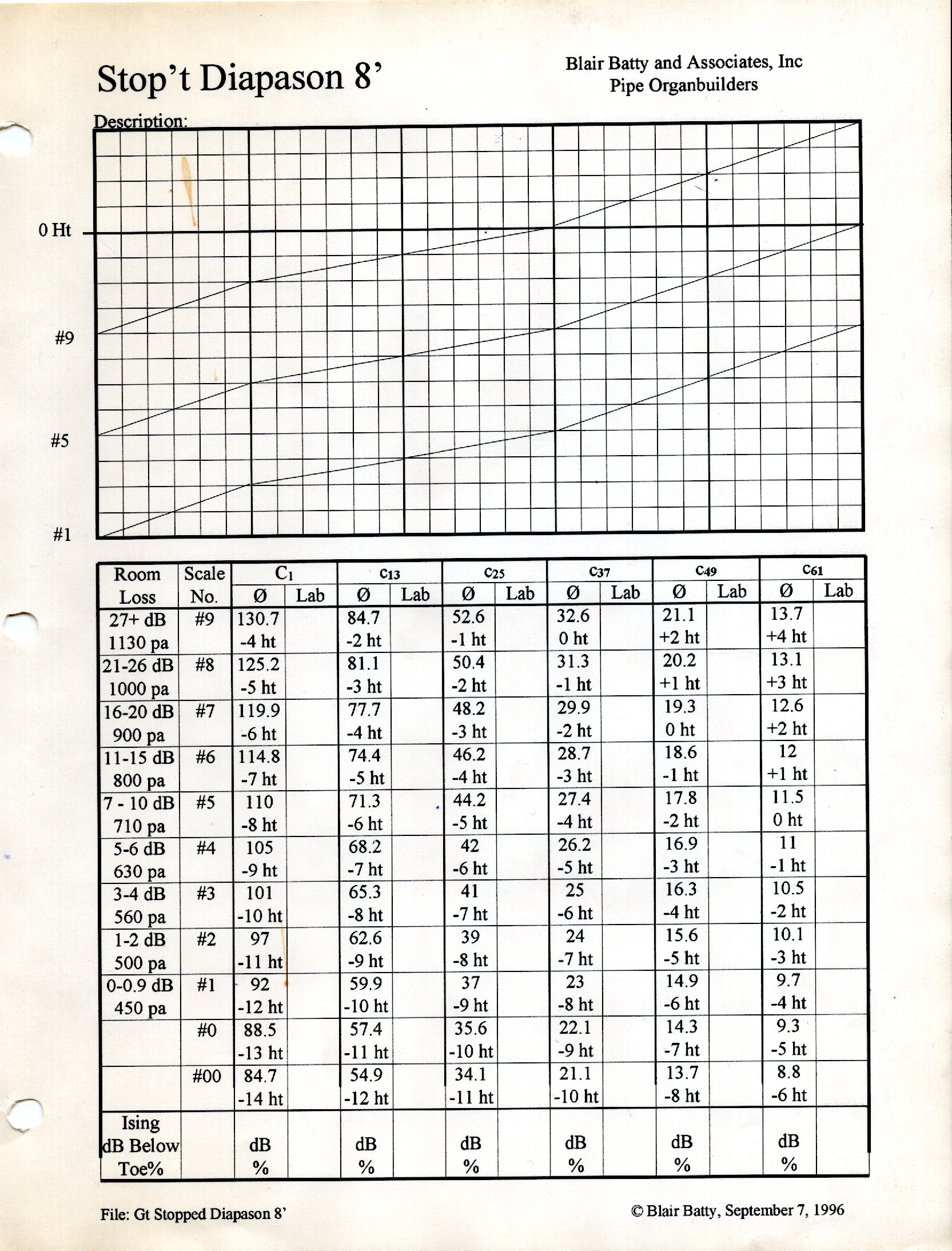
As an example of what I do, the photo (click on it) shows my generic Stopped Diapason (or Bourdon 8'). Bourdons can stand a large range of sizes, from small to large. I have the scale increase for each step in loudness and windpressure, as mandated by the acoustics of the room.
This scale is for a Great; it wants moderately high cutups, well winded. The Swell should be the same scale, or larger for a bad swell box or location. Positive and Brustwerks could be two scales smaller. For a very large organ, I may go one or two steps larger, a small organ I may go a step smaller. For a brighter, more colourful sound, add chimneys. I start chimneys at 2', chimneys in the tenor add an unfortunate tierce colour. Never use chimneys in the 8' octave, the pipes don't like it.
Make a wooden bass 2 ht narrower. Go to open pipes (not tapered) at 1/2' (you can't hear the difference) and make open pipes +2ht. Bourdon scales smaller than 85mm at 8' "C" are too narrow to work!
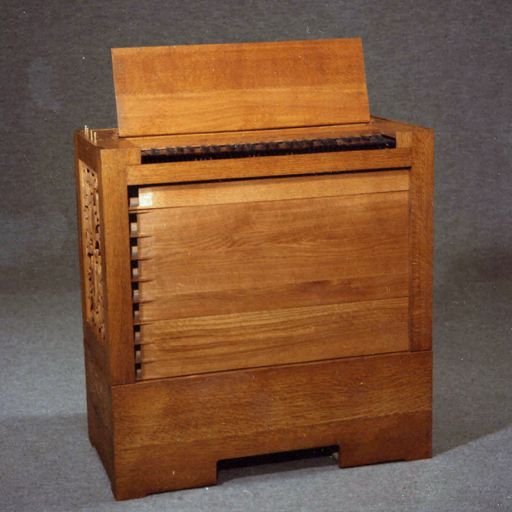
Specialized Organs, small is beautiful
Box Organs
To my mind, a box organ has a special purpose, to accompany or play with a chamber orchestra and/or choir. To do this it must meet specific, often conflicting requirements.
Many of the box organ designs are too bulky and require a truck and four strong men to move. Or they are built tall, like a positiv and block the view. Or they use miniature pipes that are voiced too weakly to be heard doing battle with a chamber group.
Miniature Organs
A church is a large building and requires a powerful musical instrument, such as a pipe organ, that can generate enough musical power to lead massed voices in hymn singing. As well, the organ must have sufficient power to fill the room when playing the organ liturature. But if you move a church organ into a home or practice studio, the pipework and voicing would overwhelm the listener. It would be too darn loud!
At Brunzema's we developed a series of small organs, using special scales and voicing, suitable for smaller spaces. As Brunzema has been dead for 40 years, the firm had no successor, and I was involved with them, I see no harm is sharing some things about them, and the box organ here. The size of these organs was determined by constraints: height by a typical home ceiling, width by the pedalboard, and depth by passage thru a typical room doorway. To save space, the two 8' stops and the pedal 16' shared 17 offset pipes. Space determined the stoplist, explaining the 2-2/3' tg, 2', 1-1/3, 1' stops.
The standardized case split into three horizontal sections, so to fit thru a doorway. The middle section has the keyboards, chests, key and stop action which could be shipped pre-assembled.
Practice Machines
Practice machines present special problems. They must be compact, and soft enough to be played in a small practice studio, for long periods of time. They require two standard, full compass keyboards, plus a standard pedalboard and three couplers: Sw-Gt, Sw-Ped and Gt-Ped. Each keyboard requires at least one independent sound, so you have a minumum of three stops.
However such a minimalist organ is a poor investment. You've paid for two keyboards and a pedalboard, plus the complete actions, chests, wind system, and casework, but you can only use it to practice fingering. It would be better to invest in a few more stops, so that you can actually make music with the organ.

Schools of Organbuilding, a brief history
I spent several summers, back in the late 1970's, organ crawling all over northern Germany and Holland looking at old organs. Many of the historic old organs survived by neglect. Often, they were located in poorer rural areas, where the congregation couldn't afford to rebuild or replace it. Perhaps it was a hand-me-down organ from a richer city church. They survived by poverty; unscathed by rebuilding or replacment by something newer. The church had no idea what they had.
The churches were usually unlocked, and the parishioners proudly encouraged me to violate their instrument to glean its innermost secrets. Often they were amused that anyone would be interested in their old junk. Many of these instruments had already been scaled by others, so I could concentrate on photographs and listening to the organ. I had amazing access, which I shameless exploited. Of course, today these same organs are considered national treasures, have been expensively and meticuiously restored, and are untouchable. They are very difficult to get near, impossible to get to play.
I am not a historian. These are my personal travel notes, plus information given to me from other builders and friends. I also got a lot of information from books (I'm not a scholar, it was for my personal use, so didn't bother to document sources). Finally I filled out some of general information by asking the "DeepSeek" AI; which I shamelessly plagerized (If you copy one source, it's plagerism, if you plagerize many sources, it's an academic liturature search).
The great schools of organbuilding are historically and geographically distinct traditions, each with unique sonic ideals, construction methods, and corresponding bodies of repertoire. There are three great schools of organbuilding, which influence modern North American organbuilding:
- The German Baroque school (e.g. Schnitger 1648-1719, G Silbermann 1683–1753)
- The French Romantic School (e.g. Cavaille-Coll 1811-1899)
- The English Romantic School (e.g. Willis 1821-1901, Wm Hill 1789-1870
It's important to understand that a "school of organbuilding" is inseparable from its corresponding "school of composition" . Composers wrote music that showcased the specific capabilities of the instruments in their region. For example, the large, multi-division organs with prominent pedals in North Germany were essential for the elaborate preludes and fugues of Buxtehude and Bach, while the French Classical organ's unique registration colors were integral to the sound of Couperin's organ masses . These historical styles are not just relics. They form the foundation of modern "eclectic" organs, which aim to combine stops from various traditions to perform a wide range of repertoire .
Historical Summary
Gothic Blockwerk Organs - 14th to the 16th centuries
Gothic Blockwerk Organs - 14th to the 16th centuries
* Key Characteristics: no stops, just a chorus of octaves and fifths like a giant mixture, organ case with
doors, played one note at a time, with the fist on huge keys. None survive, just a couple of empty cases
* Notable Builders: Heinrich Traxdorf - Mid-15th century, Frédéric Schambantz - Early 15th century
* Representative Composers: unknown
Renaissance Builders - mid-15th to early-17th century
During the Renaissance, the first real organs evolved. national schools of organ building also began to emerge. For instance, the classic Italian organ of the period typically had a single manual and was known for its delicate voicing and brilliant, colorful chorus, which included distinctive stops like the voce umana. This contrasts with the powerful, complex instruments being built in Northern Germany at the same time.
German Renaissance Organs - mid-15th to early-17th century
* Key Characteristics: short octave, developed pedal, clear Principal chorus for everyone singing, colourful flutes and reeds
* Notable Builders: Hans Scherer the Elder late-16th, Antonius Wilde 1575–1618, Gottfried Fritzsche 1578–1638
* Representative Composers: Arnolt Schlick 1460–1521, Michael Praetorius 1571–1621, Leonhard Kleber c. 1495–1556
Italian Renaissance Organs - 1550–1650
* Key Characteristics: Small stop-lists focused on principals; no mixtures, individual mutations; principal celeste (rare elsewhere); clear, rich sound
* Notable Builders: Costanzo Antegnati
* Representative Composers: Giovanni Gabrieli, Claudio Merulo, Girolamo Frescobaldi
Spanish Renaissance/Baroque Organs - 1500–1700
* Key Characteristics: Split keyboards for solo/accompaniment textures; horizontal en chamade reeds (trumpets); brilliant, vibrant sound
* Notable Builders: Echevarría family
* Representative Composers: Correa de Arauxo, Antonio de Cabezón, Juan Cabanilles
Baroque Builders - 1600-1750
German Baroque, North - 1600-1750
* Key Characteristics: Werkprinzip (north) with independent manual sections; lean, brilliant choruses
* Notable Builders: Arp Schnitger
* Representative Composers: J.S. Bach, Dieterich Buxtehude
German Baroque, Central - 1600-1750
* Key Characteristics: organs focused on colour
* Notable Builders: Gottfried Silbermann
* Representative Composers: J.S. Bach
German Baroque, South - 1600-1750
* Key Characteristics: fundamental-based sound with gentle voicing. An abundance of 8' registers (flutes, strings like Gamba, Salicional) and colorful mutations,
especially tierce mixtures . Designed for ensemble playing, accompaniment, and blending with instruments/voices, rather than dominating in complex polyphony
* Notable Builders: Joseph Gabler (1700-1771) & Frantz Jacob Späth (1714-1786)
* Representative Composers: Johann Froberger
French Classical - 1650-1770
* Key Characteristics: Abundant mutations, Cornet and bold reeds; specific registrations indicated in titles (Plein Jeux, Grand Jeux);
graceful, elegant sound with complex ornaments (inégalité)
* Notable Builders: Clicquot family, Dom Bédos
* Representative Composers: François Couperin, Nicolas de Grigny, Louis-Clérambault
Romantic Builders - 1830-1930
German Romantic 1830-1930
* Key Characteristics: Focus on blending stops for a rich, symphonic sound; higher wind pressure; crescendo pedal (Rollschweller); reeds blend into tutti
* Notable Builders: GFriedrich Ladegast, Wilhelm Sauer
* Representative Composers: Johannes Brahms, Franz Liszt, Max Reger
French Romantic - 1811-1899
* Key Characteristics: Harmonic flutes, swell box, Barker lever, symphonic sound and performance style
* Notable Builders: Aristide Cavaillé-Coll 1811-1899
* Representative Composers: César Franck, Charles-Marie Widor and Louis Vierne
English Romantic
* Key Characteristics: smooth reeds, Melodia, Tubas, multiple 8' Opens
* Notable Builders: Father Willis 1821-1901, Wm Hill 1789-1870
* Representative Composers: S.S. Wesley (1810-1876), Hubert Parry, Charles Villiers Stanford, and Edward Elgar, Herbert Howells, and Ralph Vaughan Williams
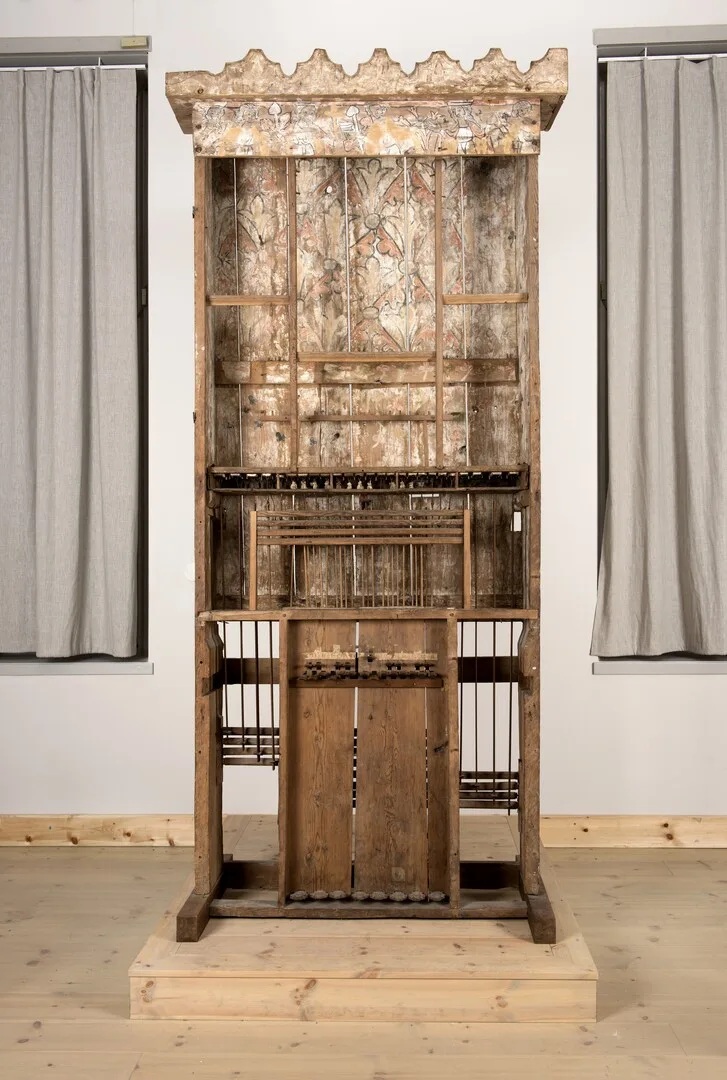
Gothic organs, Blockwerk
The Blockwerk organ represents the first great flowering of organ building in the Western church, a tradition that developed from roughly the 11th to the 15th century. Sadly, none exist any more. Some gothic cases survive in places like Sion (Switzerland), Amiens (France) and Old Radnor in South Wales. Some pipework survives, revoiced and recycled into newer organs.
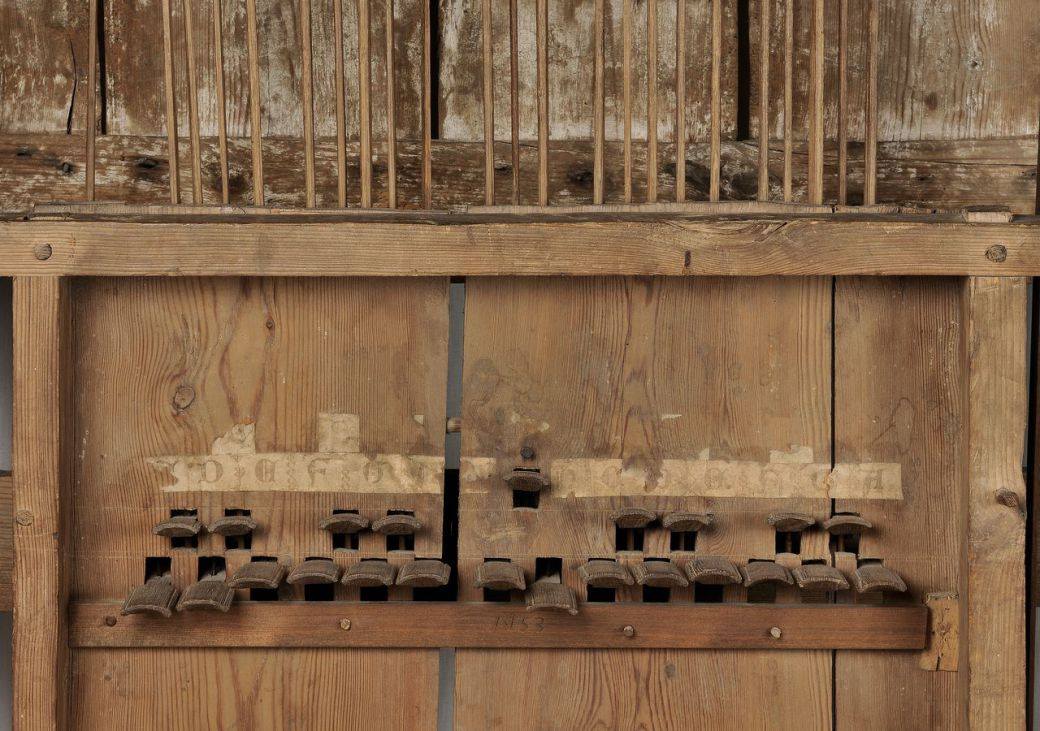
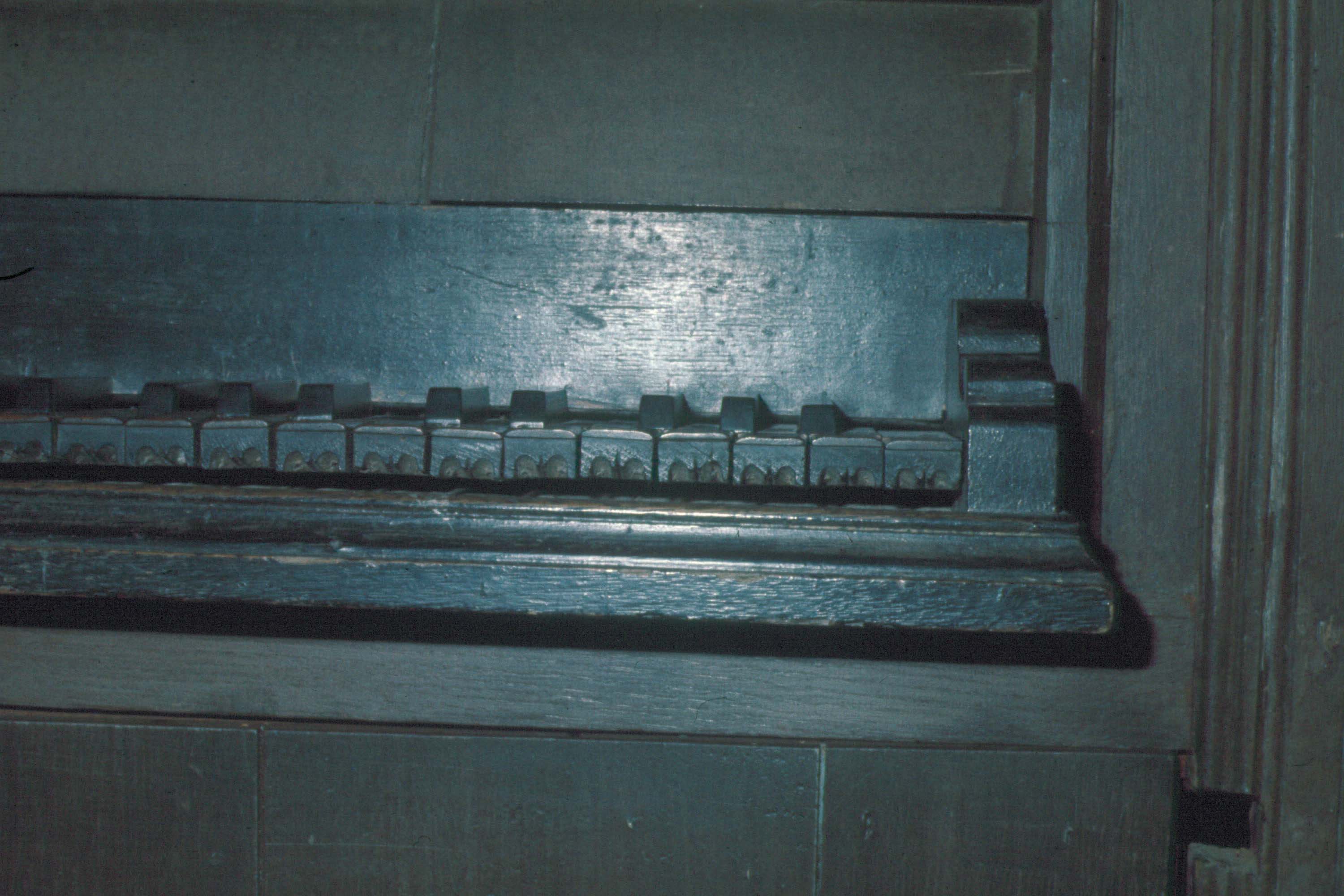
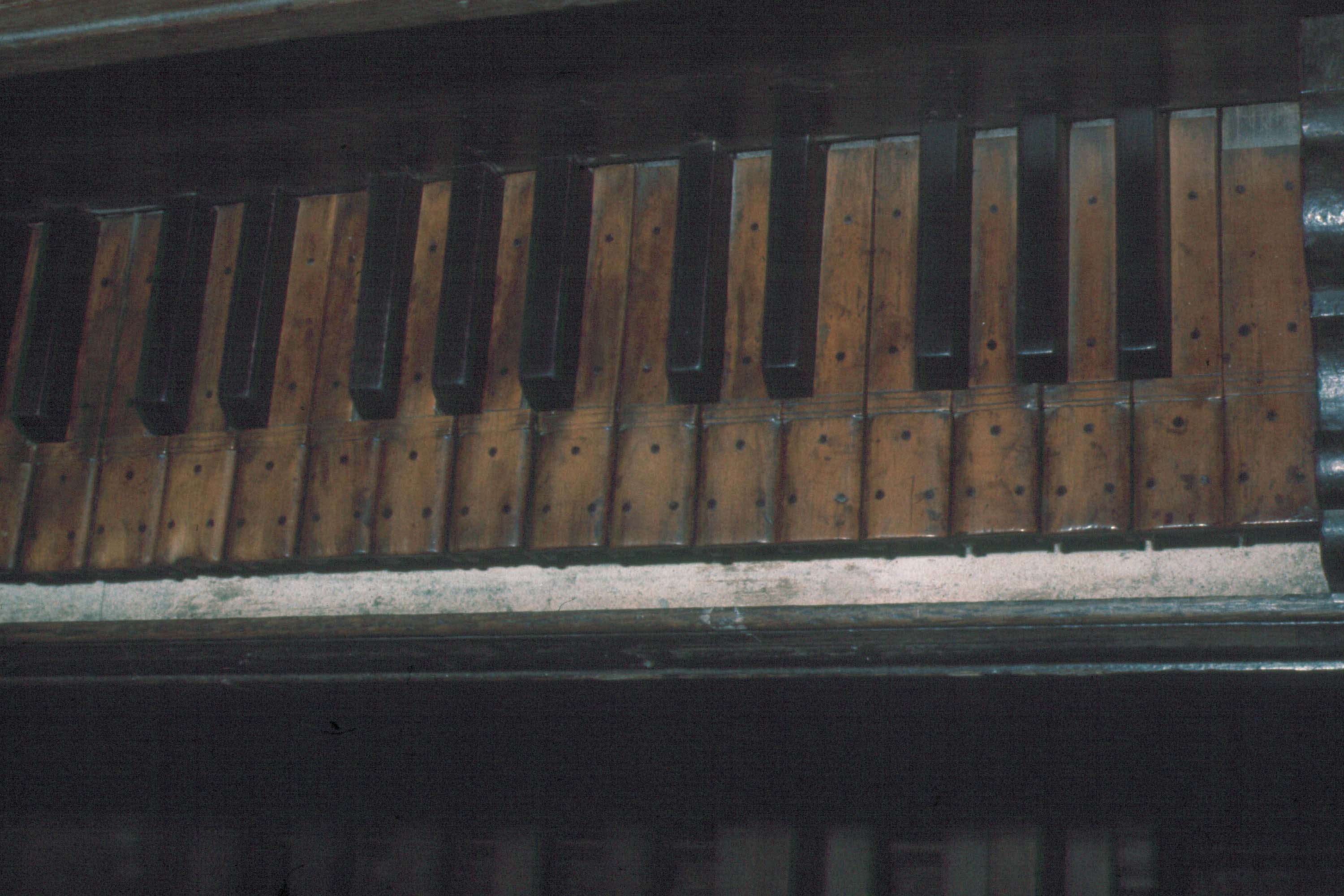
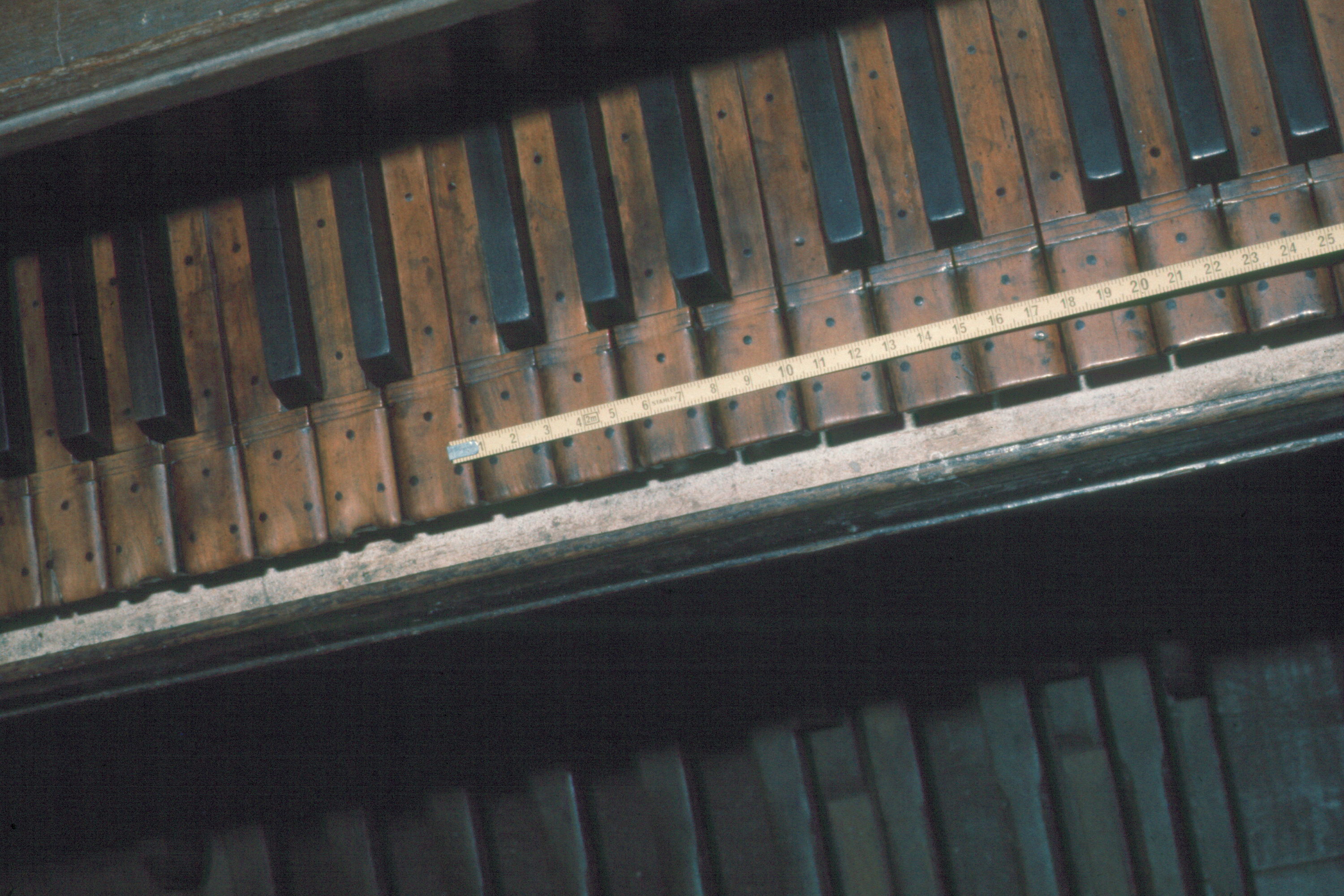
1370-1400 - Norrlanda keyboard
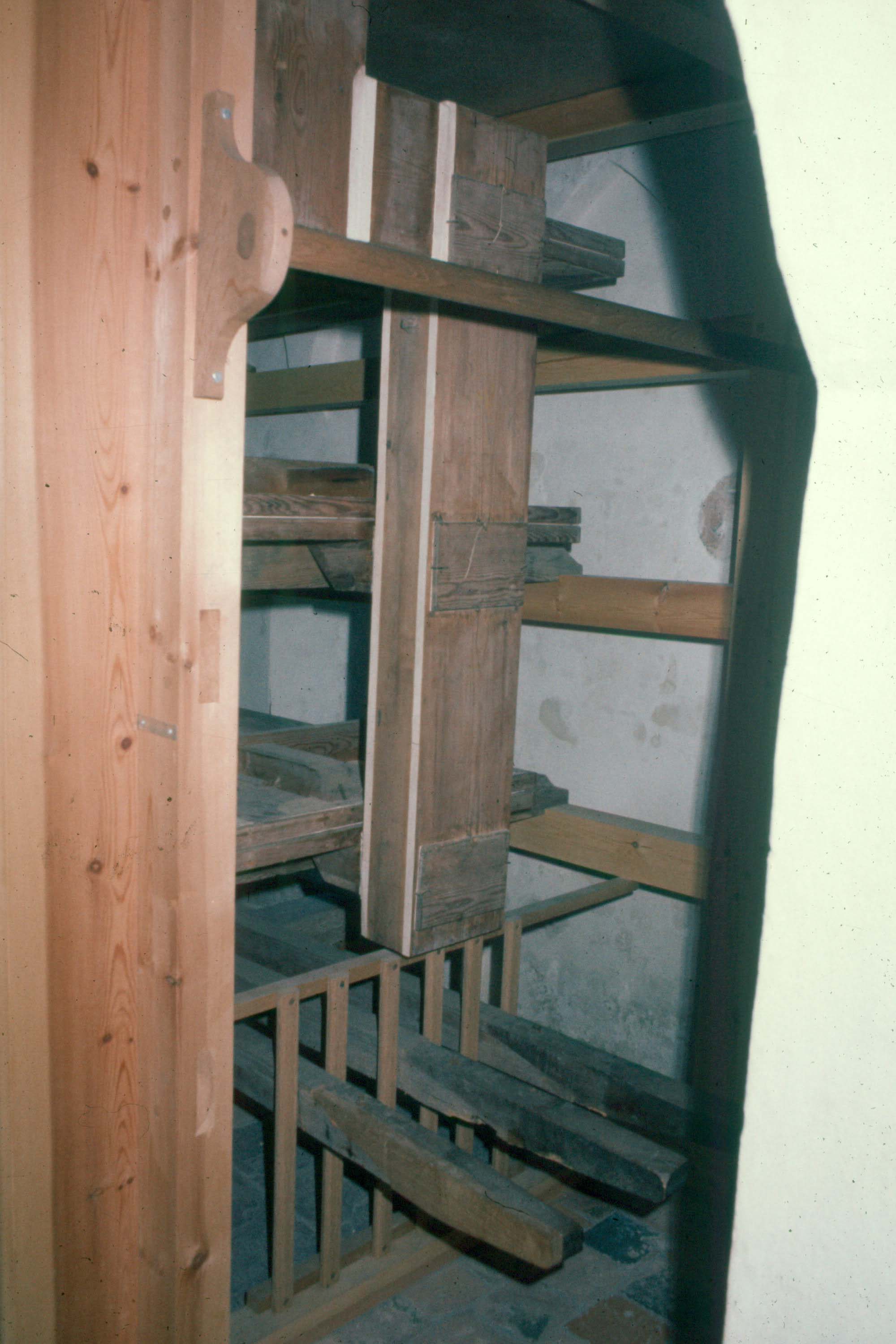
The Norrlanda Organ (c. 1370-1400) seen above, and Norrlanda's keyboard to the right, is the most well-preserved medieval organ structure in existence. The case and windchest of this organ from Gotland, Sweden, survive. A playable reconstruction can be seen and heard at the Gotland Museum in Sweden. It had an 8 key pedalboard.
Gothic cases
Gothic Architecture comes from the High and Late Middle Ages (12th to 16th centuries). It was characterized by the pointed arch, ribbed vault, flying buttress, large stained glass windows and ornate Details: Gargoyles, spires reaching to the heavens, and intricate stone carvings of leaves and religious figures. Famous Examples: Notre-Dame Cathedral of Paris, Chartres Cathedral, Cologne Cathedral, Milan Cathedral, Westminster Abbey.
Likewise, Gothic organs looked like miniature cathedrals; featuring pointed arches, spires, pinnacles, and tracery that mirrored the building's design. The organ was contained in a single, flat-fronted case. Sadly, most of the survivors shown here have lost there rooftop spires and doors.
Pre-reformation organ cases had doors covering the pipes. During Lent or other somber seasons, closed doors could visually and aurally "humble" the instrument, matching the more restrained mood of the service. The doors would be thrown open for festive occasions like Easter or Christmas. After the reformation the door were often permanantly removed. The cases are remarkably shallow, perhaps a couple of feet deep, and they have only one keyboard. They sometimes have a pedalboard.
Gothic organs were known as Blockwerk organs, a German term meaning "block work," which perfectly describes their construction: a single, unified mass of sound, to support chanting and creating a "wall of sound." This was the age before "stops," when an organ was essentially a single, massive, unchangeable chorus.
What Was a Blockwerk Organ?
Imagine pressing a single key on a keyboard. Instead of one pipe sounding, a whole group of pipes would speak at once. This was the essence of the Blockwerk. There were no stopknobs, no choice; the organ had no means of selecting individual sounds. This fixed combination is essentially a single, giant mixture stop that was always on. The sound was brilliant, loud, and powerful, designed to fill vast stone churches with a wall of sound.
The composition of this "block" could vary. A small Blockwerk might consist of just 8', 4', 2' pitches. A larger one could be 8', 4', 2-2/3', 2', 1-1/3'. The most magnificent examples might include 16', 8', 5-1/3', 4', 2-2/3', 2', 1-1/3', 1'. At first, the inclusion of the fifth-sounding 5-1/3' was not seen as a harmonic problem, as music was often monophonic (one note at a time). But as music became sophisticated, the 5-1/3' was often omitted to avoid parallel fifths and 16' resultants.
In the Romanesque (c. 1000-1200), there were smaller Blockwerks with fewer ranks. It could include a quint rank (e.g., 5 1/3'), creating a sound that worked for parallel organum, an early form of polyphony where a voice moved in parallel fourths or fifths. Supporting and reinforcing the monophonic chant and early experimental polyphony.
By the Gothic period (c. 1200-1400), Blockwerks grew significantly in size. The 5-1/3' rank was often removed, as it clashed with the harmony of true independent polyphony. Higher ranks were often "multipled," meaning there were several pipes for the higher pitches, increasing brilliance. Accompanying and inspiring the development of complex vocal polyphony.
Stop Control
The fixed Blockwerk presented a limitation: you couldn't change the sound. The desire for more variety led to the first, crucial innovations that paved the way for the modern organ. The Spring Latch Chest (Sperrventillade): The first breakthrough was dividing the windchest. Organ builders began to split the Blockwerk into two or more sections, each with its own valve that could be turned on or off. This was the first primitive form of registration.
The first division often separated the front pipes (the Praestant or Principals in the facade) from the inner pipes. The second division might separate the higher-pitched pipes (the Hintersatz, or "back set") from the main body. By the late Middle Ages, builders started to "split" the Blockwerk further, using mechanisms that allowed the organist to draw individual ranks of pipes. This was the birth of the register. For instance, the Praestant division could be split into an 8' Principal and a 4' Octave. The Hintersatz could be split into a multi-rank Mixture and a high-pitched Cymbel . This evolution, happening from the 15th century onward, gradually transformed the monolithic Blockwerk into the "register organ" of the Renaissance .
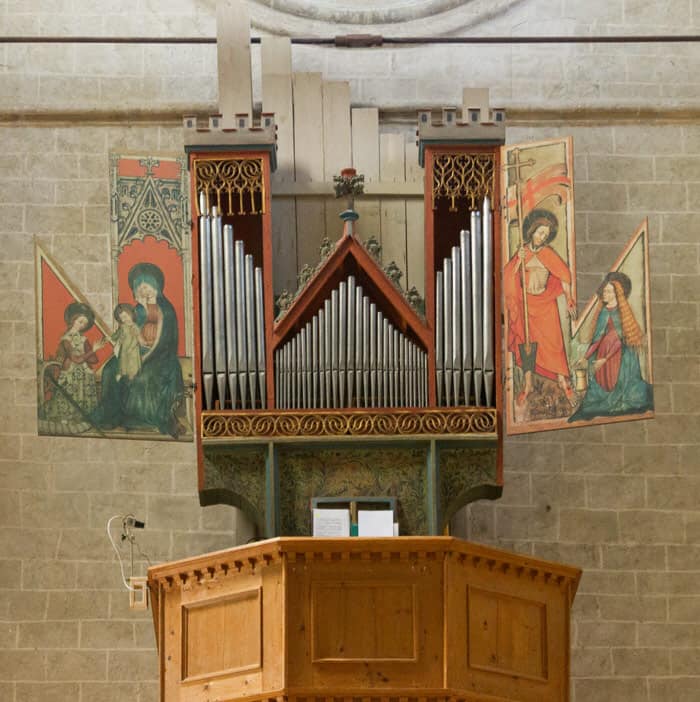
1435 - Sion, Switzerland
Valeria Kirche of Sion Switzerland has an organ whose case dates to about 1435. Many of the original pipes still exist in the existing organ. There is also a wooden Coppel 4', dated (dendrochronology) to 1390. I presume it was added during the 1687 rebuild, because what is the point of a 4' Flute in a blockwerk?
Judging from surviving pipes, it's original blockwerk was probably 8', 4', 3', 2', 1-1/3', 1' and 1/2'. In 1687 Christoph Aebi rebuilt the instrument, adding several stops and expanding the keyboard while keeping the original case. He also added stop control, breaking the blockwerk into individual ranks. Because of frequent revoicing and rebuilding over the centuries, we have no idea what it originally sounded like. Even the case has been modified, and those dreadful, hugh Bourdon pipes were added, behind the organ.
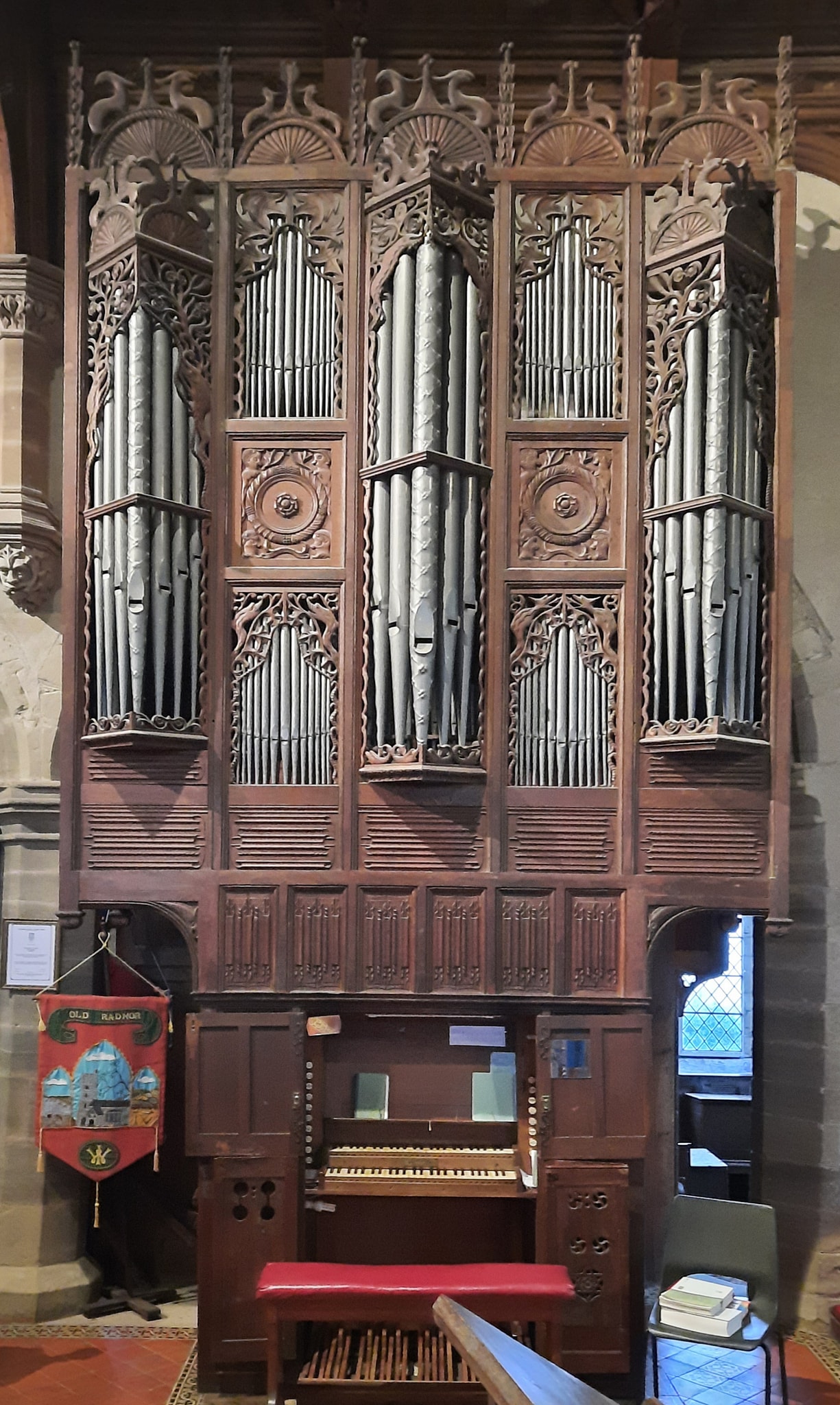
1500's - Old Radnor, Powys Wales
To the left you can see the early 16th Century case at St Stephen's Church, Old Radnor, Powys Wales. This case is the oldest in England, built just at the transition from gothic to renaissance designs. Only the case remains; chest, keyboard, action, pipes and bellows are all lost. Sutton had a new organ built (1871) inside the old case, though he tried to preserve the old case. The biggest pipe in the facade is an 8' F (6' organ.
The case is 5 meters high, 3 meters wide but only 800 mm deep, showing the gothic preference for shallow cases. There was evidence of several primitive stop actions, hugh side levers that could e moved by the bellows pumper. Sutton (1871-rebuilder) claimed there was evidence of 5 stops though there is space for more.
Gothic Blockwerk Files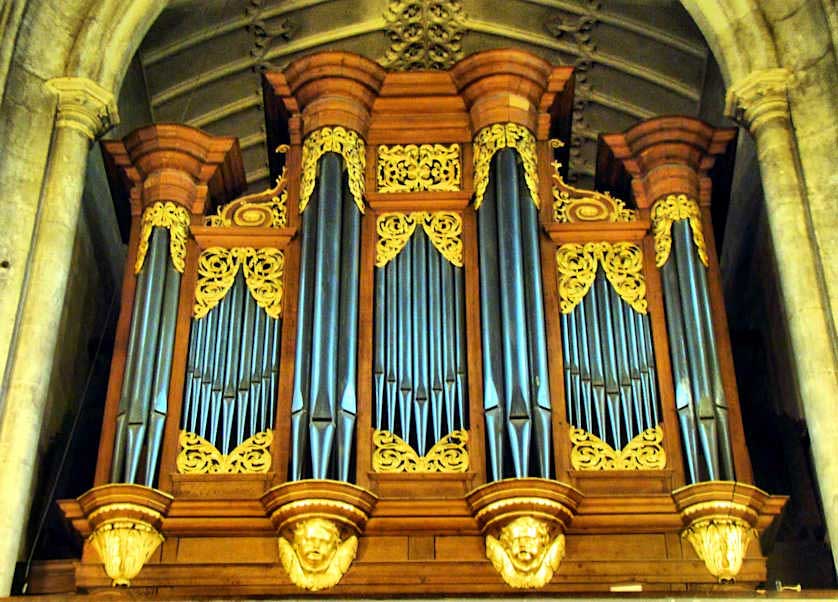
Renaissance Organs mostly Dutch/North German
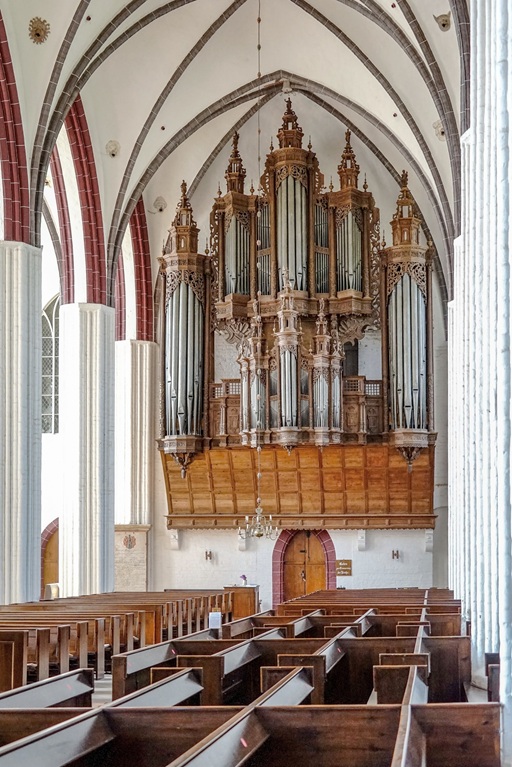
Some of these Renaissance organs have older dates than the Gothic organs. That is because the date refers to the casework and perhaps some of the pipes. Because the organ has been rebuild in the renaissance style, that is it's classification. Most organs get rebuilt every 50-100 years, so these old organs could have been changed many times. (Photo is the 1624 Scherer-Organ in Tangermuende, Germany.)
Many Gothic and Renaissance organs were "F" organs. The compass of the keyboard went from F to A above, with a range of about +3 octaves. These organs were for accompanying human singers, and F to A above was the range of the human voice. An F compass means the biggest pipe in the facade is 6' long. Most of the facades in gothic and renaissance organs are 6' (or 12'). Later rebuilding usually results in the keyboard compass rebuilt as "c".
Of course, a C compass keyboard, with a 6' facade could simply mean coping with a low ceiling...
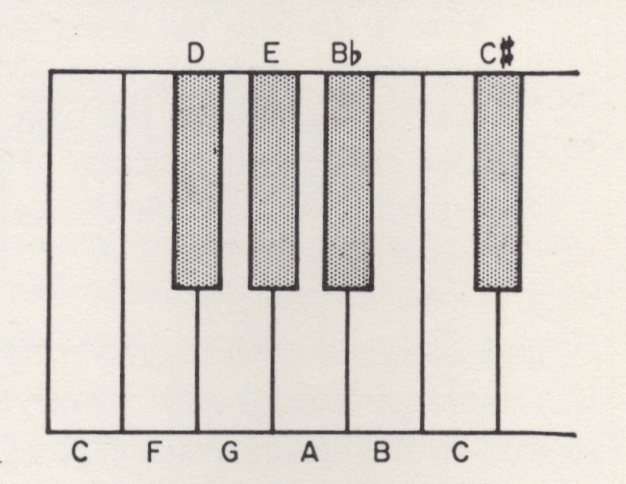
These organs often had a short octave in the bass. You rarely play the # (black) notes in the bottom octave, they are omitted, to save space and cost. There are several variants. In this example, F played the C pipe, F# played D, G played E, G# played F, A played G, A# played A, B played B. From tenor C, the rest of the keyboard was normal.
An F compass means that the biggest pipe in the facade is a 6' pipe, (an F). Large organs with a sub-octave would have a 12' as the biggest pipe in the facade. I find 12' cases to be very balanced and proportionate. Eight foot cases look somewhat squat, and the big pipes of a 16' case oversized. See the photo of the Father Smith organ, Great St Mary's in Cambridge, 1698, with a 12' facade.
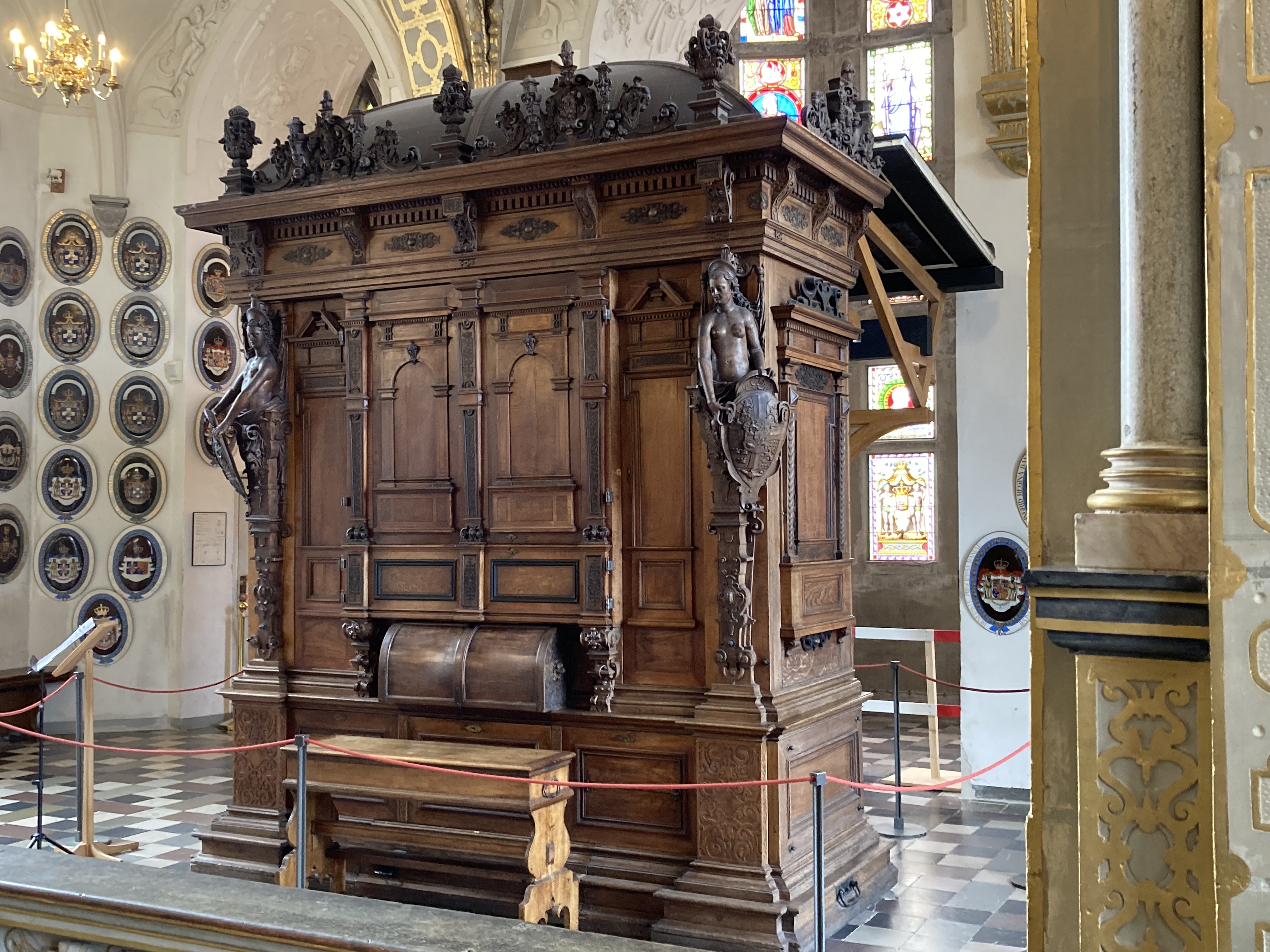
1610 - Frederiksborg Castle, Hillerod
The organ of the chapel of Frederiksborg Castle, Hillrod was built in 1610 by Esaias Compenius. Hillerod is a virgin, but it is a freak organ built for secular purposes for a Royal castle. It is built using unusual materials (ivory and ebony) and all the pipework is wooden. The organ is also a visual treasure. The exterior features intricate carvings by the master craftsman Herman van de Velde, and the visible facade pipes are covered in ivory and ebony, giving the instrument a truly regal appearance . The organ's construction dictates its unique voice. Because the pipes are wooden, the sound is often described as exceptionally soft, gentle, and "velvety" —a perfect representation of Renaissance musical ideals
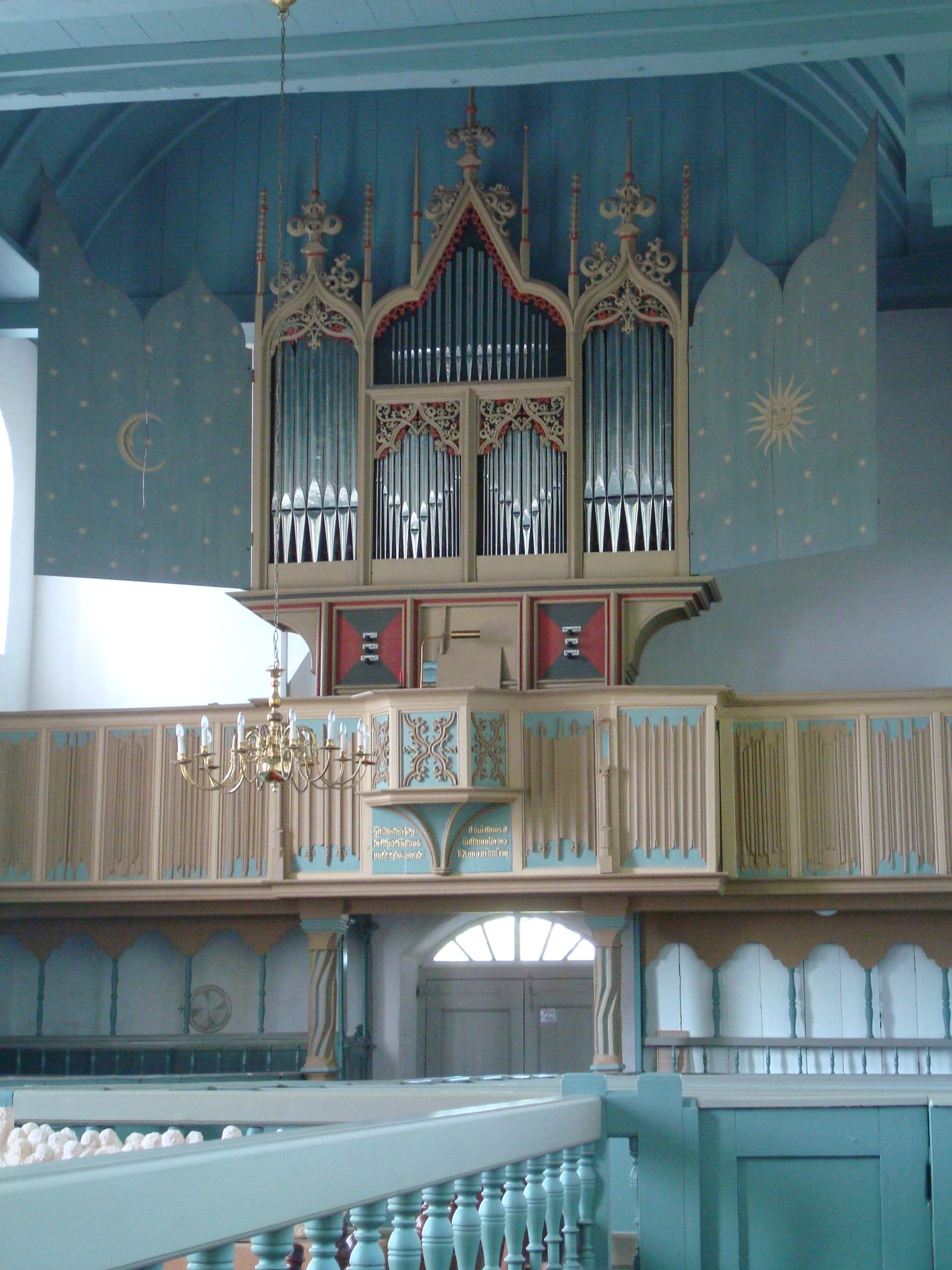
1457 - Rysum, Germany
Rysum, Germany (Ostfriesland) – Dorfkirche. Built by an unknown builder 1457. One of the oldest organs in Germany. Enlargement 1513. Restauration plus reconstruction Sesquialtera, Mixtur and Trompette by Ahrend and Brunzema 1961. The panels with a crescent moon and the sun, removed in 1737, have been reconstructed. No pedal. Pitch circa a’= 440 Hz. Tuning modified Meantone. Manual compass: CDEFGA - g''a''.
- Praestant 8'
- Gedackt 8'
- Octave 4'
- Octave 2'
- Sesquialtera II
- Mixtur III-V
- Trompette 8'
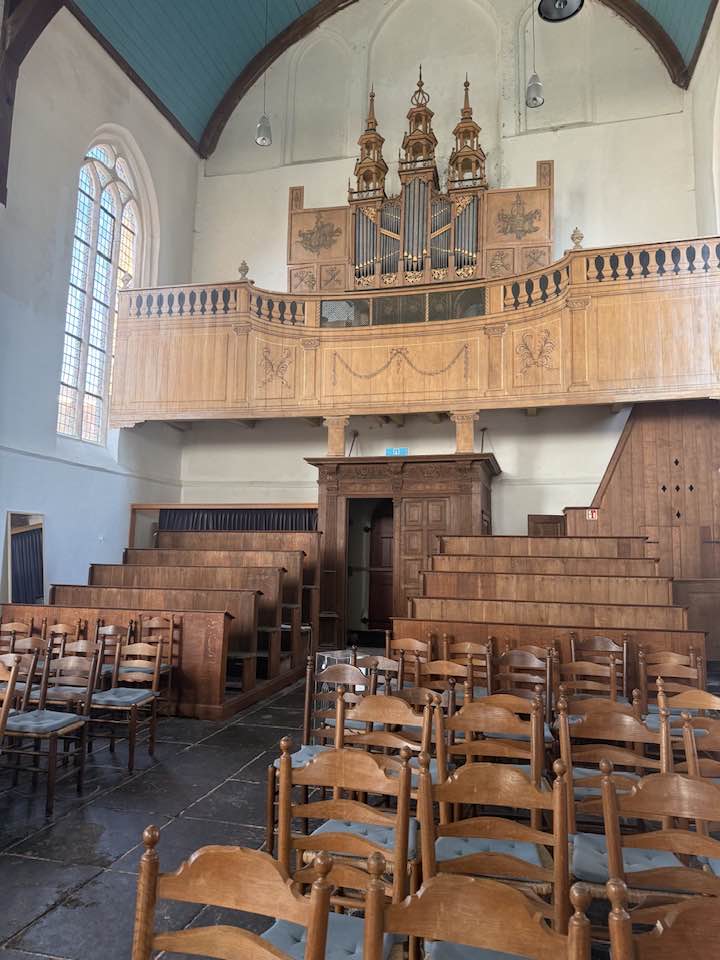
1521 - Oosthuizen
The "Oosthuizen old organ" refers to a historic pipe organ in the Reformed Church (Grote Kerk) in Oosthuizen, a village north of Amsterdam in the Netherlands. It is considered one of the oldest playable organs in the world and one of the best-preserved instruments from the 16th century in Northern Europe . Originally, this was a 6' organ starting at F.
While the organ is often dated to 1521 (the same year the church was completed), the exact origins are mysterious. The instrument is believed to be an amalgamation of parts from even older organs, possibly dating back to the 15th century. A document from 1548 confirms an organ existed at that time, and a later 17th-century restoration likely added some of the current stops.
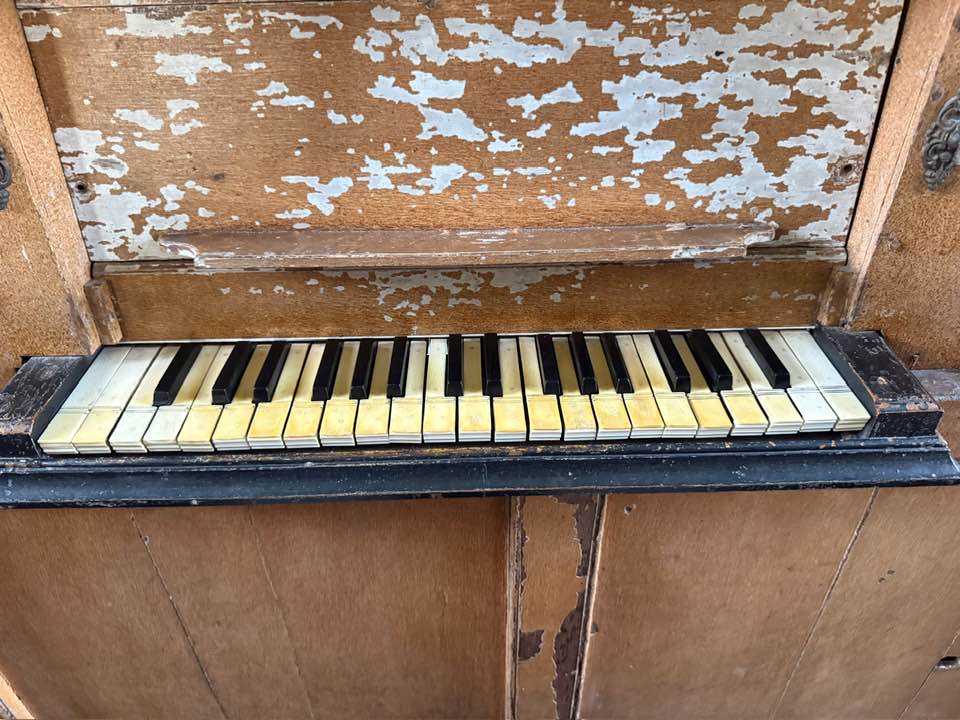
Of special interest is the short-compass keyboard, starting on F. It is a modestly sized instrument with a single manual (keyboard), no pedals, and (today) with just seven stops.
- Bourdon 16′
- Praestant 8′
- Octaaf 4′
- Quint 2 2/3′
- Woudfluit 2′
- Sexquialter II
- Mixtuur II-III
- Tremulant
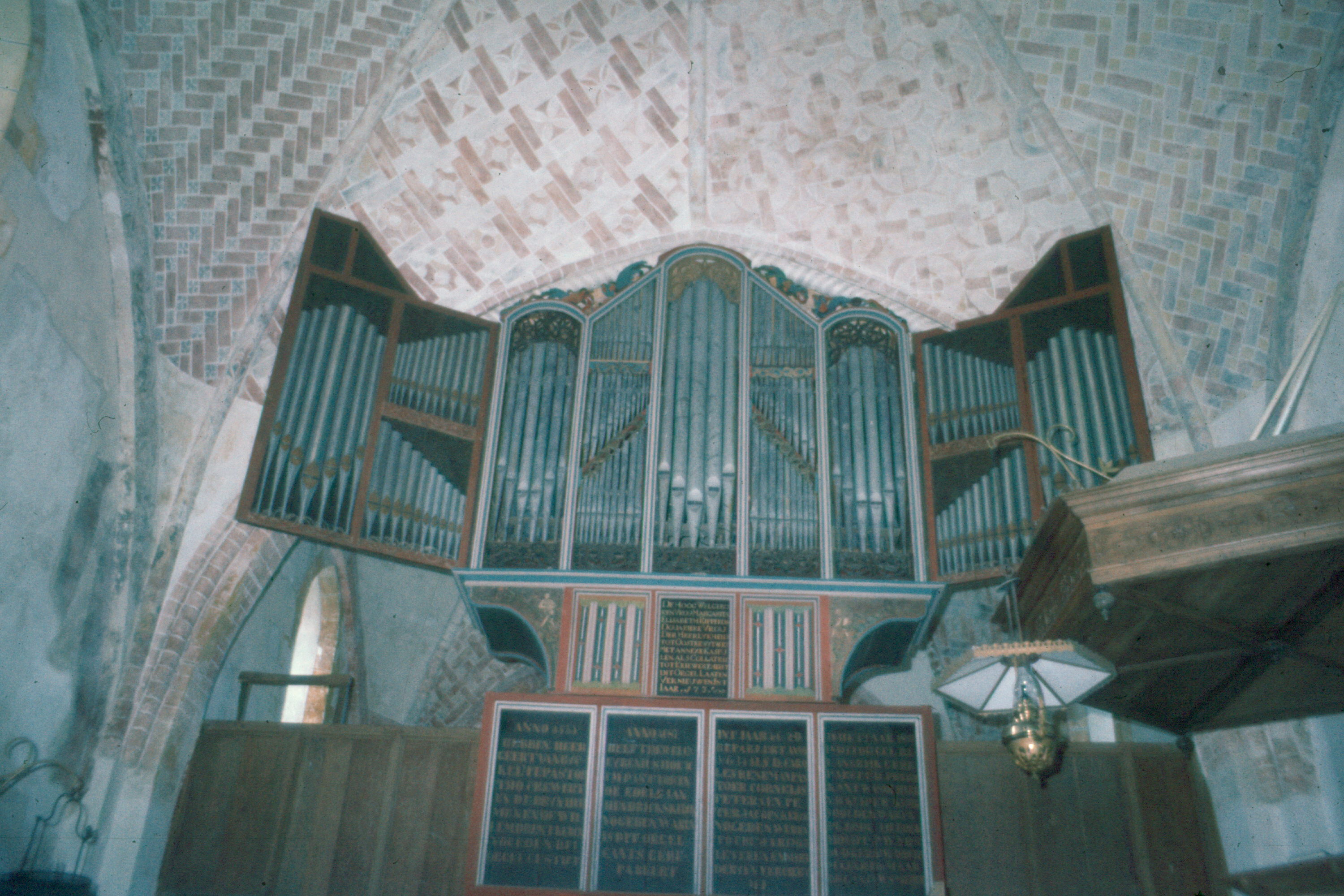
1531 Kreward, Groningen
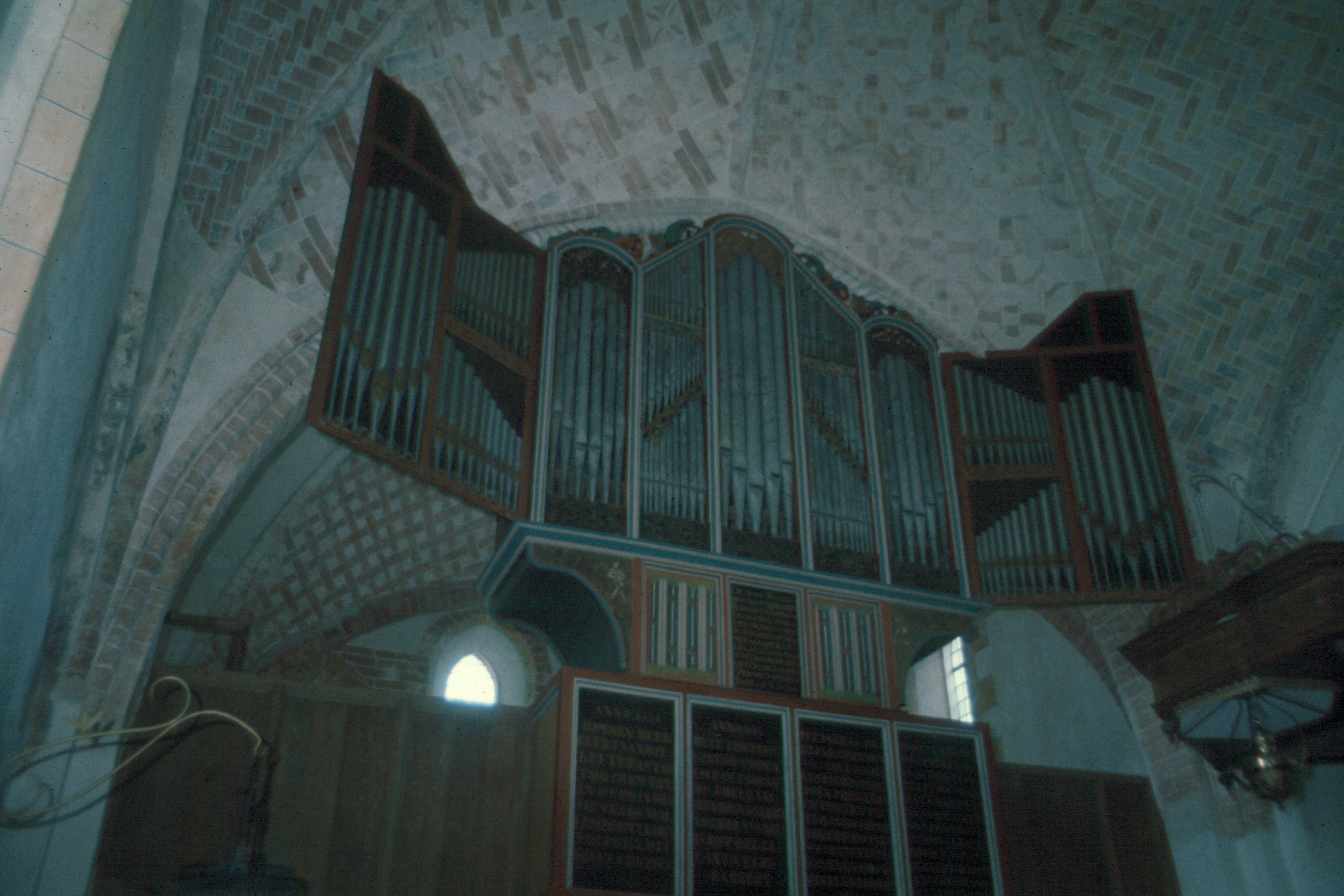
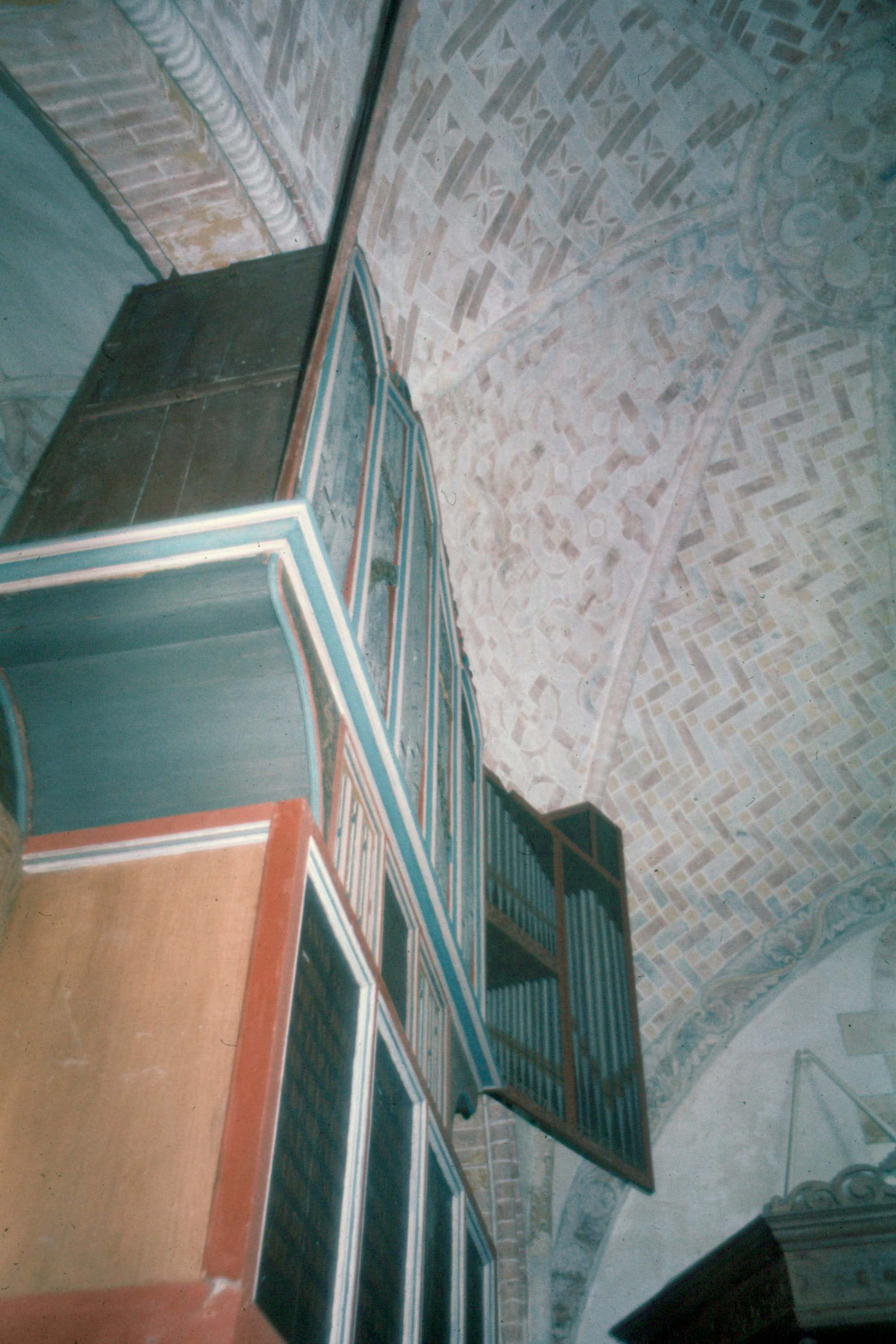
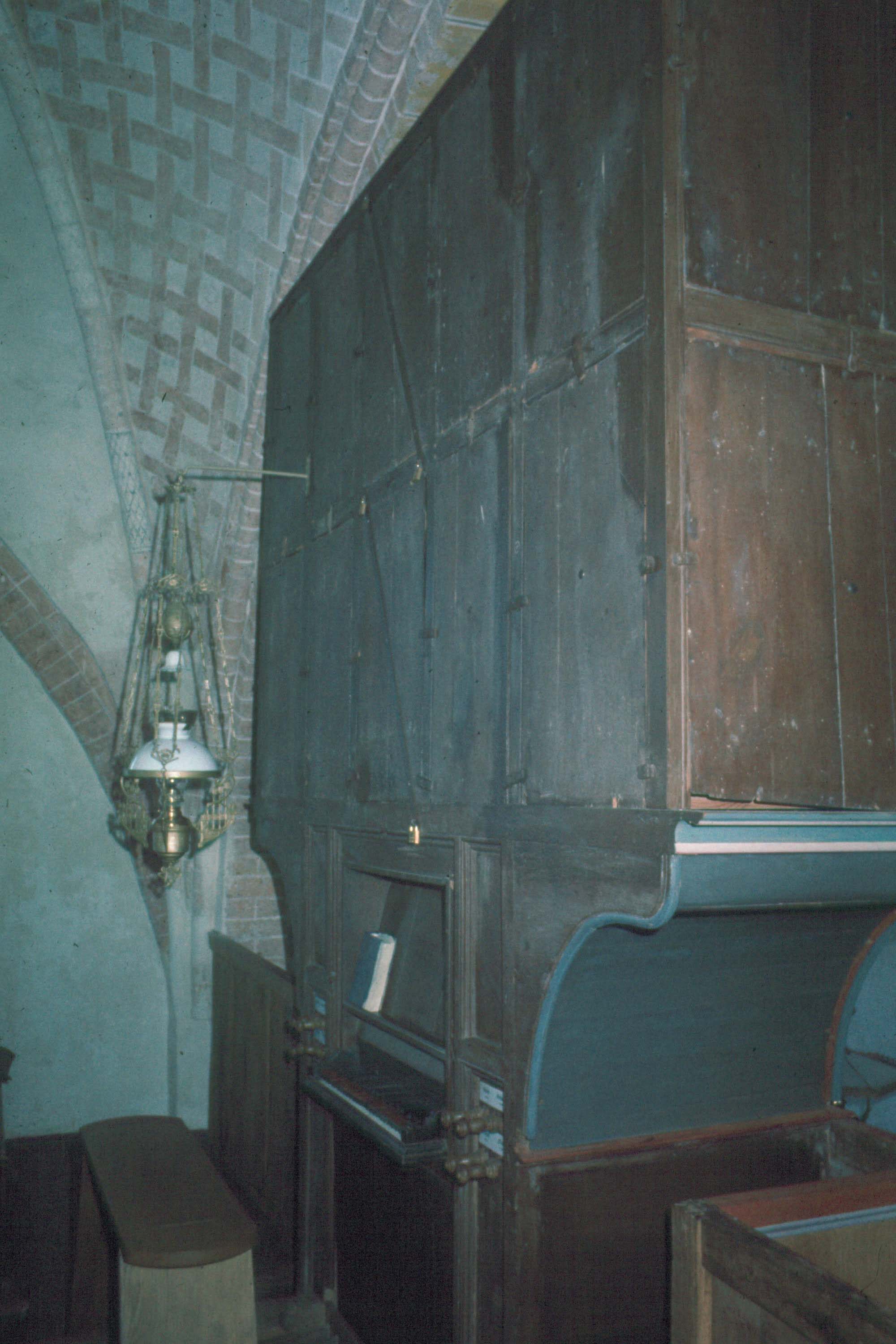
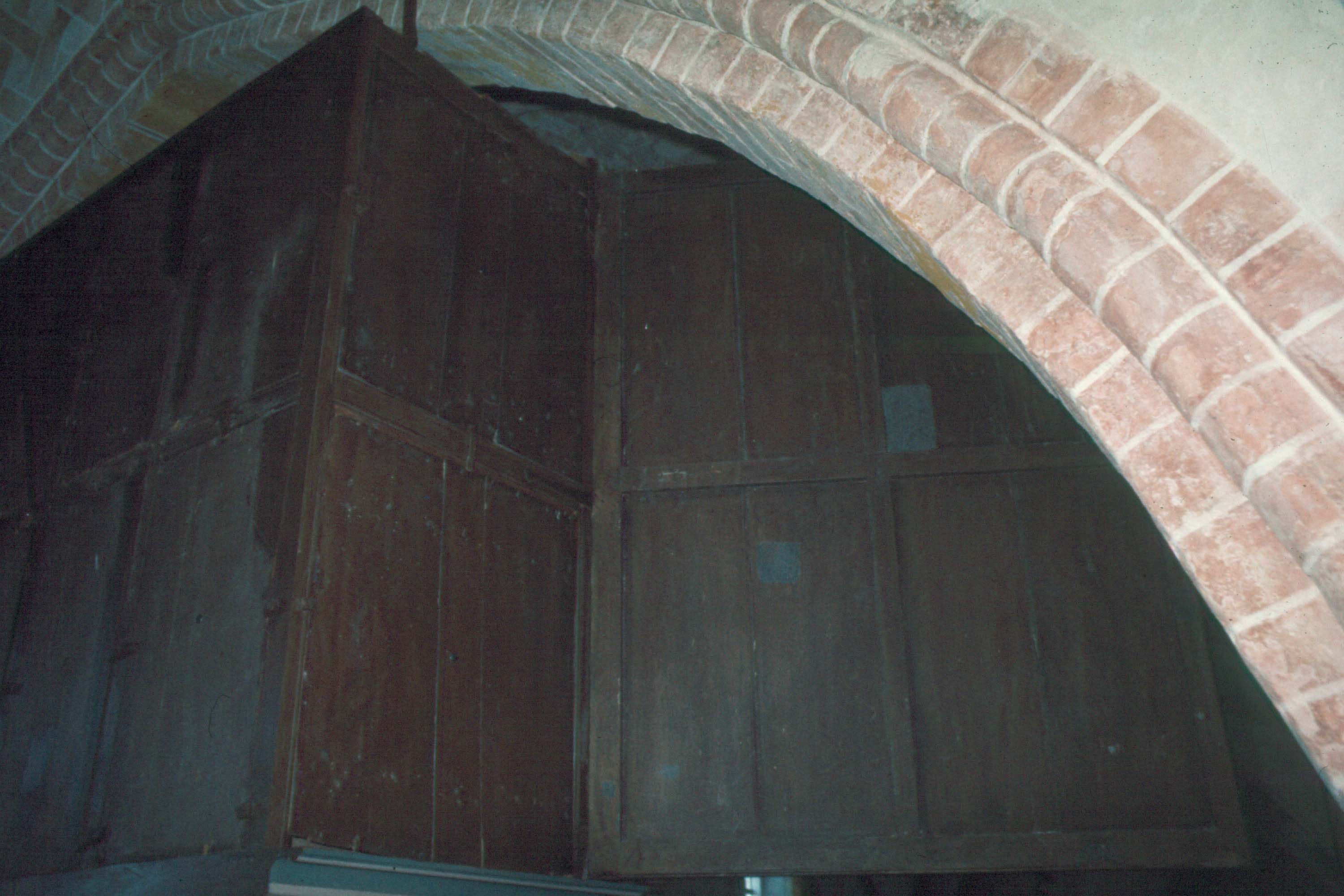
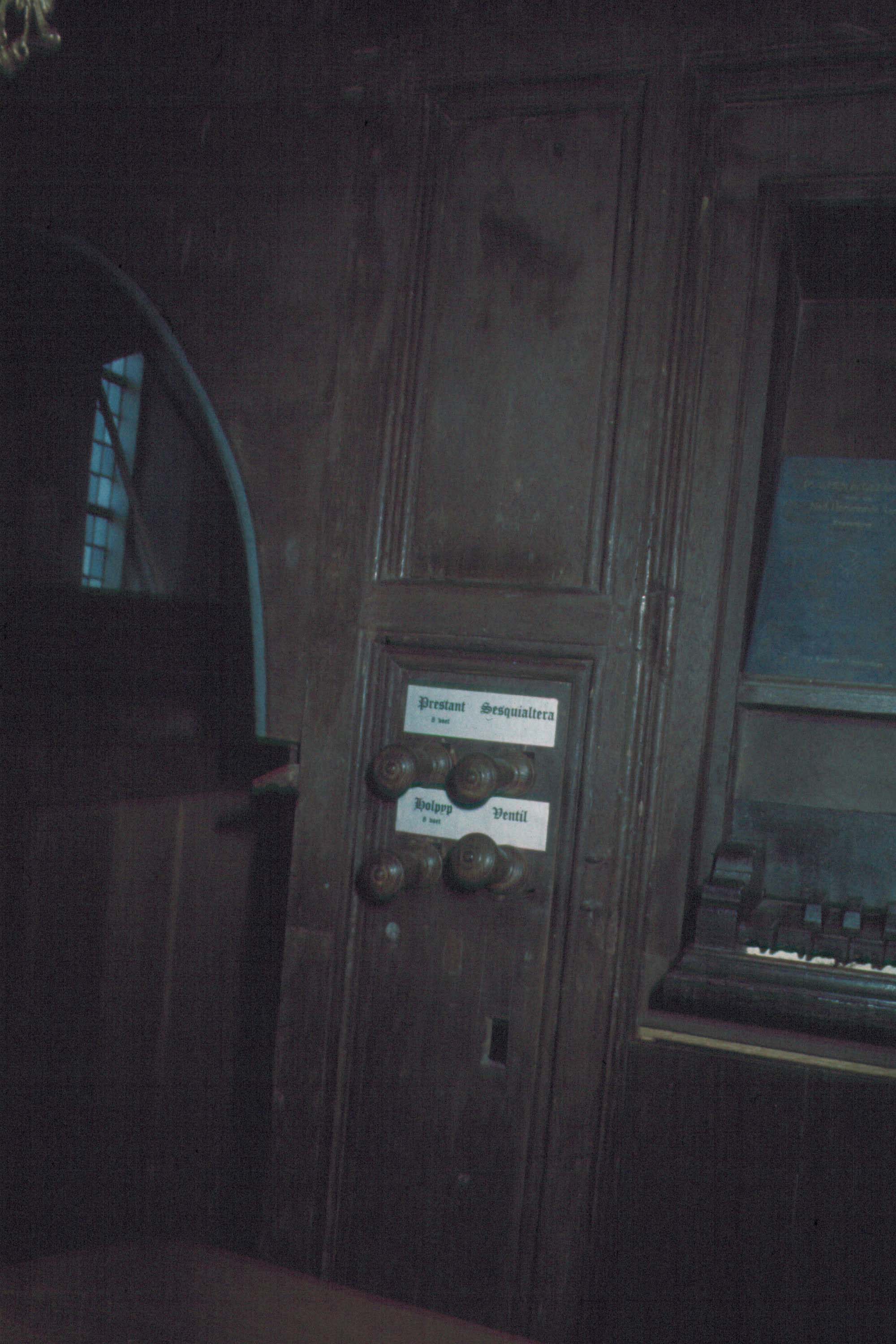
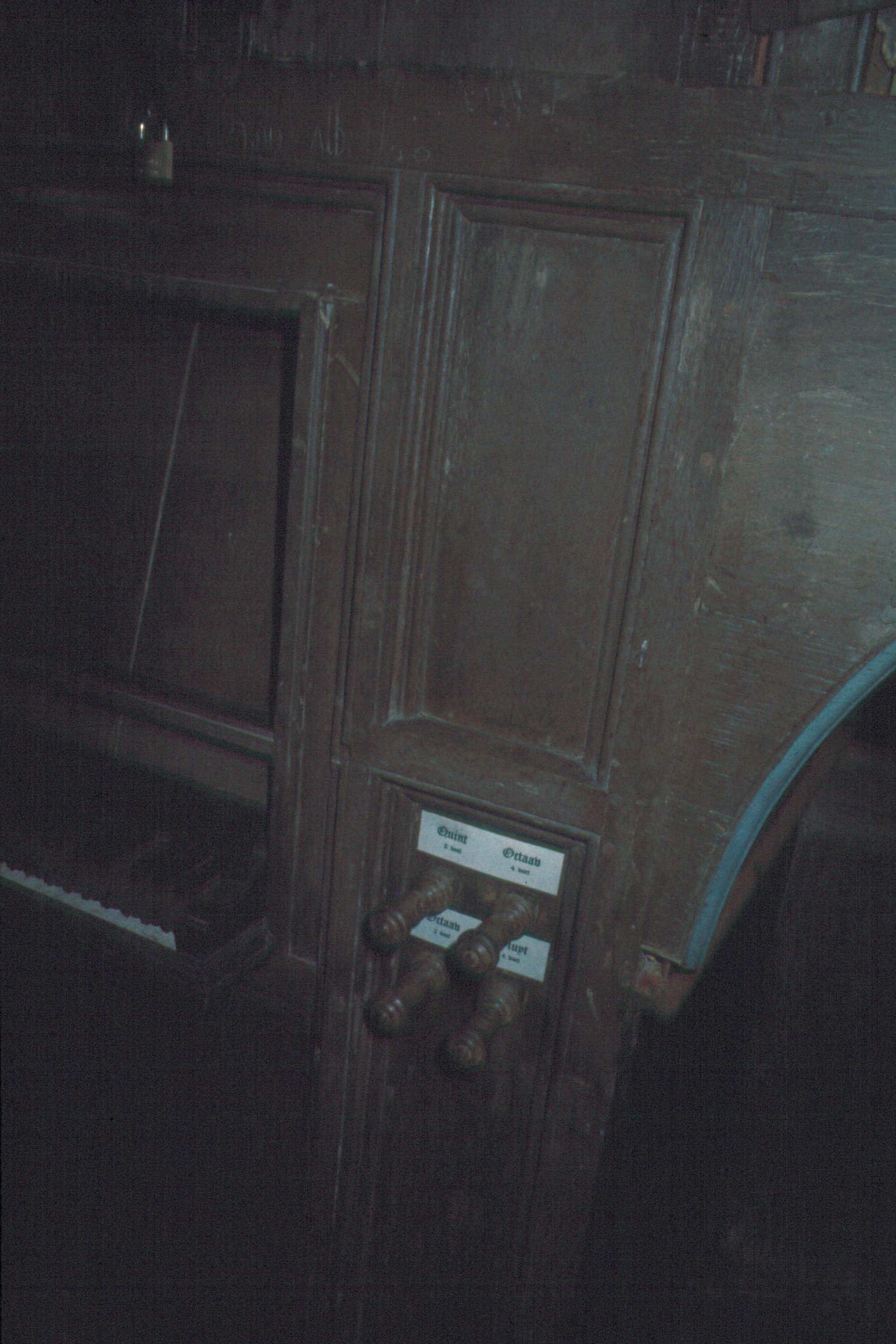
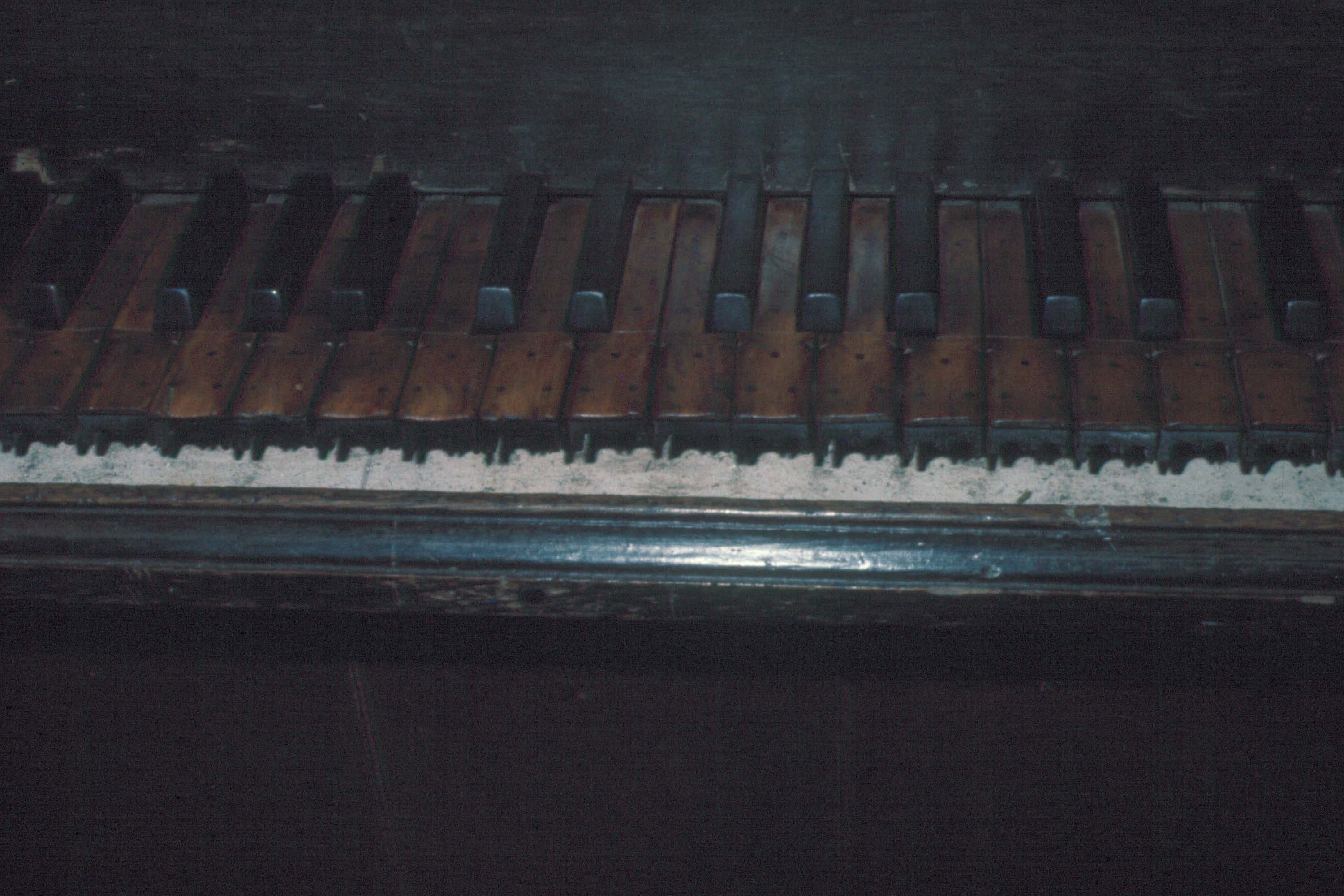
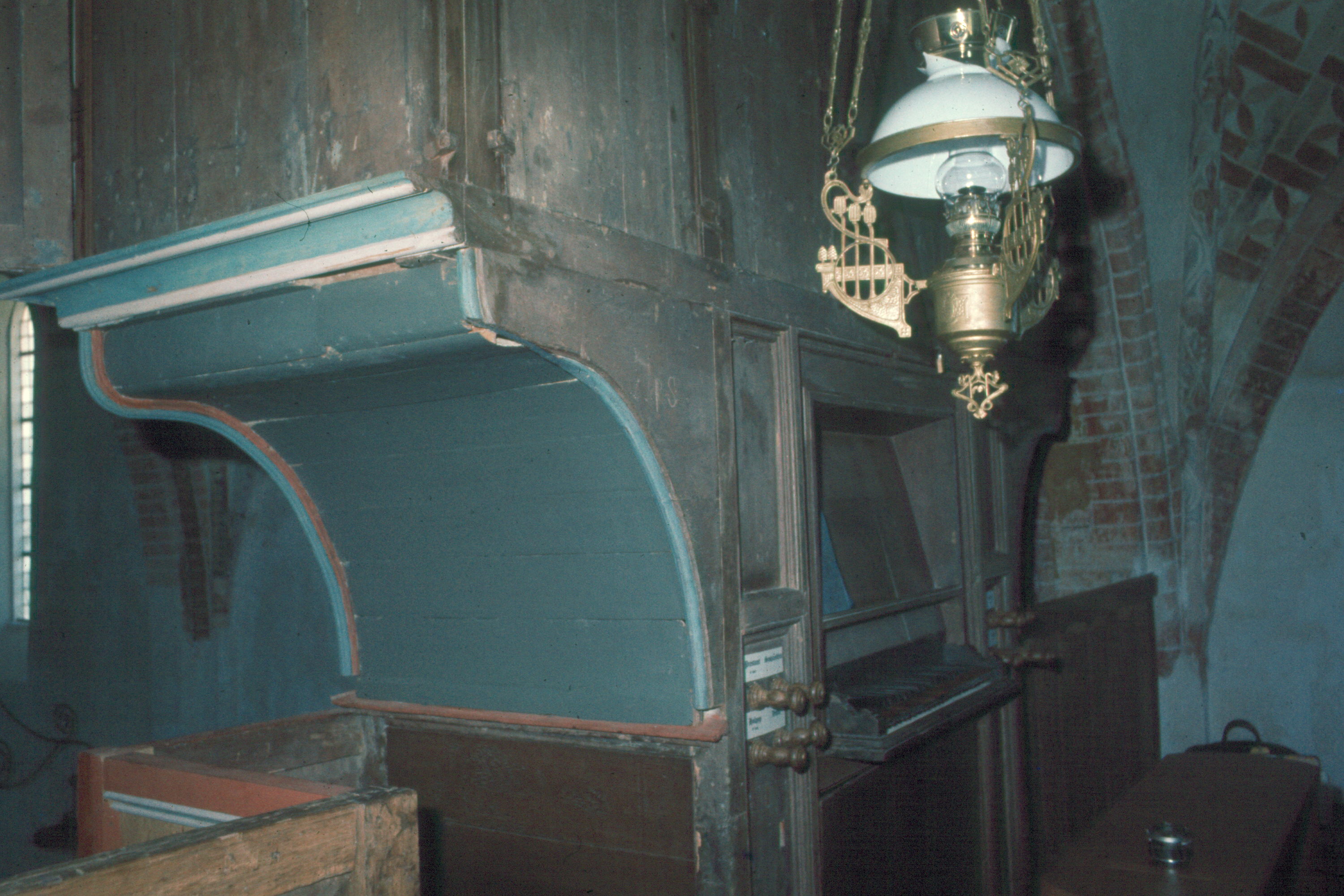
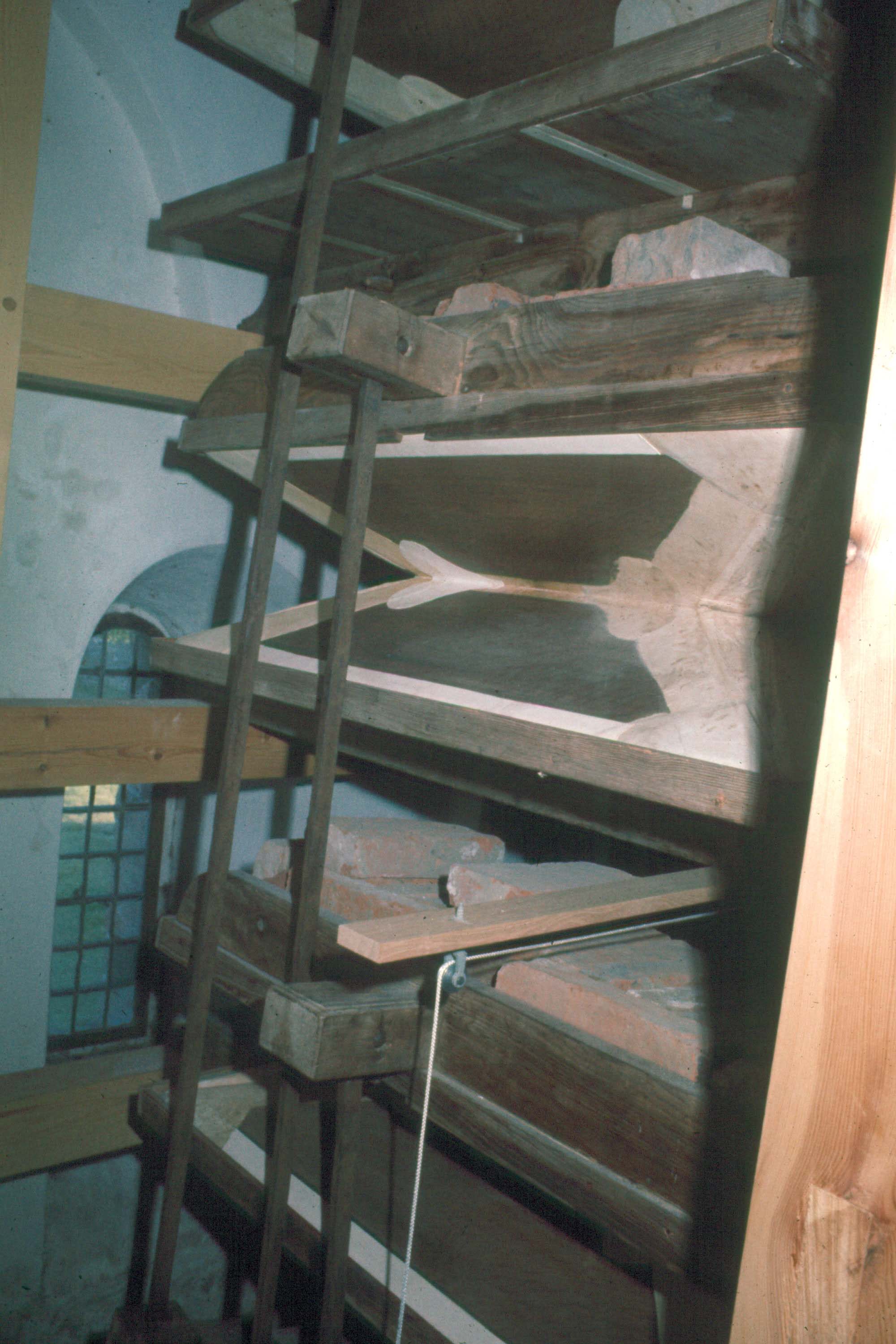
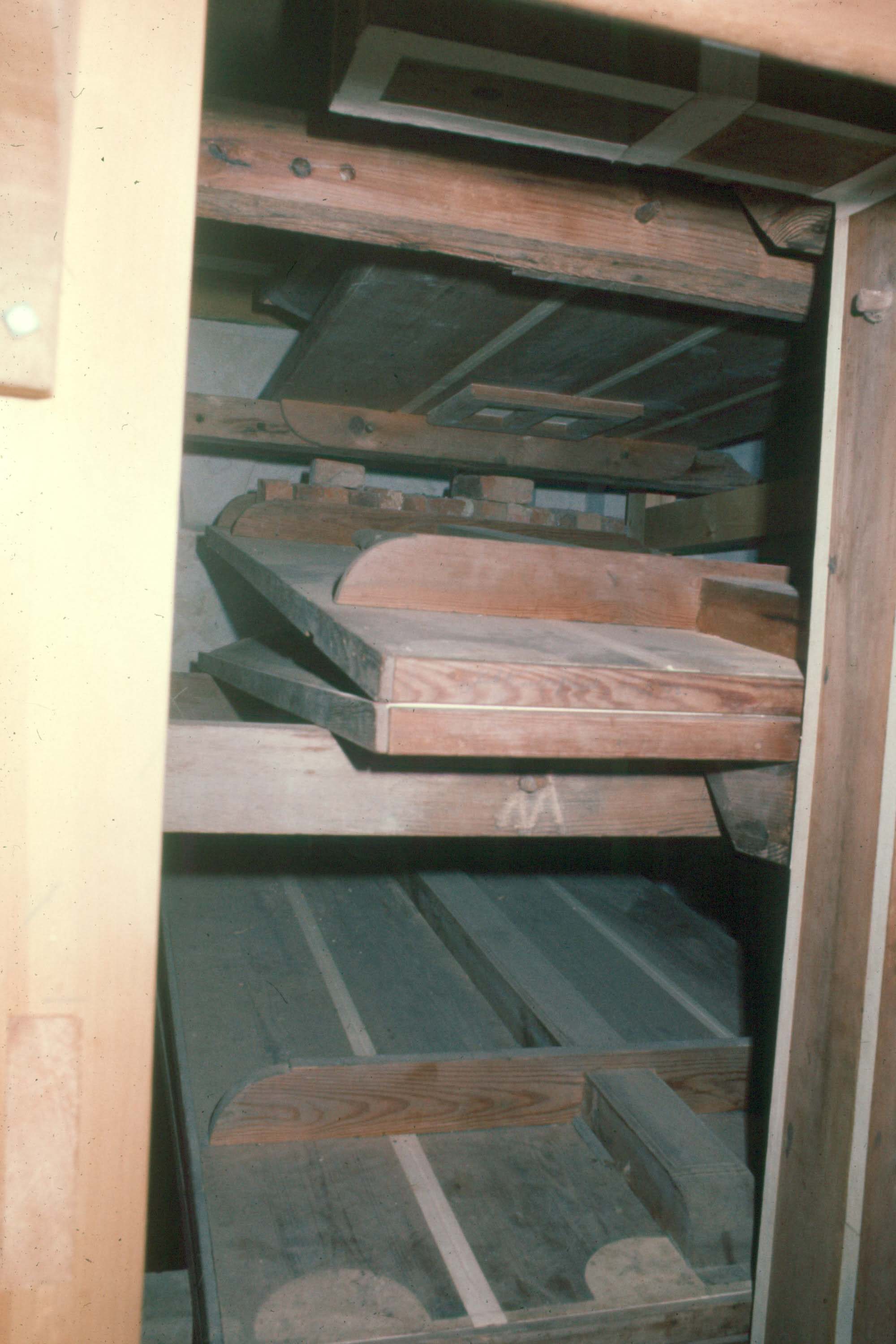
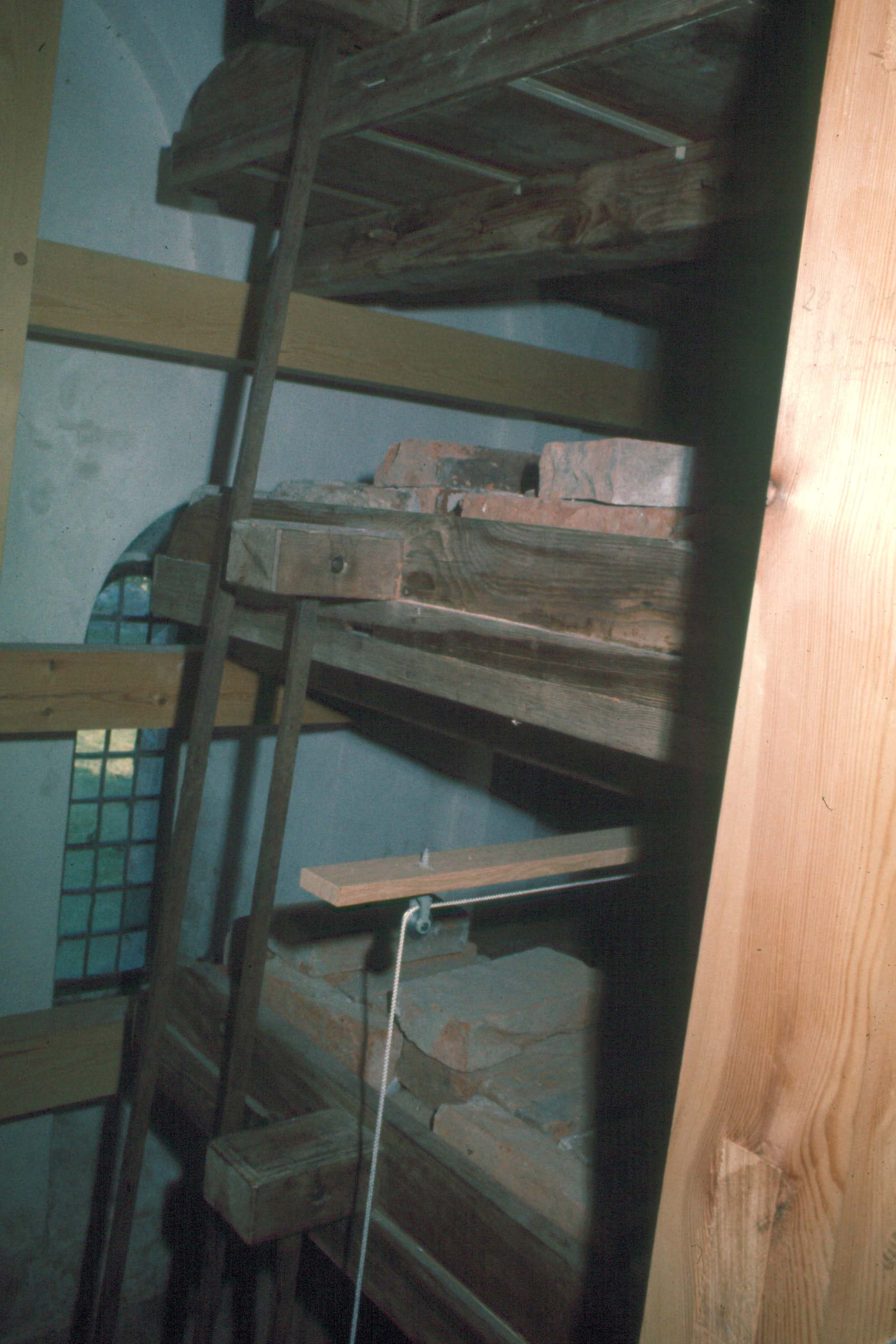
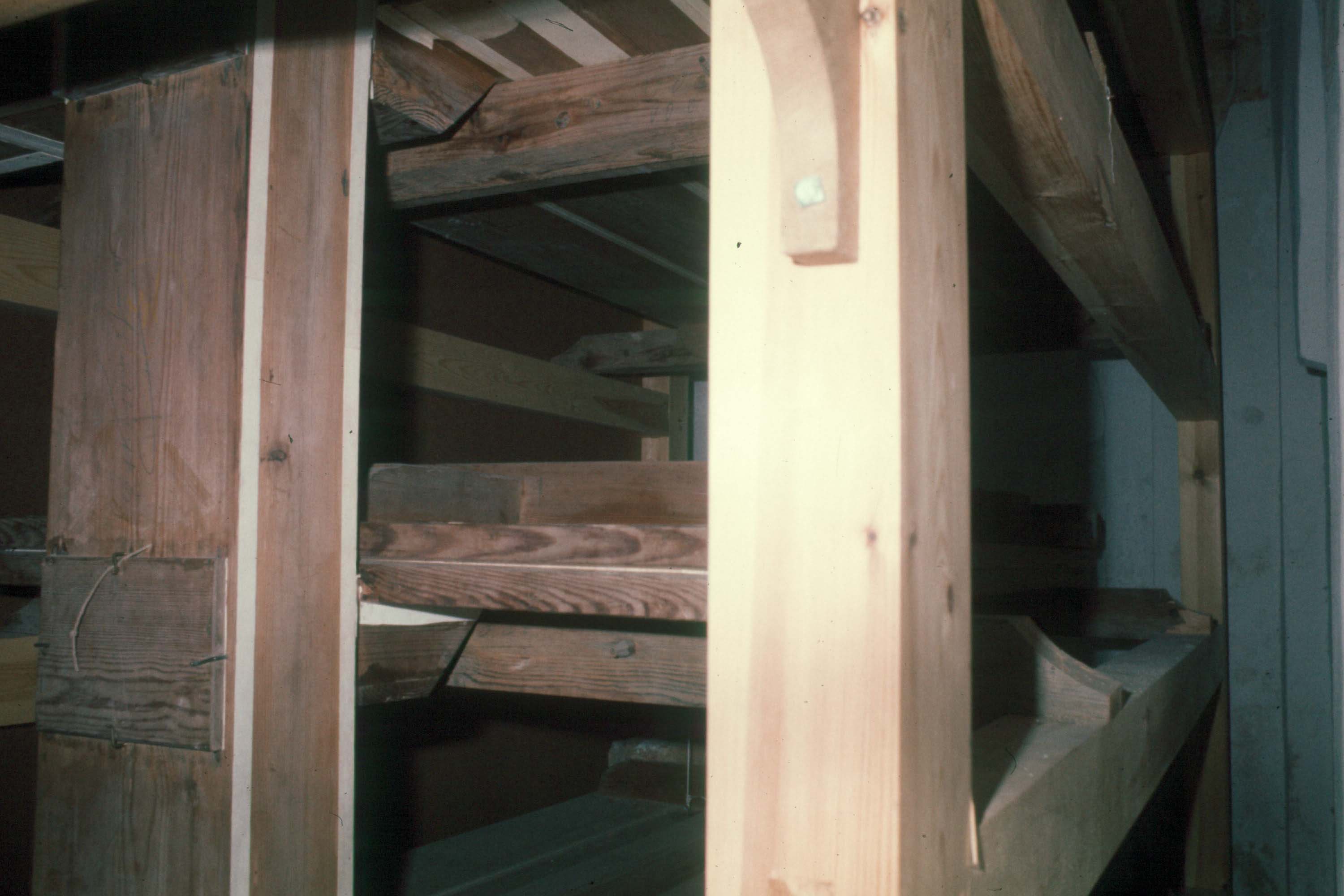
These are my photos of the 1531 Renaissance Organ in Kreward, Groningen, which I took during a visit in 1977. The church was a small building in the countryside. The upper casework with the pipes was padlocked. Click on a photo for full size view.
Built in 1531 by an unknown builder. It is the second-oldest playable pipe organ in the entire Netherlands (the oldest is from 1511 in Alkmaar). It is housed in the Mariakerk (Mary's Church), a medieval village church in Krewerd, a small village in the municipality of Eemsdelta with a population of around 75.
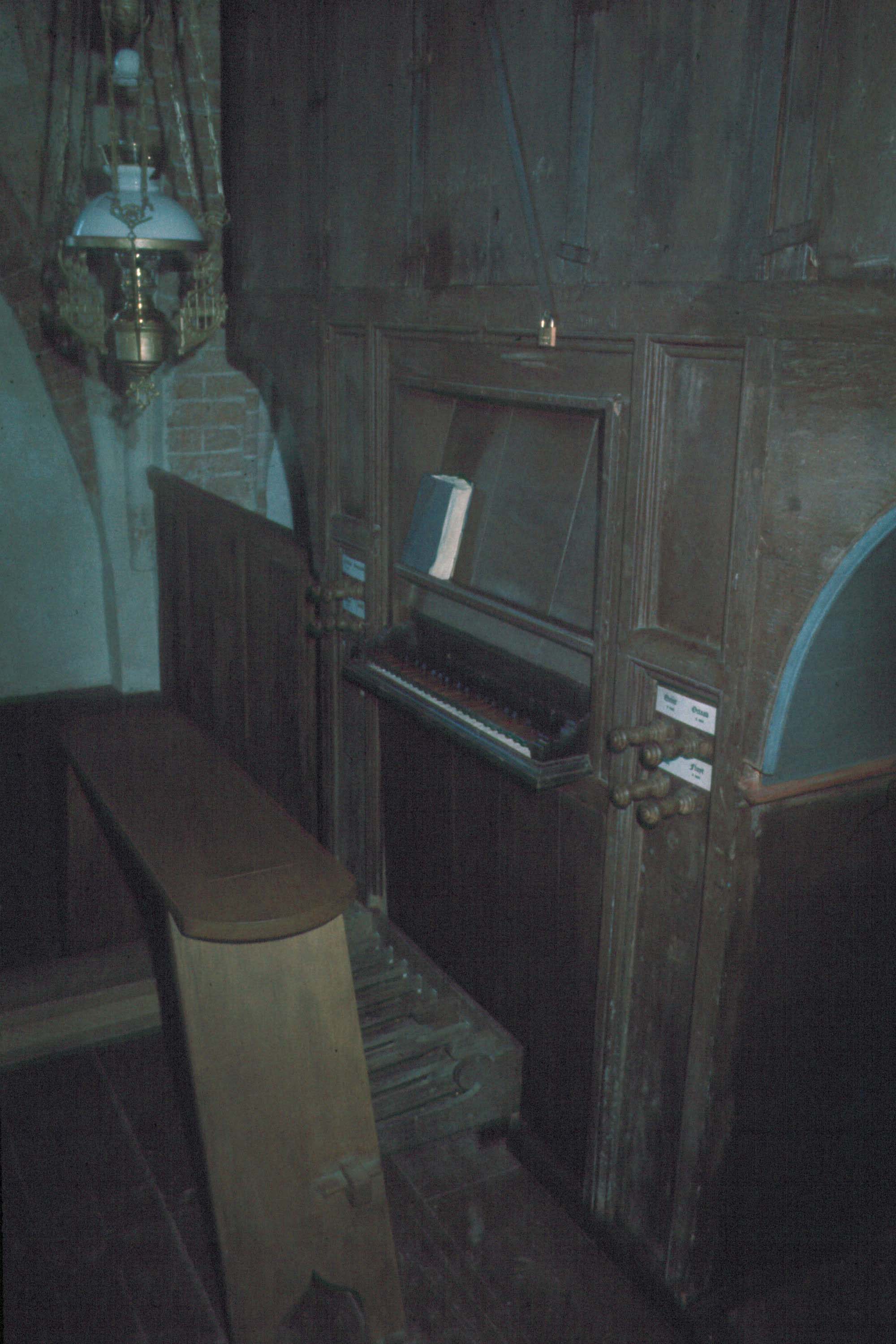
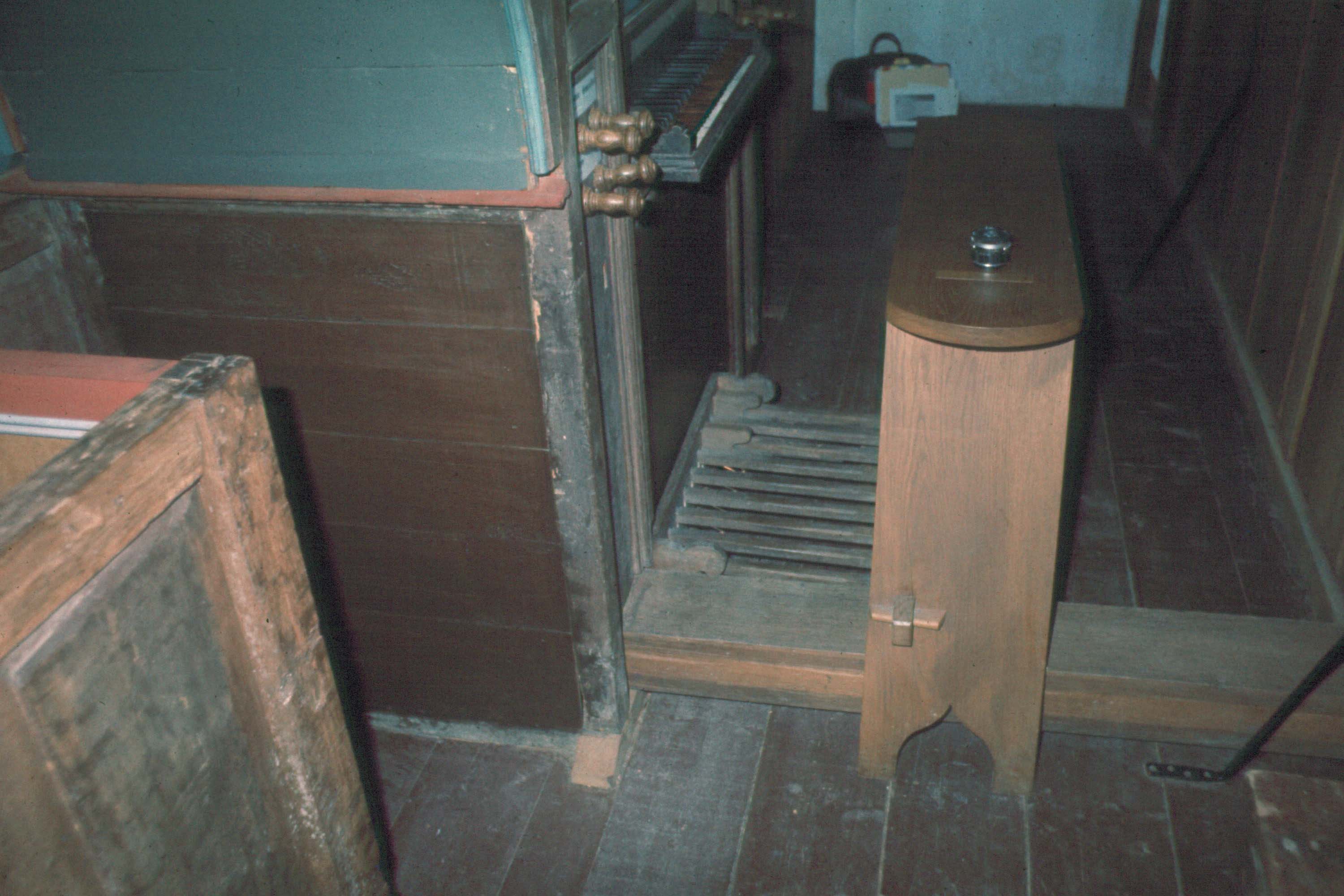
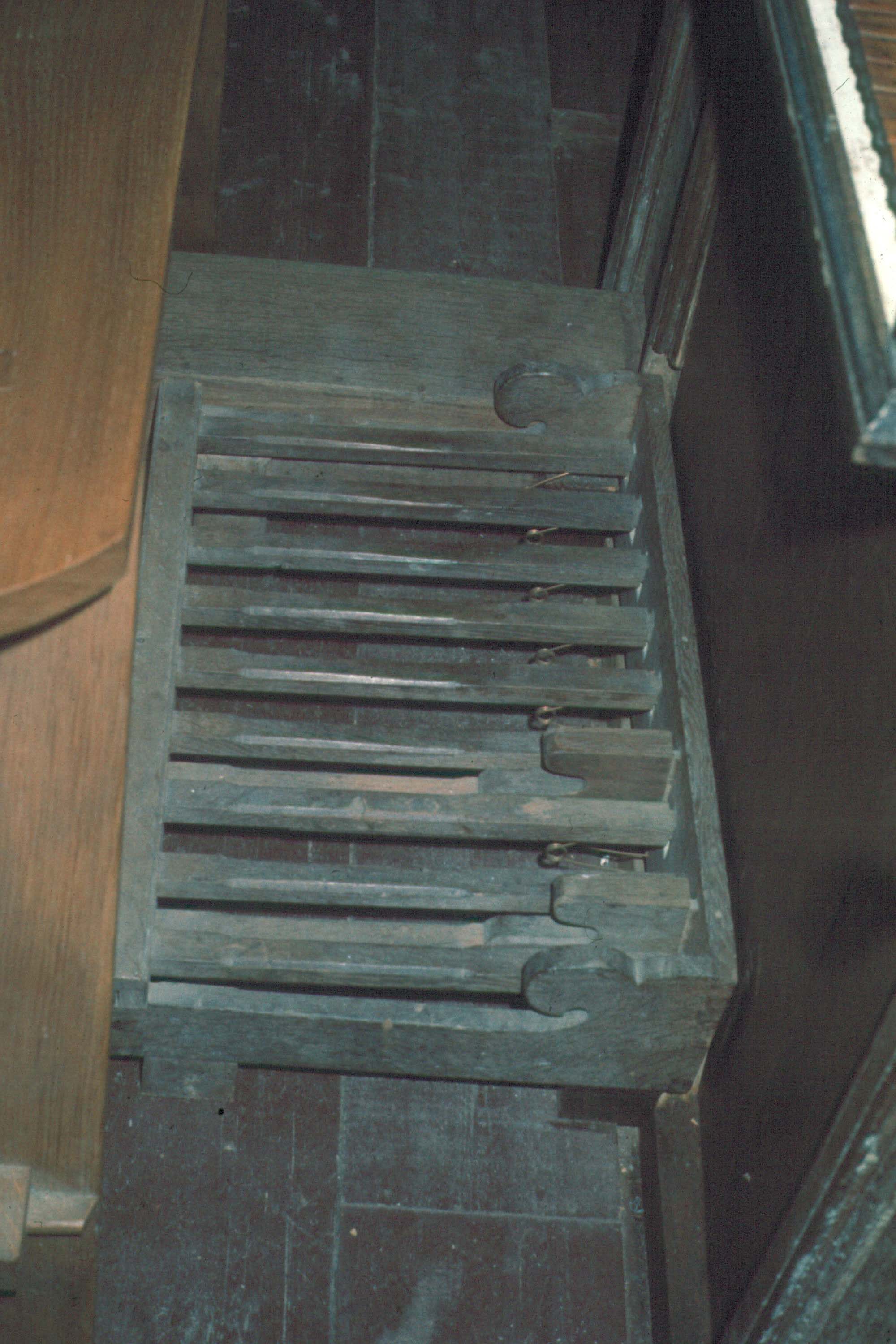
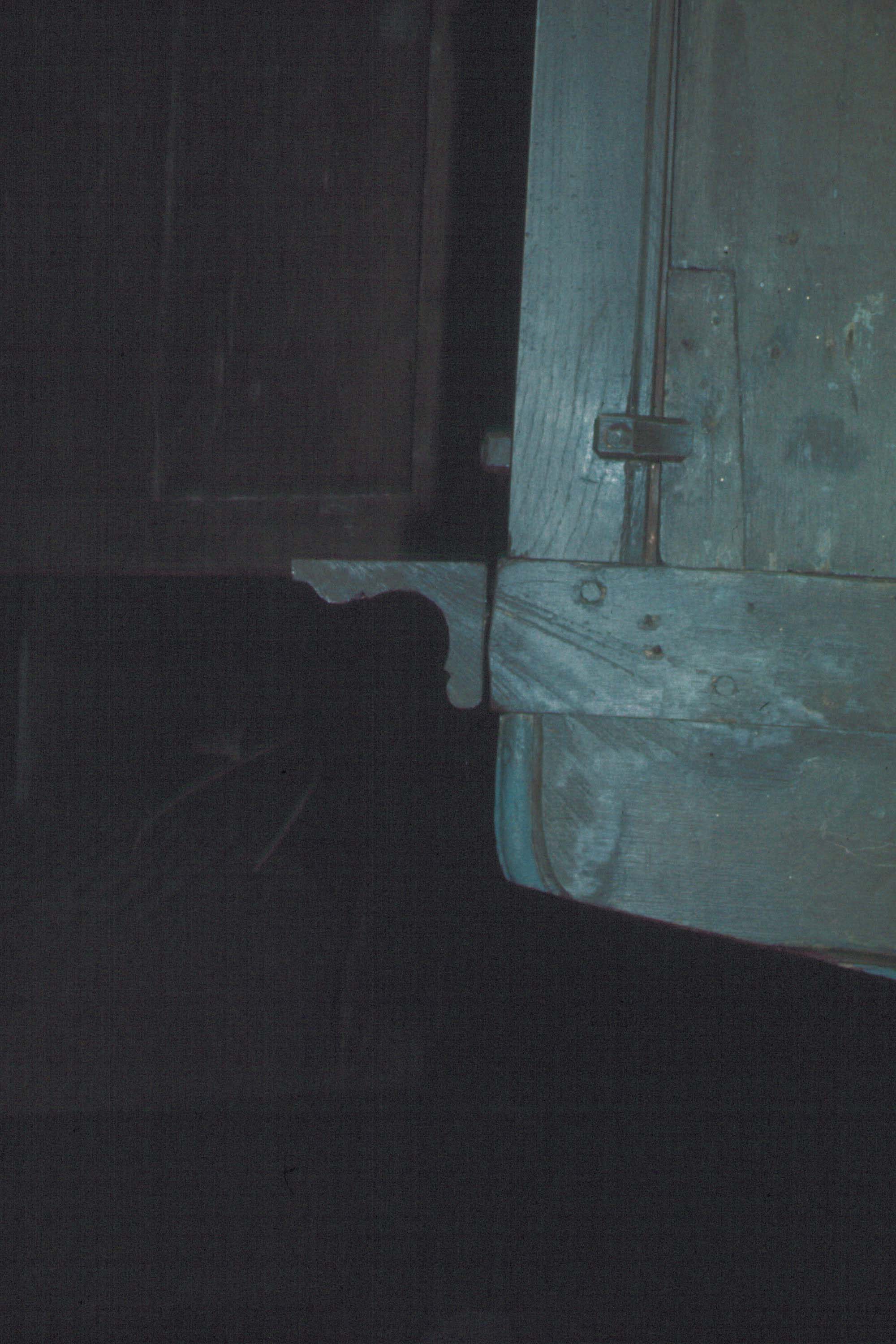

- ~1450, rebuilt 1513 - Rysum, (Ostfriesland) scales
- 1511 - Alkmaar, Grote Kerk, Small organ
- 1511 - Alkmaar, Grote Kerk, Small organ, scales 1
- 1511 - Alkmaar, Grote Kerk, Small organ, scales 2
- 1511 - Alkmaar, Grote Kerk, Small organ, scales 3
- 1521 - Oosthuisen - Church history
- 1521 - Oosthuisen - Chest details 1974
- 1521 - Oosthuisen - Casework mouldings
- 1521 - Oosthuisen - Scales Fisk 1974
- 1521 - Oosthuisen - Scales, Flentrop, graphed
- 1531 - Kreward, Groningen, History
- 1531 - Kreward organ scales - from John Brombaugh
- 1610 - Hillerod, Compenius Organ - Drawings and scales
Gothic-Renaissance-Baroque, What's the Difference?
Gothic Organs
Gothic organs were intended to be played one note at a time. Instead of one pipe sounding, a whole group of pipes would speak at once. This was the essence of the Blockwerk. There were no stopknobs, no choice; the organ had no means of selecting individual sounds. This fixed combination is essentially a single, giant chorus, 8', 4', 3', 2', 1-1/3', 1' and 1/2', that was always on. The sound was brilliant, loud, and powerful, designed to fill vast stone churches with a wall of sound. (Photo is the 1624 Scherer-Organ in Tangermuende, Germany.)
But all the pipes had exactly the same scale, voicing and loudness. No matter weather you played in the bass, tenor, or treble, all sounded same pitches, because the same blockwerk pitches (8', 4', 3', 2', 1-1/3', 1' and 1/2') were present everywhere on the keyboard. It didn't matter if you played in the bass, middle or treble, it all sounded about the same.
So the Gothic organ could bang out melodies and and simple two hand polyphony. But you basically got powerful blasts of noise, but it was unchanging tonality and pitch sense, whether you played up or down the keyboard.
Renaissance Organs
Stop controls Not true mixtures, compound stops like flemish cornets new stops Multiple divisions
Baroque Organs
Werkprencip Mixtures
North German Baroque, Arp Schnitger
By the end of the 17th century, North German/Dutch organs developed a consistant style of playing, sound, stoplist, casework (the Hamburg case), best exemplified by Arp Schnitger (1648–1719). Schnitger built in a conservative, traditional, almost backwards looking style of organ, that consolidated and summed up Baroque organbuilding. He is important because so many of his organs survive.
Arp Schnitger (1648-1719) was the idol of the Orgelbewegung. His scaling was very inconsistent between organs, and even within the same organ. This was partly because he enthusiastically recycled pipework from previous instruments. This recycled pipework was very compatible with Schnitger's style of building. Also, Schnitger had the monopoly on organbuilding in the region, so other organbuilders had to work under him as subcontractors, who brought their own methods. And, I suspect pipe scaling wasn't particularly important to him, he could work with what he got. He doesn't seem to be following any mathematical, geometrical, proportional, logrithmetic or additive scaling system.
However, people who enjoy analyzing pipe scales, find Schnitger's organs very frustrating. Certainly the general concepts are correct: a Quintatena is a narrow stopped pipe with low cutups; a Gedackt is a fat stopped pipe with high cutups. But Schnitger Gedackts, for example, can look very different from organ to organ, and even within an organ, for no apparent reason, while still being a Gedackt. When studing his instruments, it is better to step back and look at the big picture, and not get stuck on the details.
The Neo-baroque organbuilders were inspired by what they read of Schnitger. However, when you play a typical chiffy neobaroque organ, with low cutups and narrow flues, one wonders how many of them had actually seen or played a Schnitger? The Neo-baroquists built some wonderful organs, but few would be confused with one of Arp's.
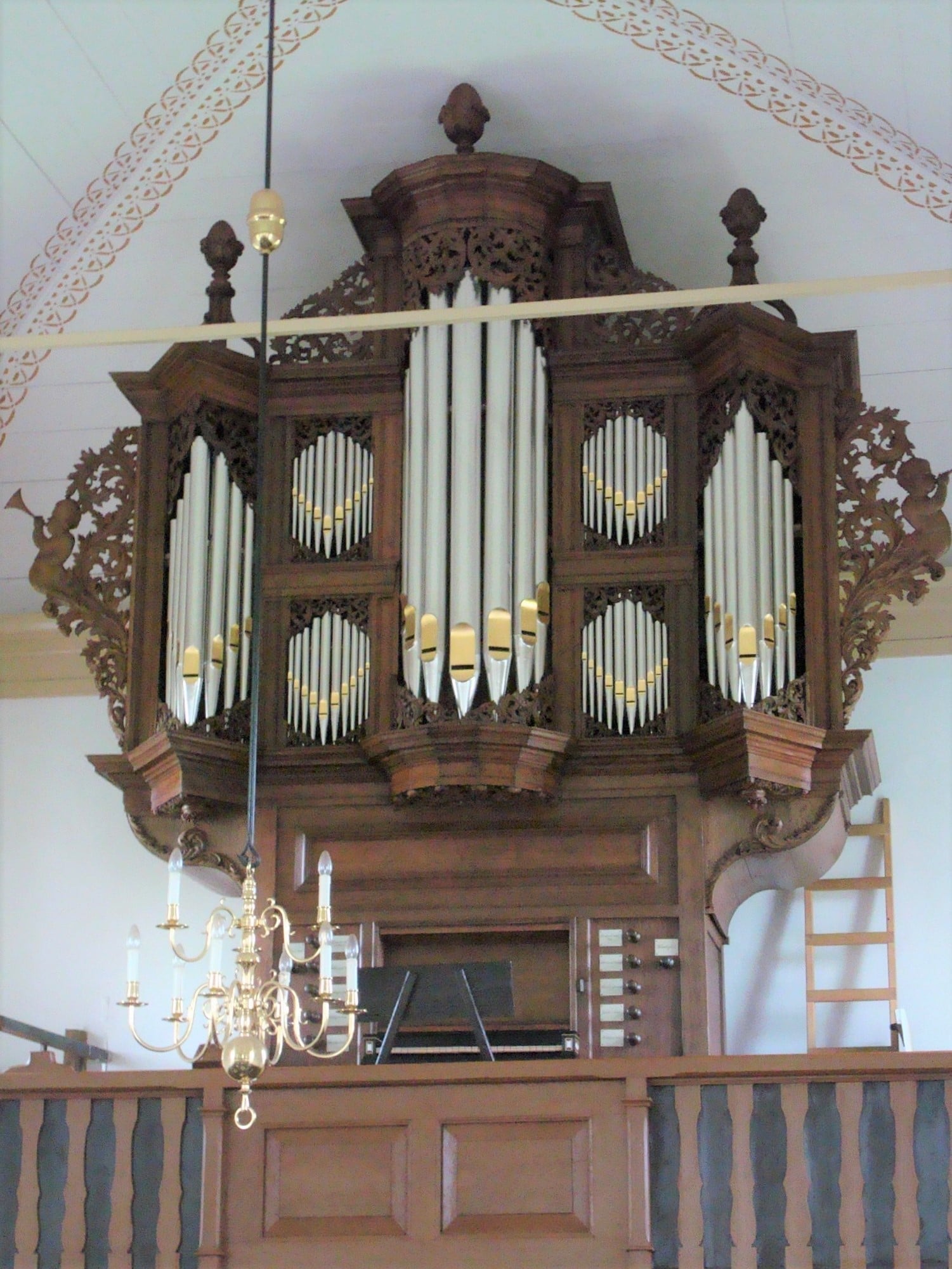
Photo is the Arp Schnitger 1698 organ (typical Hamburg case) in Reformed Church Pieterburen (Groningen).
German Organbuilding Files- List from 1970's of Historic North European Organs
- Structure of the North German Organ - Harold Vogel
- 1671 - Stade, St Cosmae
- 1680 - Cappel, St Johannis-Kloster, 1567 for some pipes
- 1680 - Cappel, St Petri & Pauli - Organ study
- 1681 - Ludingworth, rebuilt 1597 by Wilde
- 1682 - Steinkirchen, Gt scale graphs
- 1682 - Steinkirchen, Reeds
- 1682 - Steinkirchen, - data from Orgues Historiques
- 1682 - Steinkirchen, scales
- 1688 - Mittelnkirchen, with some older pipes
- 1688 - Mittelnkirchen Scale Graphs
- 1691 - Grasberg bei Bremen
- 1692 - Hollern
- 1692 - Norden, St. Ludgeri Church
- 1693 - Hamburg, St Jacobi
- 1696 - Neuenfelde Stoplist, Arp Schnitger
- 1696 - Neuenfelde Scales, Arp Schnitger
- 1698 - Nieuw-Scheemda - world's loudest, smallest Schnitger
- 1645, rebuilt 1723 - Alkmaar, St Laurenskerk - History
- 1645, rebuilt 1723 - Alkmaar, St Laurenskerk - scales 1
- 1645, rebuilt 1723 - Alkmaar, St Laurenskerk - scales 2
- 1645, rebuilt 1723 - Alkmaar, St Laurenskerk - scales 3
- 1645, rebuilt 1723 - Alkmaar, St Laurenskerk - scales - Gr & Chor
French Organbuilding my book
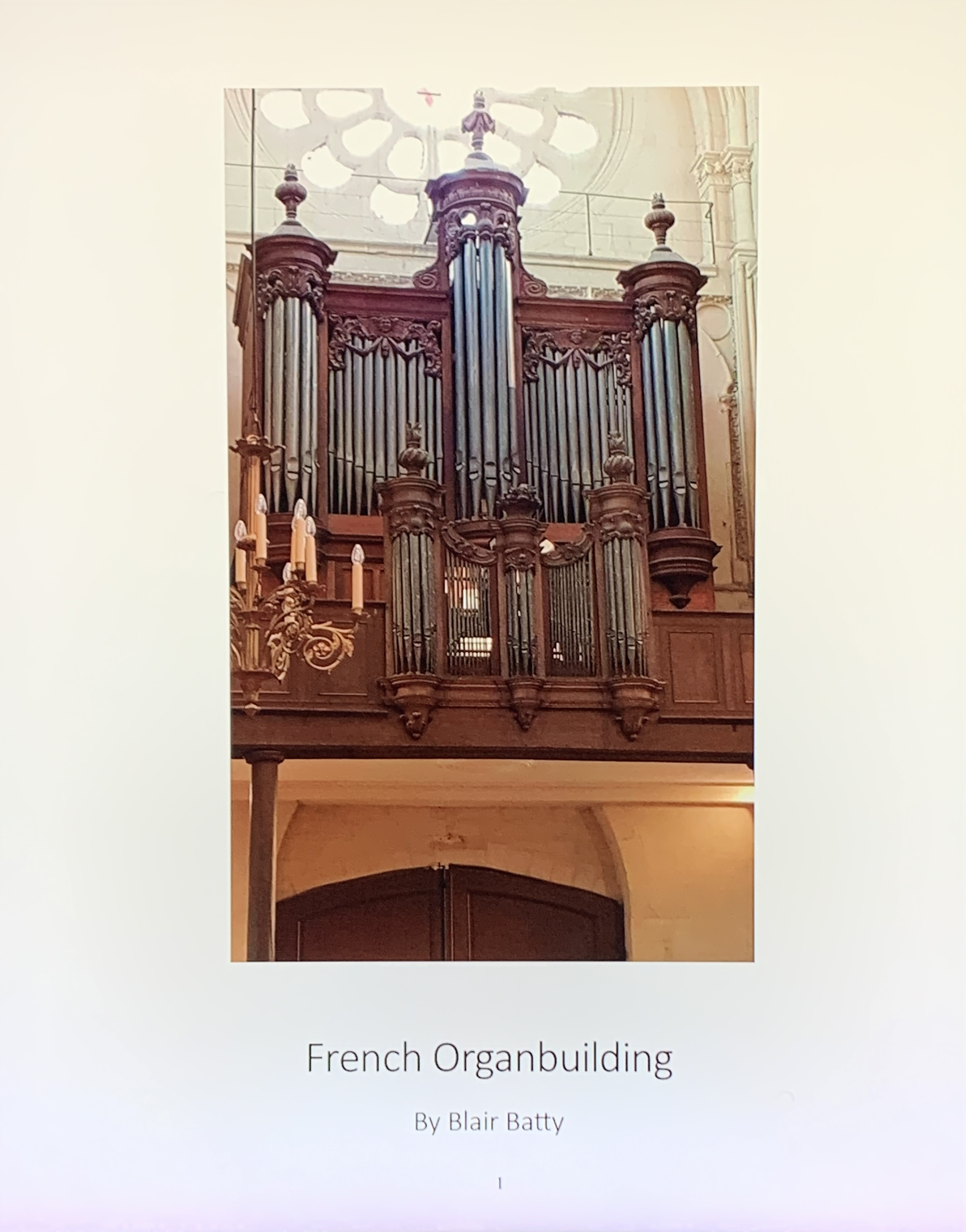
Except for some Andreas Silbermann organs in the Alsace, I have never seen or played a French organ. So it seemed quite logical to write a book about them. I have done some reading about Dom Bedos and Cavaille-Coll and looked in to their pipe scaling methods a bit, so here are my notes about that.
The Classical French Organ (1660-1770)
The French organs of the classical period where uniquely French. They were constructed according to strict rules, to conform to specified appearance, construction, stoplist design and sound. The way the organs where played also regulated, with specific instructions as to how the stops were to be registered and even how the ornamentation was to be played. And thanks to Dom Bedoes and Cliquoit's books, we have those design rules.
Strict Design Rules
The strict design rules of the classical French pipe organ were enforced by the powerful guild system (maîtrise et jurande) of instrument makers in Paris, backed by royal authority. In 1599, King Henri IV officially granted the instrument makers' guild its letters of patent. This created a legal monopoly, meaning only guild members could legally build organs in Paris.
The path to becoming a master organbuilder was rigidly controlled. It required a six-year apprenticeship, followed by a fee and the completion of a "masterpiece" (chef-d'œuvre) to prove one's skill. The guild was run by elected or appointed officials called jurés (jurors) and gardes (guards). These individuals had the authority to inspect workshops and products to ensure all members were following the guild's regulations.
This system ensured a consistent, high-quality "French classical" sound across different builders. It wasn't until the French Revolution in 1791 that these guilds were abolished and the profession was opened to free competition. The guild system ensured that French organbuilding was stagnant and unchanging for several centuries. It was the French Revolution that freed Cavaille-Coll to invent a new kind of French organ.
French Organ Characteristics
The Classic French Organ represented a unique high point in organ building and composition. This period produced a remarkably standardized instrument, perfect for a specific and highly refined musical language. The French Classical organ school reached its peak under the reign of Louis XIV, driven by a strong sense of French national identity in the arts. The most distinctive feature of this school is its division of stops into two contrasting sonic categories. Composers would specify which to use:
1) The Plein Jeu (Full Play): A bright, clear, and powerful chorus based on principal pipes (like 8', 4', 2' ranks). It was often used for strict, contrapuntal writing.
2) The Grand Jeu (Great Play): A loud, majestic, and reedy combination, typically featuring the Trompette and Clairon stops, often with a Cornet to fill out the treble. This was used for grand, declamatory passages.
Uniquely classical French stops were the brilliantly powerful Trumpettes, colourful reed stops: Voix Humaine, Cromorne, Haut Bois, powerful composite Cornet V, and the strong, fluty mutations: Nazard, Quart 2', Larigot, Tierce (basically a decomposed Cornet).
Composers
This era was defined by a close partnership between famous builders (like the Thierry and Clicquot families) and renowned composer-organists (such as François Couperin and Louis-Nicolas Clérambault). Composers wrote "Masses," "Suites," and "Noëls" (Christmas carol variations) that were organized by the modes of the church. The music is highly ornamented and deeply connected to the rhythm and phrasing of French speech and dance.
Classical French Organs- L'Art du facteur d'orgues - Dom François Bedos de Celles - 1778
- Théorie-pratique de la facture de l'orgue - François-Henri Clicquot (1732–1790) - 1789
- My French Organbuilding Book, (It has Dom Bedoes' pipe scales)
- 1689 - Notre-Dame Cath, Rouen, Robert Cliquot
- 1782 - Souvigny, Clicquot
French Alsace, the Silbermanns
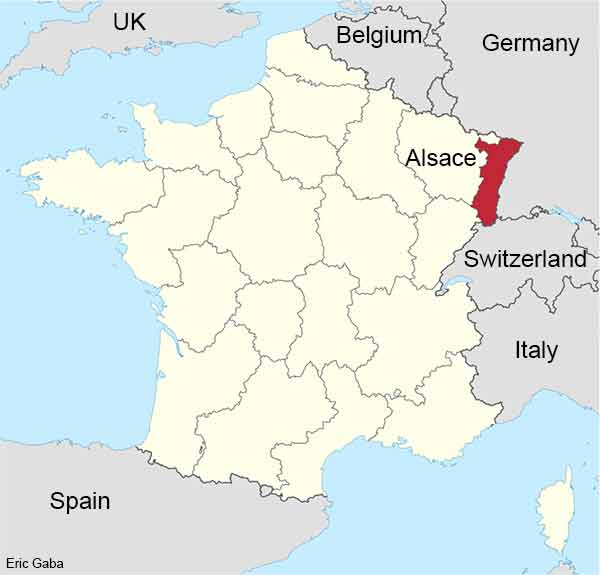
Europeans continuously squabble and make war amongst themselves. The Alsace region has the misfortune of being a highly desirable bit of land sitting between France and Germany.
After the collapse of Charlemagne’s empire (the Treaty of Verdun, 843), Alsace became part of the German speaking Holy Roman Empire. Then, after the Thirty Years' War 1618 to 1648, the Peace of Westphalia (1648) formally granted most of Alsace to France, though German remained the common language. The French ruled from 1681 to 1871, though the vast majority of people continued speaking Alsatian (a German dialect). The region became one of France's most prosperous and industrialized areas.
After France's defeat in the Franco-Prussian War, The German Empire annexed Alsace in the Treaty of Frankfurt (1871). Alsace returned to France in 1919, after Germany's defeat in World War I. In short, the history of Alsace is a story of shifting borders between two great powers, which created a resilient, hybrid culture that is neither entirely French nor German, but uniquely Alsatian.
French organbuilding, as done on Paris in 1700's, was remarkably standardized, with strict tonal and design rules, and how the organs were to be played. But, if you travel east to the Alsatian towns, far from Paris, organbuilding is much more amenable to Germanic ideas.
Andreas Silbermann, a skilled cabinetmaker from Saxony, moved to Strasbourg, Alsace in 1699 to train as an organbuilder. Then in 1704, Andreas Silbermann moved to Paris to study the French organ-building style with François Thierry. He went, to complete is apprenticeship and earn his master organbuilder accreditation.
In 1701, at the age of 19, Andreas' younger brother Gottfried moved from his home in Saxony to Strasbourg to join Andreas to also apprentice as an organbuilder. Gottfried remained in Strasburg, and in 1706 Andreas returned to rejoin Gottfried in Strasburg where they built organs together. Then, in 1719 Gottfried returned to Freiberg, Saxony to set up his own organbuilding business. Andreas stayed in Strasbourg for the rest of his life, building organs.
So we have two Germans who moved to the fringes of France (Alsace), far from Paris but contagious to Germany, where half the churches are Lutheran and everyone is bilingual. The consequence is that Andreas ended up building French organs with a German accent. But Gottfried built German organs with a strong French accent. They both used simular curved French additive pipe scaling, but not curved as aggressively as in Parisian Bedoes. Their Principal scales didn't grow as fat in the bass or treble, making them useful for chorus. Andreas' voicing was in the refined French style, but Gottfried's chorus voicing was much more aggressive, aided by his use of higher wind pressures, making his pipes more suitable for north German polyphony. Both brothers used french scales for mutations, flutes and Cornets.
Gottfried Silbermann's reed pipes were a mix of French building techniques and German Baroque tradition. He used large scale, closed shallots, and his trumpets integrated into the overall ensemble without being harsh or overpowering. Andreas' French reeds were a splash of exciting power, overwhelming everything.
The result is that Gottfried's organs were a synthasis of German and French ideas, making it an eclectic instrument that was versatile, performing both French and German Repertoire. Also, Gottfried was very consistant in his design and scaling of his organs, making his organs easier to copy. Gottfried's organs are an excellent model for contemporary organs.
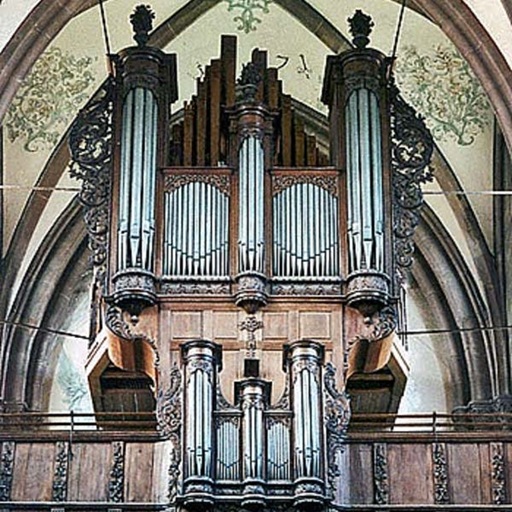
Andreas Silbermann
Andreas Silbermann (1678–1734) was a highly influential French organ builder of the late Baroque period, and a central figure in the famous Silbermann family of organ builders. He was the older brother of Gottfried Silbermann (1683–1753), who became even more famous. The brothers learned organ building in Alsace (then part of the Holy Roman Empire, now France) from another important builder, Andreas’s brother-in-law, Johann Friedrich Wender, and were also influenced by French organ building traditions.
Andreas settled in Strasbourg (in present-day France) and built organs mainly in the Alsace region, as well as parts of southwestern Germany. His organs were known for their clear, balanced tone, fine craftsmanship, and incorporation of French classical organ features (reeds, mutations) into German liturgical music needs. He built about 30 organs, many of which survive in restored or partially original condition. Today, Andreas is seen as the founder of the Alsace branch of Silbermann organ building, while Gottfried led the Saxon branch blending German and French aesthetics.
Andreas younger brother, Gottfried Silbermann, was forced to flee to Germany to excape prison after a scandel. In Germany he build German organs with a strong French accent. Gottfried worked in Saxony and became the preferred builder for J.S. Bach’s circle, with a somewhat different tonal style (more German Baroque, influenced by central German traditions).
- Andreas Silbermann (1678-1734)
- Gottfried Silbermann (1683-1753)
- Johann Andreas Silbermann (1712-1783), son of Andreas
Andreas' son Johann Andreas Silbermann (1712–1783) inherited the Strasbourg workshop and documented many Alsace organs in detailed organ surveys. He continued his father's Alsatian style but was also influenced by his uncle Gottfried's Saxony German accent. He worked primarily in Alsace (now France). He was known for his meticulous craftsmanship, elegant cases, and a sound that blends French elegance with German solidity. Johann Andreas adapted German scaling for his principals, while continuing French scales for Flutes and Mutations. However, Gottfried Silberman continued using French scales.
Notable Surviving Andreas Organs
Notable Surviving Johann Andreas Organs (the son)
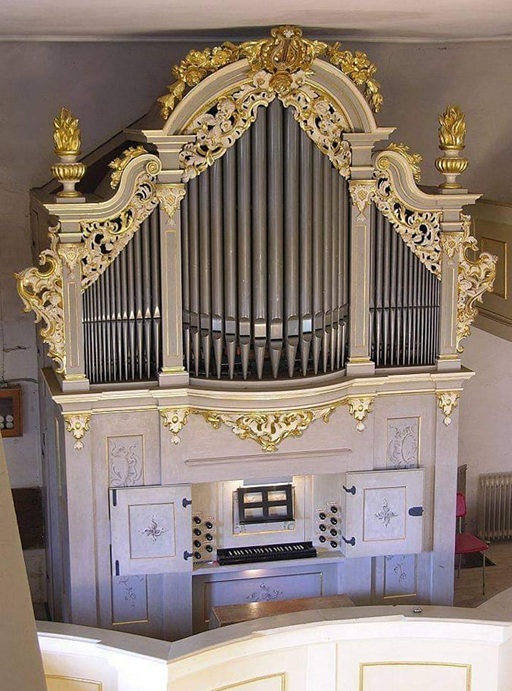
Central German Baroque Gottfried Silbermann
Gottfried Silbermann was Andreas younger brother, and he learned organbuilding from Andreas. Gottfried was forced to flee from Alsace to Germany to excape prison after a scandel. In Germany he build French organs with a strong German accent. Gottfried worked in Saxony and became the preferred builder for J.S. Bach’s circle, with a somewhat different tonal style (more German Baroque, influenced by central German traditions).
Gottfried Silbermann (1683–1753) was building organs that consolidated German and French ideas. He was building an organ looking away from the early Baroque and toward the future, even hinting at Romantic ideas. He never recycled old pipework as it wasn't compatible with his organs, and kept tight personal control over the design of his instruments. The stoplists, casework, voicing and scaling were very consistant from organ to organ.
Because so many Silbermann organs have survived to the present, have a uniformity of design, and are simular to modern American-Classic organs, Gottfried's organs were greatly admired and copied by builders like Larry Phelps. Indeed, add a Gamba and Celeste to a Silberman and you get a stoplist that could easily be confused with a modern organ.
Notice that the central German organ casework is styled differently that the Schnitger North German cases.
(Photo is Frankenstein, Dorfkirche, Sachsen, Germany - Gottfried Silbermann 1753.)
Gottfried Silbermann Files- Gottfried Silbermann's Fluework - by Colin Pykett
- Planning your Silbermann Tour
- Gottfried Silbermann: Master Organ-Builder of the German Baroque
- 1728 - Lahm im Itz, Schlosskirck, Herbst, scales (not Silbermann, but in his style.)
- 1718 - Kestenholz
- Lots more Silbermann to come...
 <
<
French Romantic Organbuilding Cavaille-Coll
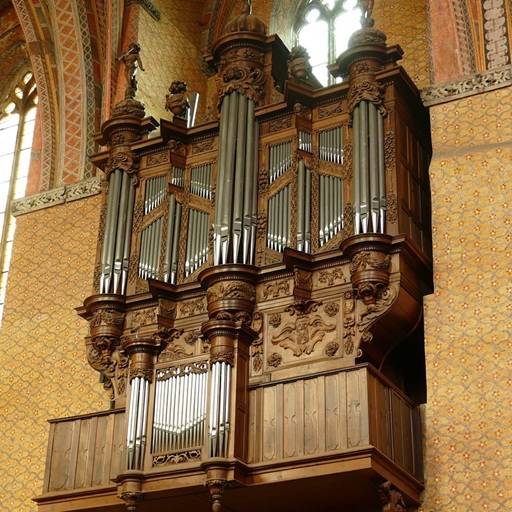
The photo is the 1864 Aristide Cavaillé-Coll organ in Moissac Abbey (France). The case dates from the mid-17th century.
The Romantic French school of organbuilding is defined by a single, towering figure: Aristide Cavaillé-Coll (1811-1899). He didn't just build instruments; he created a new kind of symphonic organ that revolutionized composition and performance, inspiring a golden age of French organ music that continues to this day .
Think of him as the "Stradivarius of the organ," whose instruments were so inspirational that they essentially created their own repertoire. Before Cavaillé-Coll, French organs were in a state of decline. He changed everything.
His career was launched with a major commission to rebuild the organ at the Abbey of St. Denis in Paris, completed in 1841. This early masterpiece caught the attention of the establishment, and with the support of Napoleon III, he received government contracts to rebuild many of the great cathedral organs in France, providing him with a platform to develop and perfect his revolutionary ideas . Iconic examples of his work can still be heard today in places like Saint-Sulpice and Saint-Ouen in Rouen .
Sound of Cavaillé-Coll
Cavaillé-Coll's instruments evolved from the romantic organ. They were capable of the same power, colour, and nuance as a full Romantic orchestra and could ably play orchestral transcriptions. His organs were not built for the intricate polyphony of the Baroque era, but for sweeping melodies, lush harmonies, and dramatic dynamic swells. This created a sonic palette that could imitate different sections of an orchestra—flutes, strings, and reeds—and, most importantly, blend together seamlessly.
But Cavaillé-Coll's genius was to reimagine the organ as a new kind of symphonic instrument. He invented new stops, like Harmonic Flutes and voiced his pipes to produce a rich, foundational sound built on a wide variety of foundational 8' stops. He also introduced many mechanical devices that transformed the way the instrument could be played.
Cavaillé-Coll's new symphonic organs inspired a new form of music. A remarkable lineage of organist-composers, many of whom held posts at the very churches where Cavaillé-Coll had built organs, wrote music that was inextricably linked to their new "symphonic" sound.
Key Innovations of the Cavaillé-Coll Organ
The Appel (Ventil) System: This was a brilliant innovation. Instead of a single, massive crescendo, Cavaillé-Coll divided the organ's wind supply into different "departments." By using foot pedals (appels), the organist could bring in entire families of stops (like the reeds or the mixtures) at once, creating a series of terraced dynamic plateaus. This allowed for dramatic, orchestral-style build-ups of sound.
Expressive Swell Boxes: While not his invention, he perfected the récit expressif (expressive division). This was a box enclosing a set of pipes with Venetian-style shutters that could be opened and closed by a pedal, allowing for controlled crescendos and diminuendos on a single division—a truly Romantic capability .
The Barker Lever: For his massive instruments with heavy key action, Cavaillé-Coll employed the Barker lever, a pneumatic assist system that made it possible to couple multiple manuals together without the keys becoming impossibly heavy for the organist to press. This made his monumental symphonic organs physically playable.
The Composers
Cavaillé-Coll's instruments didn't just accompany church services; it inspired a new school of music, the organ symphony. This school is often traced through a direct pedagogical lineage, with Cavaillé-Coll as its central, unifying figure. The following table illustrates some of its key members:
- César Franck (1822-1890) The "father" of the school; his chromatic harmony and cyclical forms.
- Camille Saint-Saëns (1835-1921) A close friend and advocate of Cavaillé-Coll, he bridged the worlds of organ and orchestra .
- Charles-Marie Widor (1844-1937) His ten symphonies for organ, defined the genre of the organ symphony.
- Louis Vierne (1870-1937) Widor's successor at Notre-Dame, his six organ symphonies where the heights of complexity and emotion.
- Marcel Dupré (1886-1971) A virtuoso and improviser, codified the teachings of the school, composed monumental works like the Symphonie-Passion.
- Maurice Duruflé (1902-1986) The last great proponent of the French romantic school of organ playing," "eloquent lyricism" and "controlled sensitivity" .
- Olivier Messiaen (1908-1992) His mystical works explore colour and rhythm in ways only possible on the rich palette of the French Romantic organ.
The legacy of the Romantic French school is a testament to the powerful synergy between a visionary builder and the inspired musicians who played his instruments. The organs of Cavaillé-Coll didn't just accompany a musical style; they actively created it.
Cavaille-Coll Organs
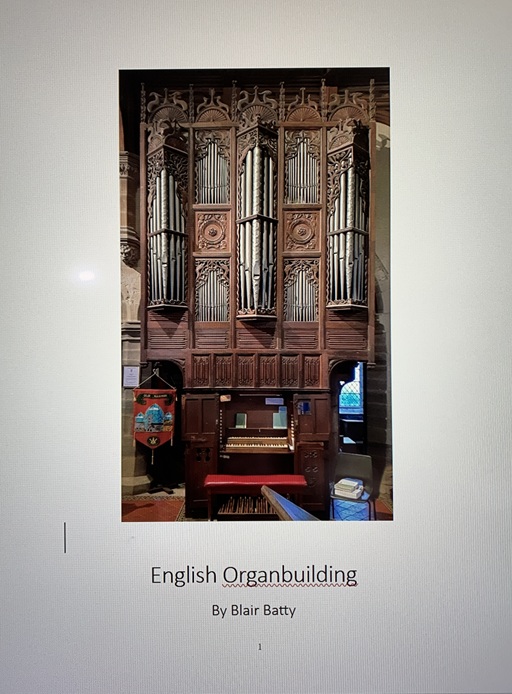
English Organbuilding my book
My PDF has some of my personal notes about English organs; click to download it.
It also contains information send to me by friends, as well as information from various books and publications. Much of it I wrote down decades ago. I’ve ignored history, which is well covered by others. It’s been three decades since I’ve heard the organs, so I’ve refrained from discussing what they sound like. There are excellent commercial recordings of historical English organs, with appropriate repertoire played authentically.
I also ignored construction and mechanism, which at the time I felt we were already doing better. Mostly, I was interested in how the stoplists and pipework evolved over the centuries; and how the pipework was constructed and voiced. I’ve documented pipe measurements, which is interesting to organbuilders, and difficult to obtain.
Romantic English Organbuilding
The English Romantic school was a gradual evolution driven by a few great builder families. Those builders were inspired by the changing demands of Anglican Choral tradition and the burgeoning concert hall. The result was a powerful, "orchestral" instrument, suited to the repertoire of Victorian and Edwardian England. Besides accompanying the demanding Anglican Choral Service, the organ had to lead large masses of congregational hymn singing. Romantic english organs were built from a rich 8' foundation and powerful, smooth reeds.
"Father" Henry Willis (1821-1901), was the preeminent builder, but he was surrounded by a rich ecosystem of builders. He was a meticulous craftsman and a brilliant designer whose instruments defined the sound of an era . Evan though his organs were awell-balanced tonally, with a solid foundation of traditional organ voices the were called called "orchestral" because Willis included stops designed to imitate the sounds of the orchestra. This made is organs useful for the transcribing orchestral works for the organ, which was quite populat at the time.
Father Willis was famous for the unparalleled quality of his reed stops. They were powerful, brilliant, and characterful, yet they could also blend seamlessly into the full ensemble. A "Father Willis reed" is still considered the gold standard by organists and builders today. Unlike some of his competitors, Willis's specifications included a lots of mixtures and upperwork, which prevented the organ from becoming muddy, even in the vast acoustic of a cathedral.
William Hill & Son (1832-1916) was the other prominent, large firm. They had a long history of building magnificent Romantic instruments.
English Organbuilding Files- My Book on English Organbuilding
- Willis Oboe boots, ACAD file
- Hill Gt & Ch chest layout ACAD file
- The Englishness of the English Organ - Thistlethwaite
- Dictionary of Organs and Organists - 1921
- Harris organ in Guimiliau, 1676
- Old Radnor Case, 16th Century
- Fr Smith organ, 1698, Gt St Marys, Cambridge
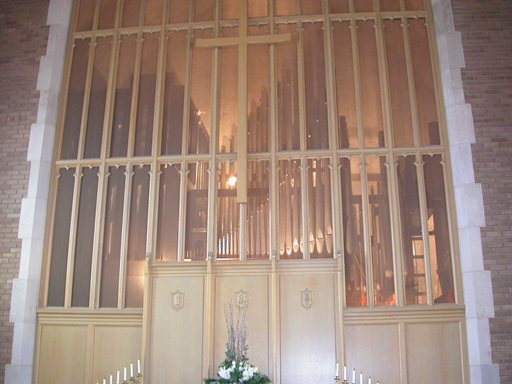
Contemporary Organbuilding Examined Organs
This is an assortment of organs of the past century, that I've examined. Selection was according to availability (e.g. we were cleaning the organ, so had intimate access to it), rather than because it was exceptional...
Some Modern Organs- 1961 Casavant (early Phelps)
- Lots more to come...
- Lye Brochure and Opus list
- Lots more to come...