
Reeds, Cleaning and restoring
Unstable reed pipes are the usual complaint of organists and tuners. Bad reed stops won't stay in tune, have uneven tone and loudness, attack unevenly, flyoff speech, and have dead notes. Presumably, when the reeds were new, they were perfect. Otherwise, how could the reedmaker sell them, or the organbuilder accept them? So, why do reeds go bad?
The most common cause is that the pipes are dirty. For 50 years, dust has been settling out of the air, funneling inside the resonator and into the shallot. Churches love burning candles, and may have oil furnaces, so 50 years of grease may also be built-up inside the reed pipes. Not to mention, 50 years of blower wind blowing thru the pipes, leaving behind grime.
Another common problem is pitch. Older organs were sometimes built as A-435hz; most Woodstock organs were originally A-435hz. Tuning a reed is the balancing of the pitch of the resonator, with the pitch of the tongue. Simply retuning a tongue from 435 to 440 pitch, results in resonators that are too long. Ripping the tuning slots open at the top of the resonator to compensate, results in unstable reeds.
One of the biggest problems with reeds are organ tuners! Fifty years of tuning and mishaps leaves it's mark on the pipes. Pipes get kicked, tongue weights knocked off and lost, tuning wires bent, tongues kinked, bungled attempts at tongue recurving, resonator tuning slots ripped open, loose and crooked tongues and wedges that haven't been corrected. All sorts of amateur errors and accidents.
Unstable reed problems are almost ~NEVER~ caused by a bad tongue curve. The tongues were curved properly in the first place, and are unlikely to go wrong, unless some idiot tampered with it. You should clean the shallot and tongue first. Don't try to recurve a tongue unless you know what you are doing, and even then, you probably shouldn't.
SUGGESTION TO TUNERS: Dirt accumulates around the chest pipe hole countersinks. If you pull a pipe out to work on it, that dirt falls into the hole and into the pallet. If you return the pipe and play the note, you blow that dirt into the pipe. So instead, before you return the pipe, tell your keyholder to play that note (blowing any dirt out). While it's still blowing, return the pipe back to a clean hole.
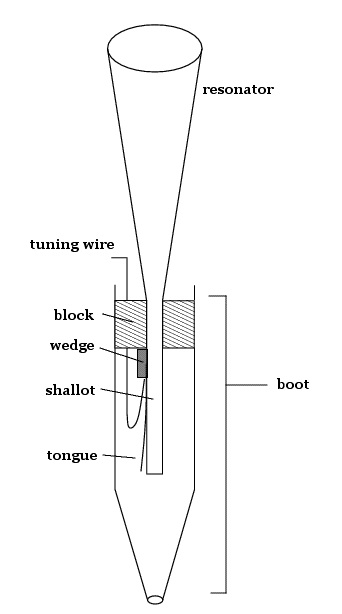
Reeds, parts of the reed
From the drawing, left, you can see the names of the parts of a reed. I use the Canadian labels, which is also used by Americans. The British, and sometimes the Americans, often confuse the names, expecially the boots and sockets.
For the big pipes the resonator is often removable. The resonator plugs into the socket, which is a short, tapered tube soldered to the top of the block. The boot sits on the chest, supported by the rackboard, and the block plugs into the top of it.
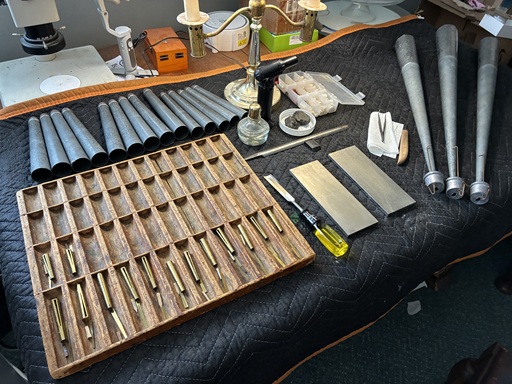
Reeds, disassembly of the reed
The first thing to do is lay all the pipes out in order. Then remove the socketed resonators, and the boots, keeping them all in order. Remove the wedges, tongues and shallots. You will need trays to keep all these small parts in order. Because pipes are handmade and hand-fitted there are minor variations in every part. If you mix them up, even though they look identical, you will hae trouble getting them to fit together again.
If shallot is stuck, don't try to twist it out: you'll put a twist in the shallot and ruin it. Try tapping the stuck shallot out (or wedge), with a brass rod, inserted through the socket.
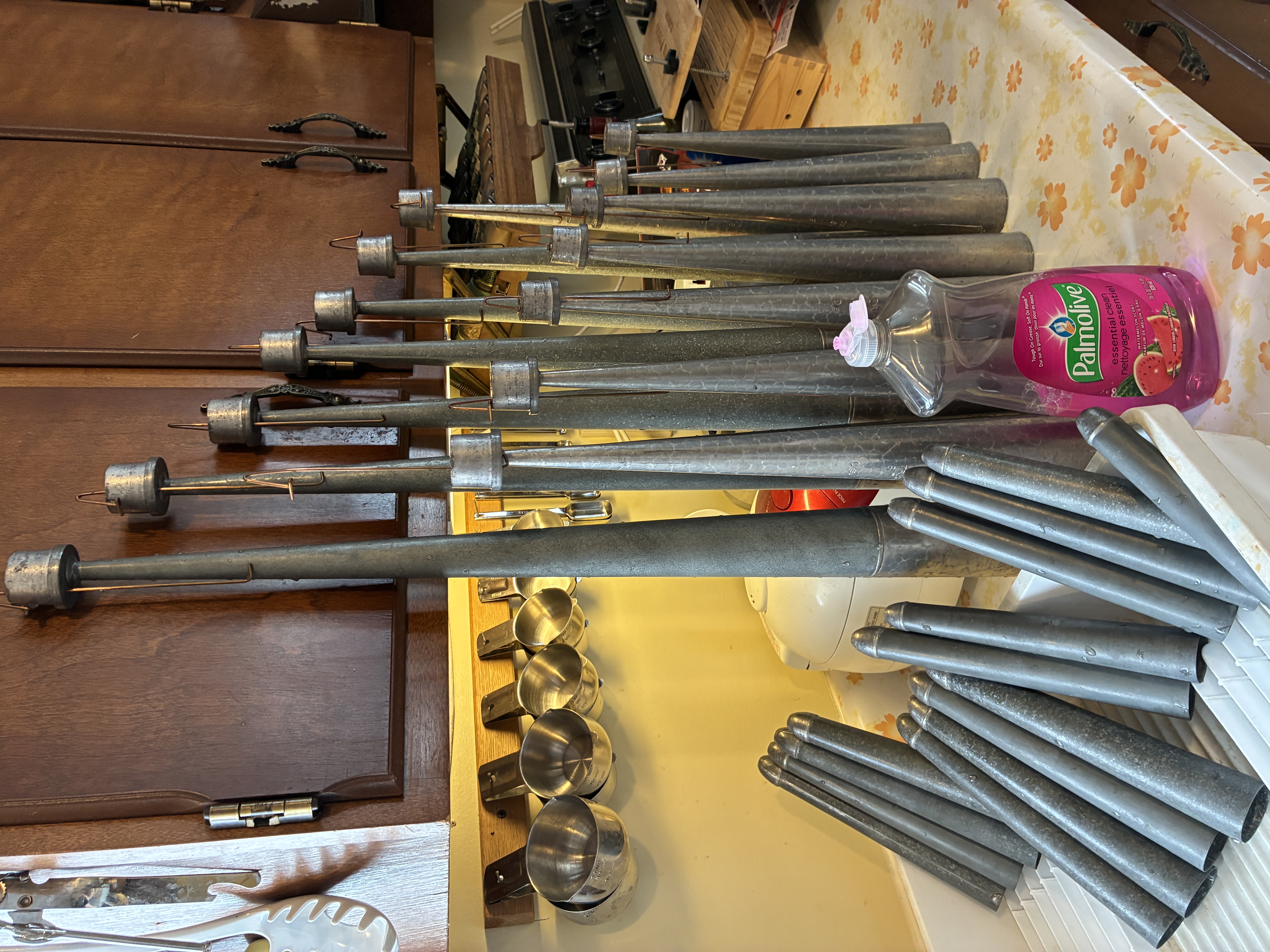
Reeds, Washing the bodies
Wash the resonators, boots and blocks in soap and water. Use water, as hot as you can stand it. Newly soldered pipes need scalding water to melt the wax soldering flux. I use Palmolive dish soap as it is gentle on your hands and pipes, but is a powerful grease-cutter. Use bottle brushes to clean the insides. Then rinse with clean water and air-dry.
Old zinc pipes are often sealed with shallac, but a quick wash in water usually doesn't harm the shallac. If the shallac turns cloudy from the water, let it dry. Then dip it into diluted shallac to restore it. In extremely wet enviroments, the shallec sealant will be deteriorated. If there is a white powdery dust (zinc oxide), get rid of it with a wire brush or steel wool.
If the lead blocks were made from contaminated lead (blocks were frequently cast from recycled metals), you will sometimes find the block covered with a white powder. That white powder is lead oxide, and is water soluble and poisonous. CAREFULLY steel wool or wire brush it off.
Then dip the damaged zinc or lead parts in diluted shallac to seal them again.
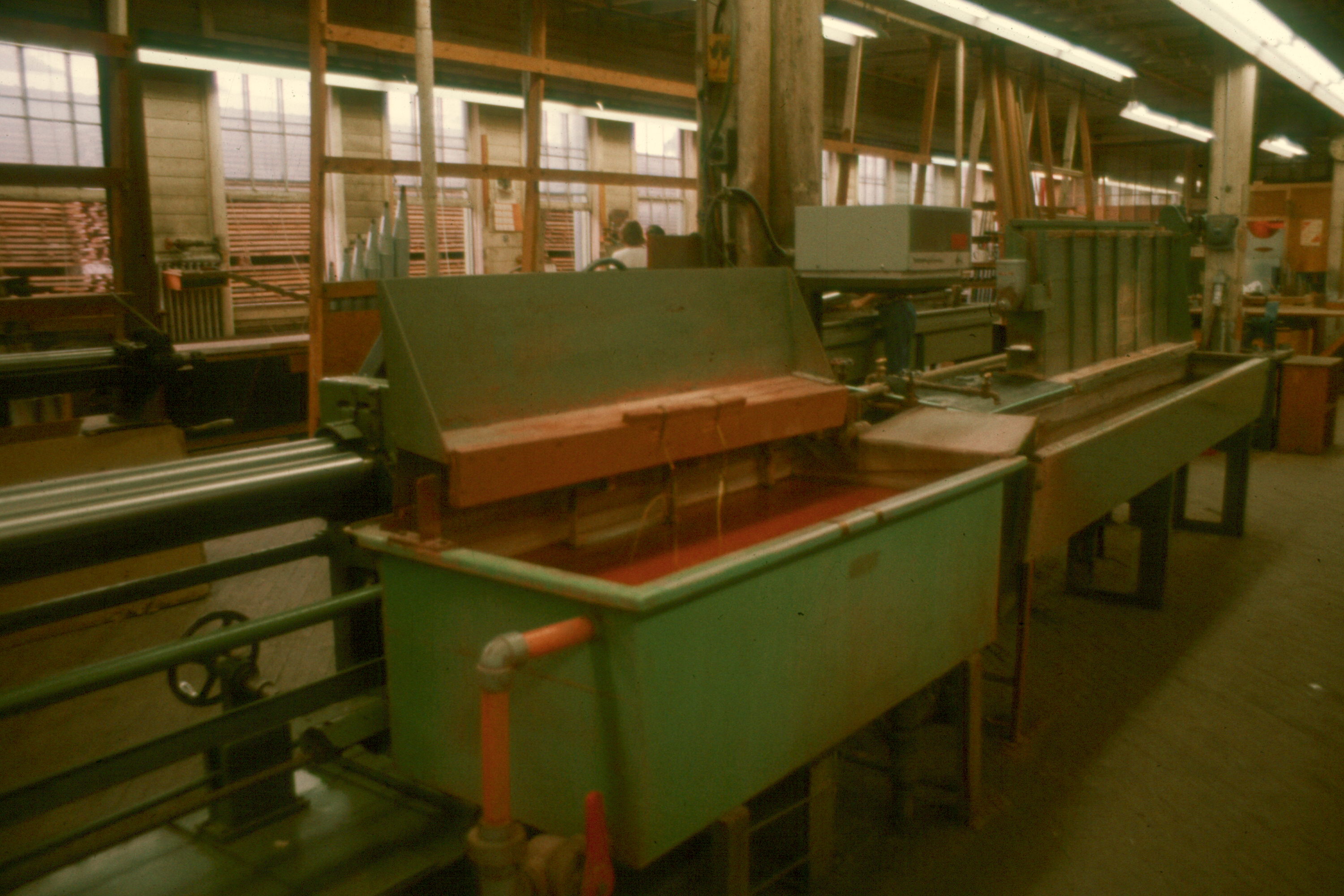
Pipe Washing Sink
This photo shows the Casavant pipewash sink, it has an industrial ultrasonic cleaner attachment. My shop had a custom made stainless steel sink. It was long enough for a 4' rank, wide so lots of pipes could soak, but shallow (for one layer of pipes). A sink big enough for 8' pipes is very difficut to keep the water hot. For the same reason I recommend treating the bottom and sides of the sink with waterproof styrofoam insulation.
You want a large drip tray behind the sink, to stand your drying pipes.
Wash the tongue and shallot
Carefully wash the tongues and shallots by hand in hot water and (Palmolive) soap. Inspect the shallot insides for bugs, and then bottle brush them. Be very careful not to bend the tongues. Rinse in clean, hot water and stand to air dry. Be very careful not to mix up the order.
Reeds, pipe repair
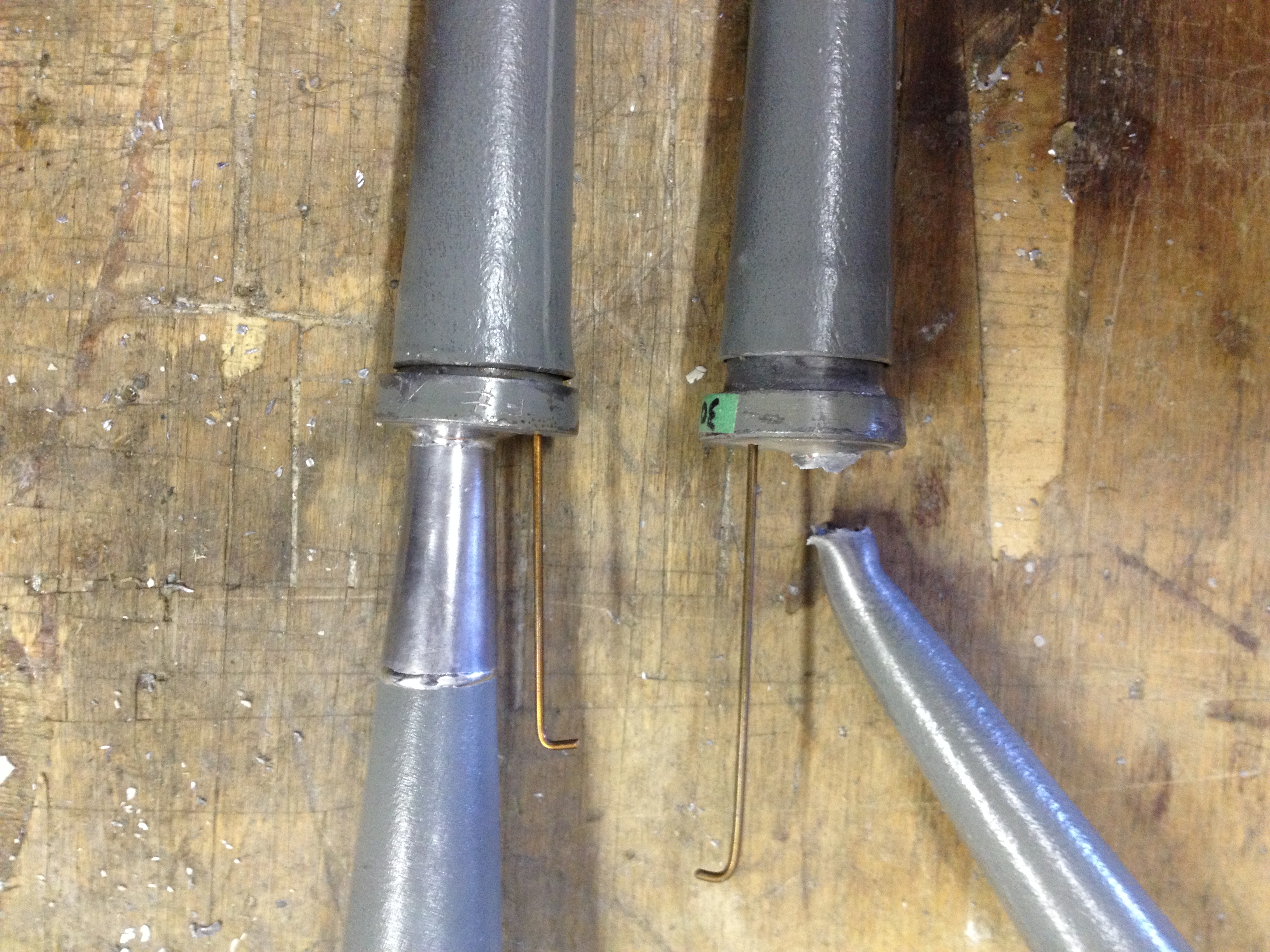
You will want to put any dented or crooked resonators and boots on mandrels and round them again, using a pipemaker's beater. If the resonator/block solder joint is broken, you will have to resolder it. You cannot shorten the resonator without changing the tone, so you may have to make a new resonator tip, to restore it's length.
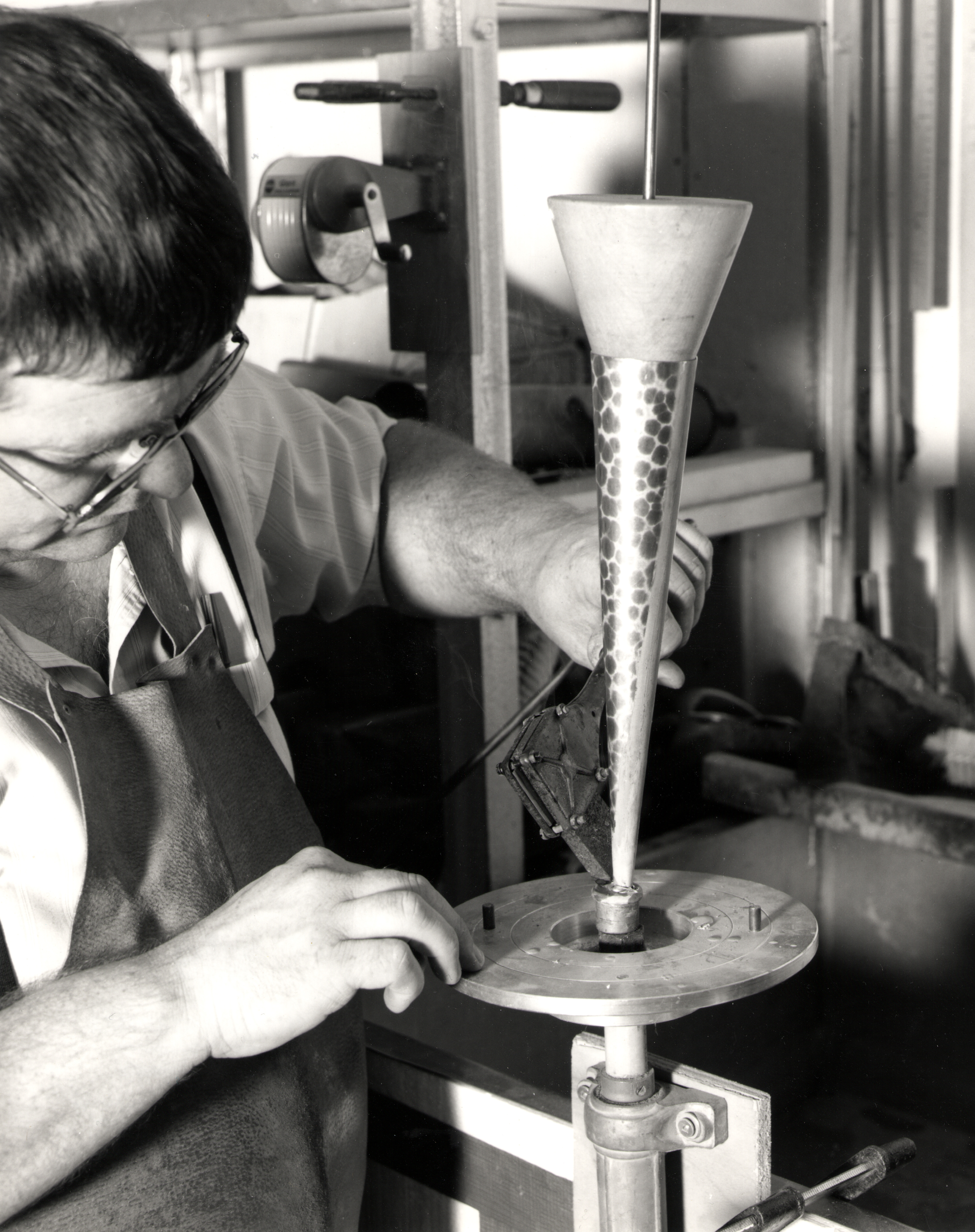
To reattach a resonator to the block, you need a blocking jig, which holds the pipe vertical and square to the block. It has a turntable that you can rotate while you are soldering.
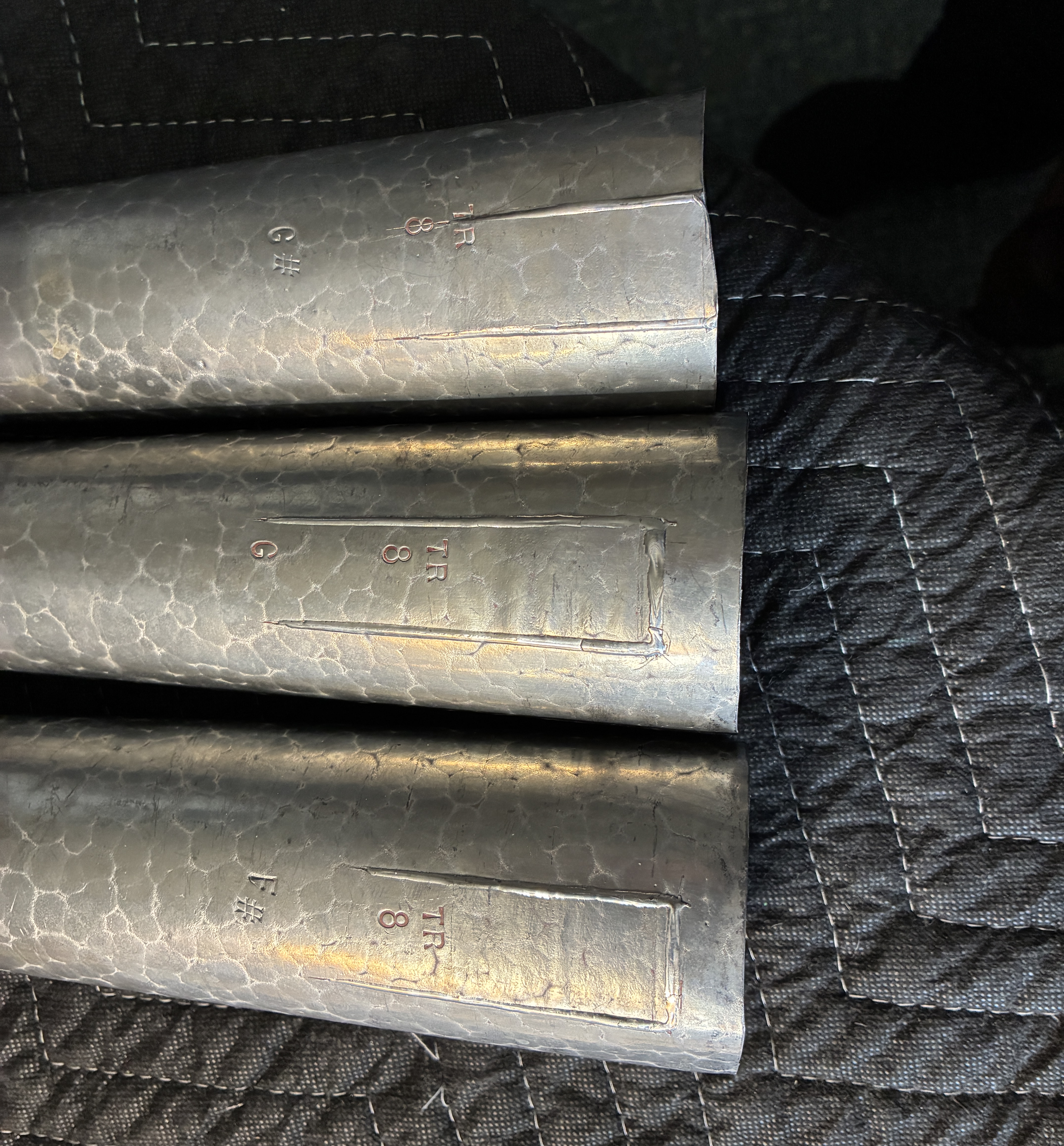
Torn resonator tuning slots can be straightened on a mandrel and the torn parts soldered. If the damage is bad, it is better to solder the old slot shut, and cut a new tuning slot in another location. I prefer to solder the tuning slot soldered shut, then cut the resonator dead-length.
Dead-length treatment improves the tone and tuning stability. Of course, you'll want to do the whole rank, so all the pipes sound better. This is also the way to fix A-435 pipes. Phelps-Casavant trumpets are often too short, and can be fixed by dead-lengthening.
Reeds, tuning wire
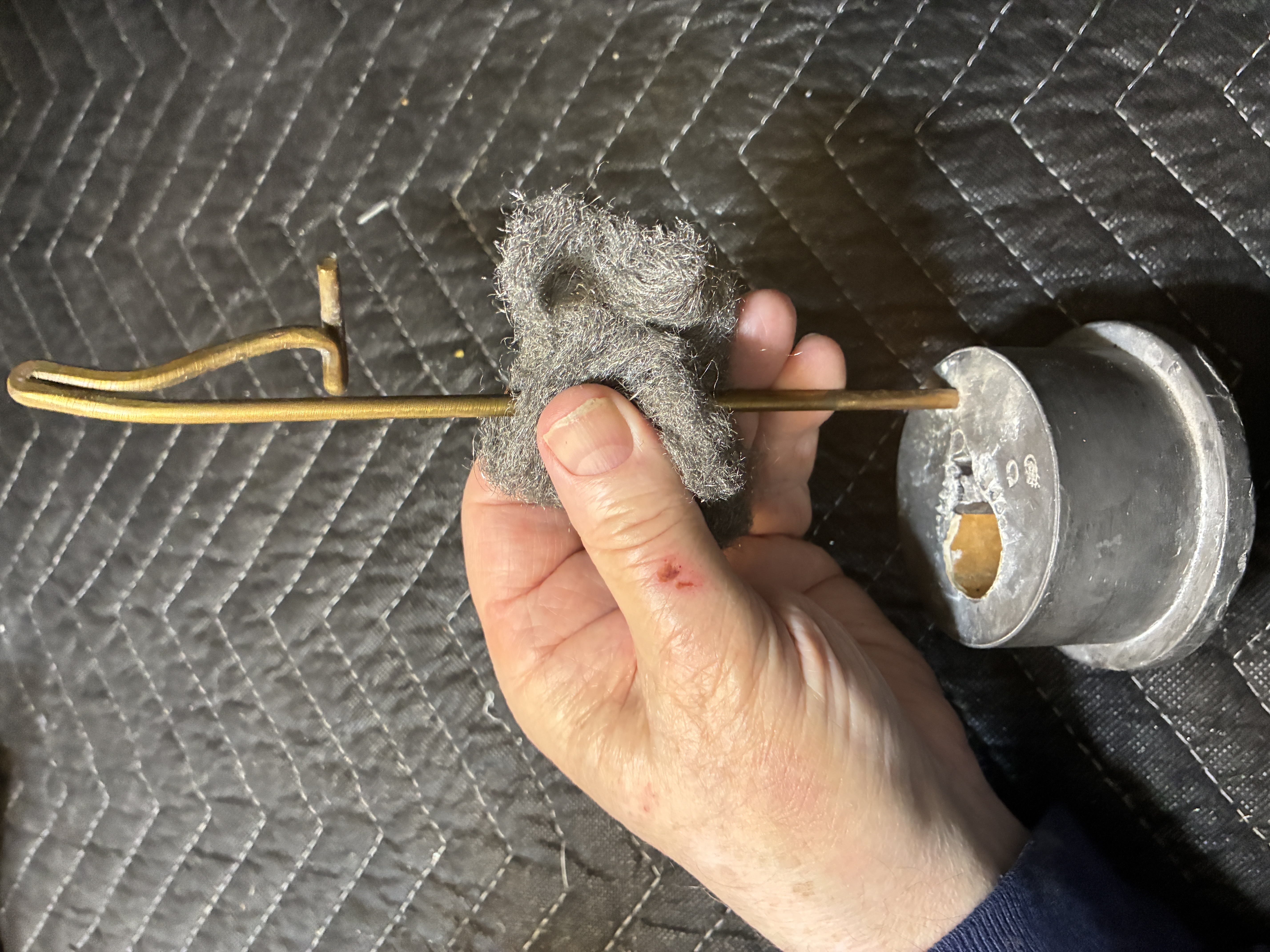
Clean the brass tuning wires with steel wool. This is not cosmetics, it is to clean off corrosion or grime, so the wire moves smoothly and freely through the hole in the block. Also, you must straighten any links or bends in the tuning wire that cause binding in the hole.
The contact point of the wire onto the tongue must be centered and square. Adjust the wire tension so it is firm, but not too hard!
Reeds, flatten shallots faces
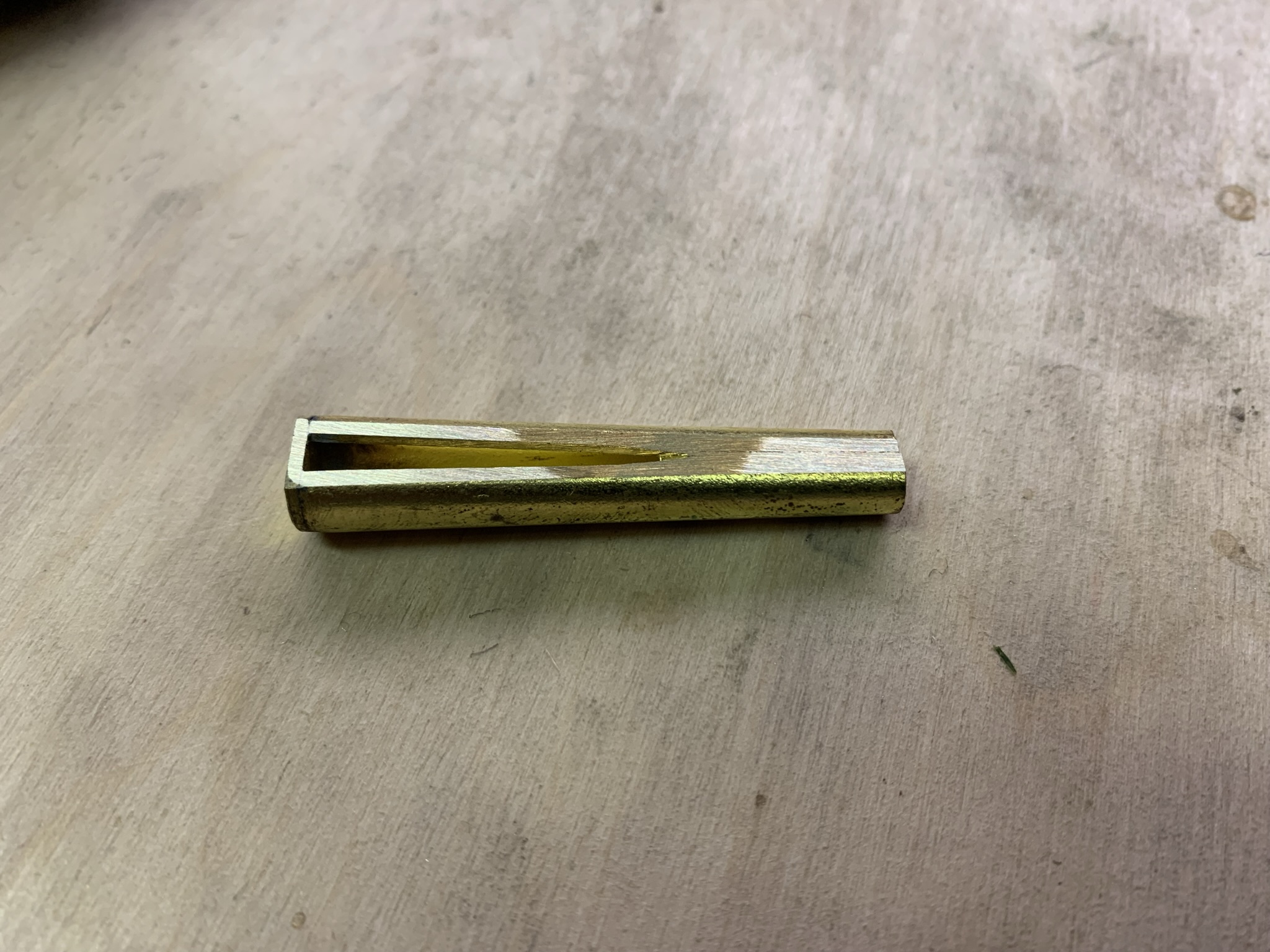
A common source of poor reed pipe speech, is the shallot face not flat. Poor manufacture, metal "memory" or technician abuse could cause this (I've seen vicegrip teethmarks on shallots, where a tuner twisted a stuck shallot out of a block). If the shallot is twisted, you must put it in a vice and un-twist it.
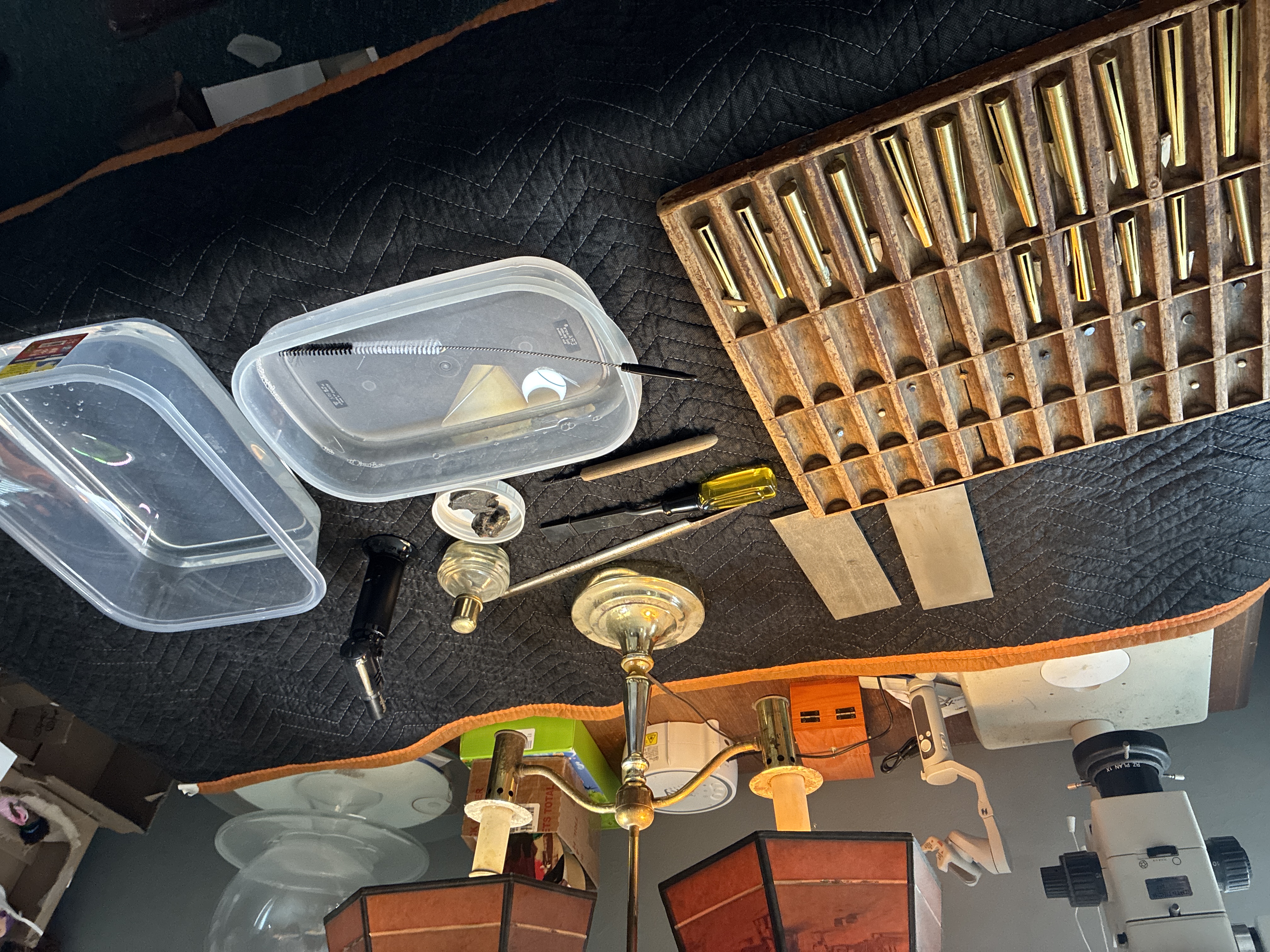
I've even found problems with new reeds. When cleaning, revoicing or rebuilding reeds, I used to file the faces to ensure flatness. But this requires the correct file (Nicholson, Flat long-angle, mill bastard) and some measure of skill. DON'T try to FILE a shallot, you'll wreck it unless you know what you're doing.
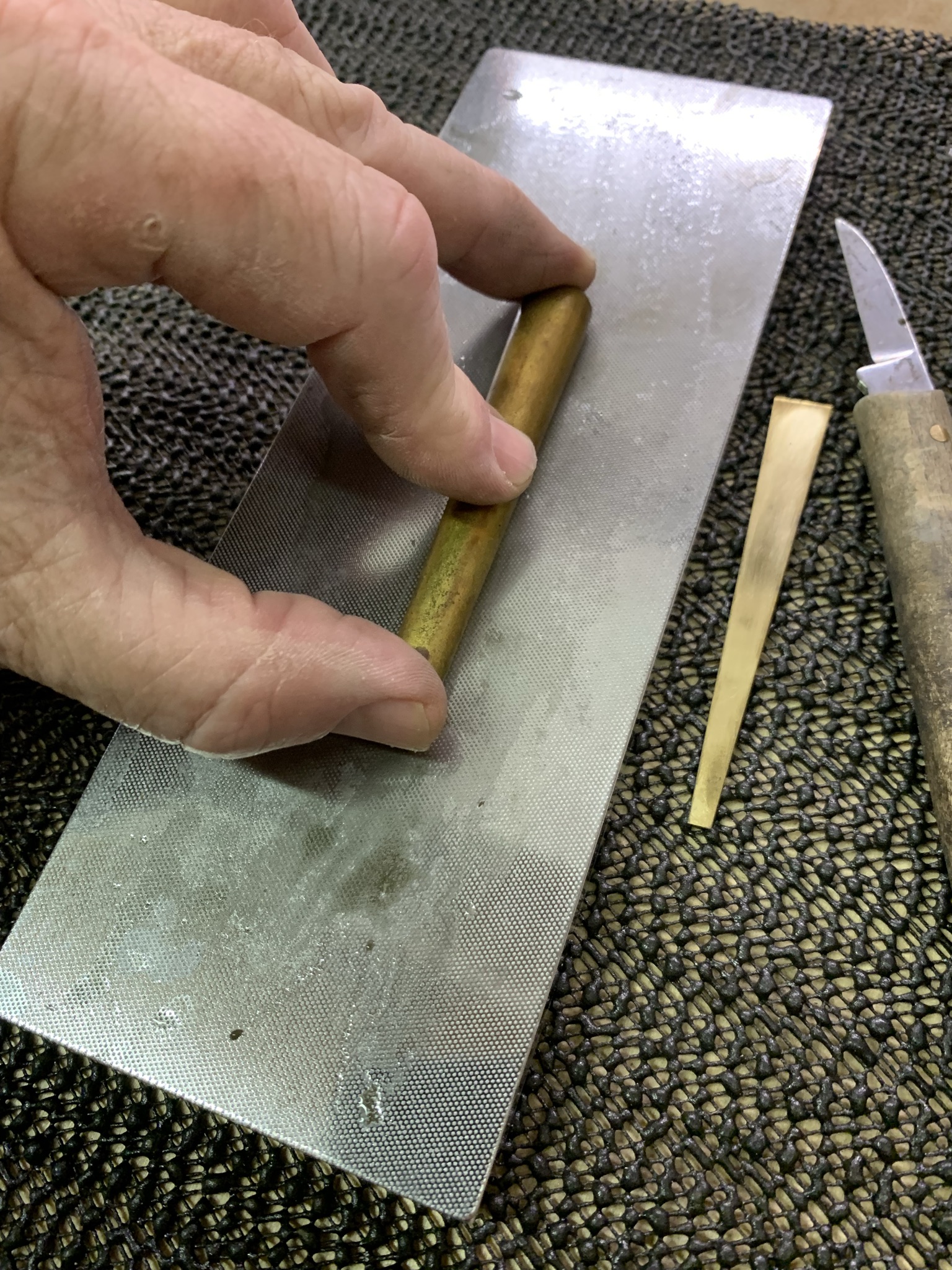
Recently, I've found that Japanese diamond sharpening stones do a better job of flatting. The substrate is precision ground flat metal plate. 400 grit quickly flattens the face and 1200 grit polishes it. They work well wet or dry; I've had no problems with clogging. Also, If you haven't tried Japanese diamond stones with your woodworking tools, I really like them.
Shallot not flat
In this photo, on the shallot that has been partly worked, you can clearly see that it is not flat. It does not need to be a mirror finish, just flat and smooth.
Reeds, Flatten the tongue
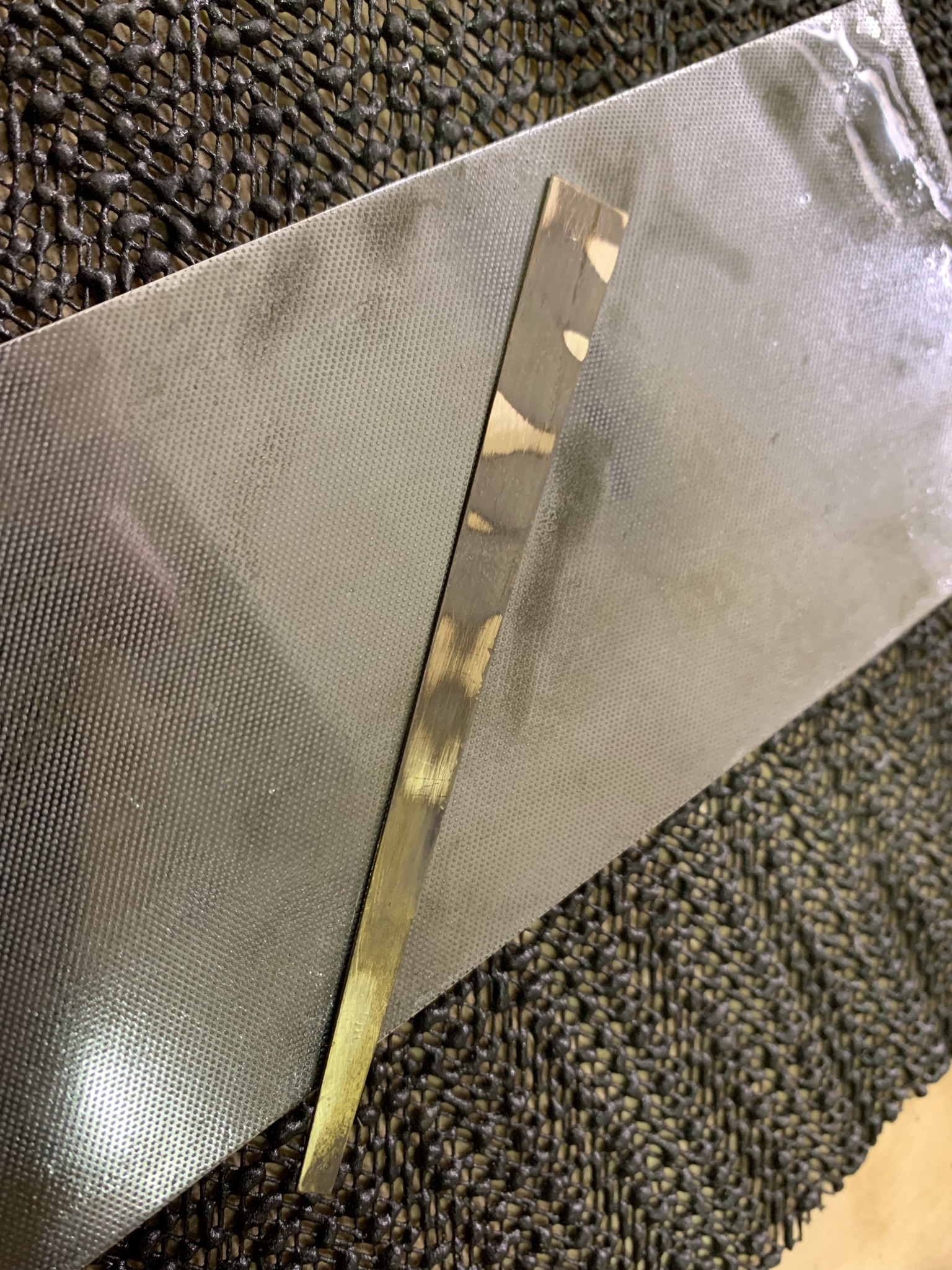
You should give the tongues a light polish also. The intent is just to clean the surface and remove any burrs. You cannot flatten it. The more you fuss with a tongue, the more you mess up the original curve.
If there is a kink in the tongue, replace it. Stick it in a envelope and mail it to OSI. Request they make a copy. They'll even curve it for you, perhaps it'll work. I've attempted to burnish out a kink, but brass has memory and the kink always returns. It'll be dead again, in a month
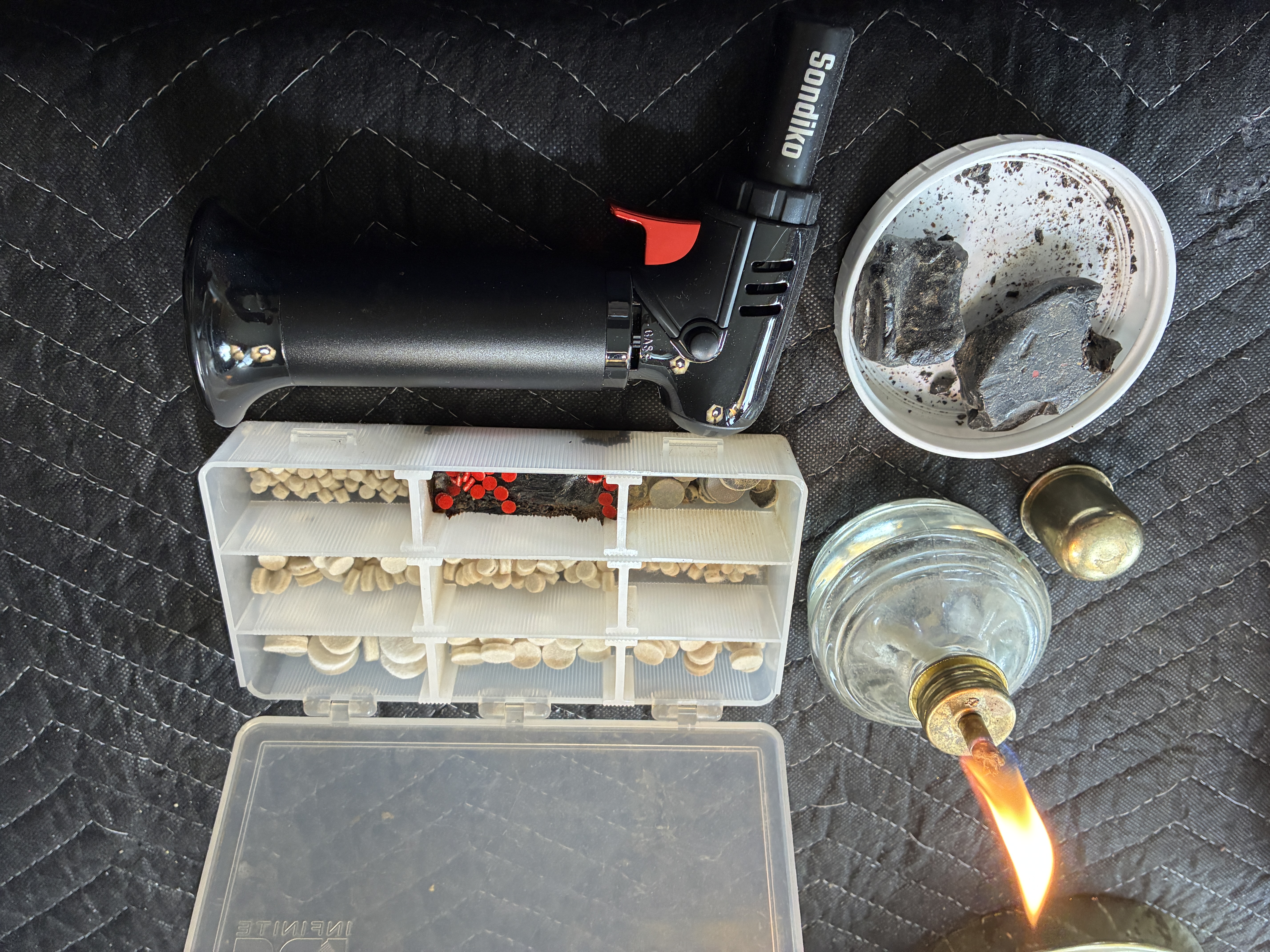
Reeds, replace the missing weights
You should have an assortment of weights. Buy a small assortment box and punch some out of hard felt and soft lead. Use Chatterton compound (Kimber-Allen) to hot-glue with, using a alcohol lamp. If you ever scrap a reed, keep the old tongues, wedges and weights.
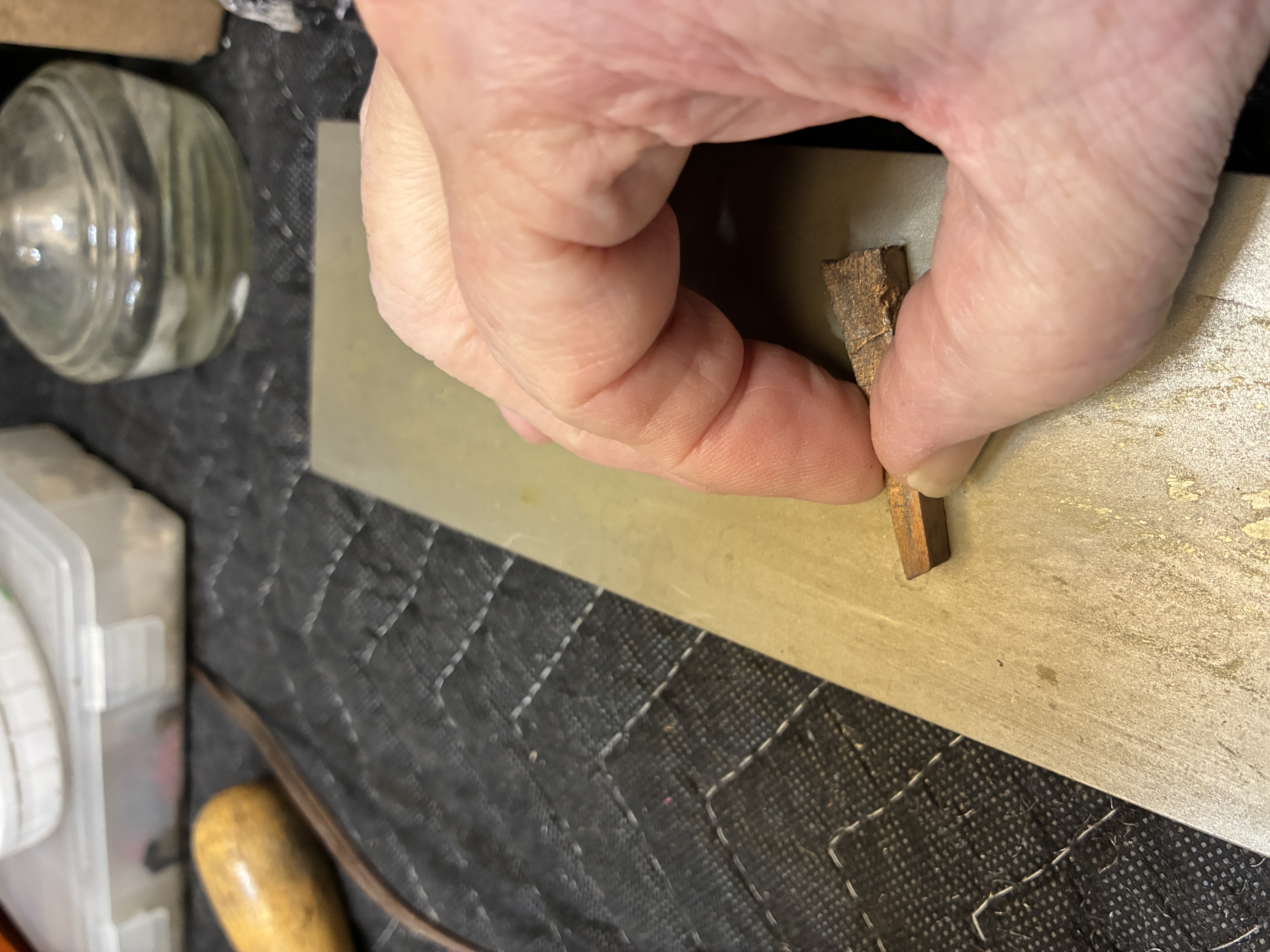
Reeds, fitting the wedge
The wedge should fit the block perfectly. If the sides are too tight to push in with your fingers, sand them on your diamond plate to size it. Replace any damaged wedges.
Download "Reed Clean and Restore" as a PDF