Rocks and Fossils
I like to collect rocks and fossils. I've always had an interest in geology and have been informally collecting rocks for years. Most of my collection I have gathered myself, having purchased only unusual or extremely interesting pieces. I like hand-size pieces and can make petrological (microscope) slides of the interesting ones.
I collect rocks and minerals for their geologic interest, I am not interested in their gemological (jewelry) value. I am also interested in astronomy, so have some Meteorites and Tectotes. Because of their rarity, my meteorites have been mostly purchased.
Fossils are another special interest of mine. Most specimens have been collected by myself, with a few obtained by trading or purchase. I'm interested in all fossils, though mostly have invertibrates, bracheopods, trilobites and corals. I don't have much to say about rocks, so what follows is a description of how to manage your collection, that I wrote years ago.
Documenting Collections keeping notes
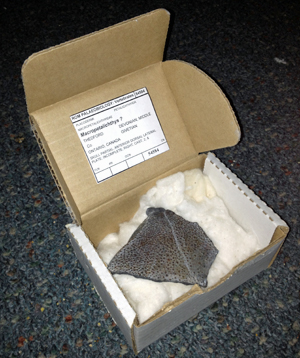
For a serious fossil collector, the single most important bit of information about a fossil is the exact place it is found. But this is not just so that you can return to the site. The location in the strata indicates the time period the fossil lived in, and by studying the matrix you can learn about it's paleo-environment (did the fossil live on a mud seafloor, reef, etc). Without the location, its just a piece of rock. So we document.
Seen above is the specimen, in it's padded specimen box with the Specimen label attached to the lid. Not seen is the specimen number inked onto the bottom of the specimen. After all, if you lose the number, mix the boxes or lose the label, the specimen becomes worthless.
In the old days, you would have three files: Collecting Site Records, Accession Records and Specimen Records
Collecting Sites where we found them
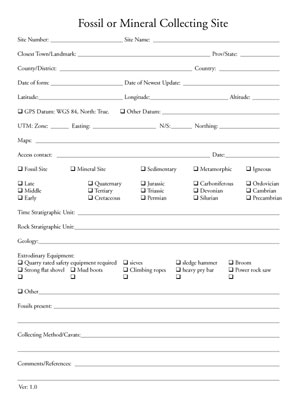
Collecting Sites was a notebook describing each site (quarry, dig, mine, etc) that you goto to collect rocks and fossils. It gives directions, gps location, geology, where to get permission, geological period, maps and whatever important information I want to record. I won't show you my book; but you can download a sampler page (click the picture).
Accession Records what do I have?
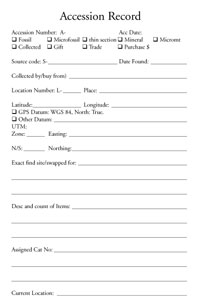
Accession Records relate to the specific spot you collected, at that location. For example all the fossils you collect out of a hole in the "Hungary Hollow Formation" would be put in one collecting bag with a AccRec. If you moved two feet uphill, into the Arkona Shale, you would use a new bag and AccRec, because the geology has changed, even though they are both at the same collecting site.
Indeed, if you returned the next day to work the same hole some more, you would assign a new accession number, because there is no guarentee it is the same hole! In other words, the purpose of the accession record is to identify a collecting event; the exact location and time which the collecting bag's contents were found!
Many collectors keep a field notebook. I used to use the Accession record book for that, adding notes or extra pages.
The Specimen Record what do I have?
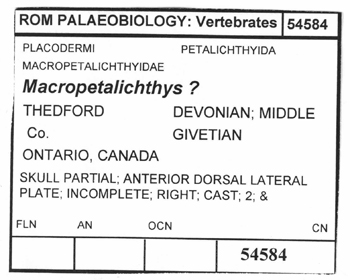
The Specimen Record is a book listing the information about a particular specimen including a unique specimen number. A copy of the specimen record is also printed on a small slip of paper, glued to the specimen box holding the specimen.
The specimen record consists of: collection number, accession record number, collecting site number, common name of item, taxonomy and description,
After cleaning, each fossil has its unique specimen number marked onto the fossil (or the fossil's box if the fossil is small). I use waterproof, permanent, black india ink and write with a fine point mapmaker's "dip nib" pen. You can (and should) write tiny numbers with that pen. Many professionals use a Rapidograph fine point draughman's mechanical pen, but I find they keep clogging because I don't use it frequently enough. Some items require a tiny dab of white paint (or typewriter "whiteout") to provide a non-porous, contrasting background for the ink.
Resource List of Links
I offer this list of links, Clubs, Organizations and Vendors for information only. I don't provide endorsement of any particular group and may know very little about them. It is up to you to decide their suitability.
- Niagara Peninsula Geological Society
- London Gem and Mineral Society
- Calgary Rock and Lapidary Club
- Brantford Lapidary and Mineral Society
- The Central Canadian Federation of Mineralogical Societies (CCFMS)
- Gem & Mineral Federation of Canada
Jewellery, Gemstones and Faceting
Museums & Government
- Museum of Nature, Ottawa
- Royal Ontario Museum
- University of Waterloo's e-Museum of Rocks, Minerals and Fossils
- Geological Survey of Canada
Fossil and Mineral Dealers
Mineral Cameras & Photography
Ontario Collecting Sites
Southern Ontario's finest mineral collecting area! Sphene, apatite, zircon, betafite, graphite spheres, tremolite, beryl. Also in the Brancroft Area:
- The Bancroft District
- The Rockhound Gemboree, Bancroft
- Beamsville: Lincoln Quarry (open only to CCFMS organized trips)
- Chatsworth: Quarry
- Cobalt: fossils
- Cobalt: Agnico-Eagle mine, Pyrargyrite
- Cobalt: Larose mine & McKinley-Darragh mine: silver
- Dundas: LaFarge Quarry (open only to CCFMS organized trips)
- Georgetown: Hilltop Quarry: celestine
- Greely: Grant Quarry
- Markstay: almandine garnets
- New Liskeard: silver
- Madawaska: Gole Quarry: zircon
- Marmora: Mormoraton Iron mine: iron minerals, andradite
- Madoc: fluorite, arsenopyrite
- Niagara Falls: Montrose Road Rock Dump: fluorite, calcite
- Paris: Grand River: calcite
- Rosenthal: Gutz Farm, Corundum
- Six Mile Lake: quartz xls
- Arkona Fossil Site (Devonian Invertibrates)
- Craigleith Fossil Site (trilobites)
- Formosa: fossils (reef)
- Pt Colborne Quarry
Quebec Collecting Sites
- Laniel: garnets in mica shist
- Lac Saint-Antoine: Comet mine
- Lacorne Township: Massberyl property
- Mt St Hilaire, Alkail-nuts
- Wakefield: Evans-Lou mine, molybdenite
United States
- Alden Center, NY: brachiopods, Leiorhynchus; crinoid stems; and trilobites
- Penn Dixie Paleontological and Outdoor Education Center
- A List of Northeast USA fossil sites