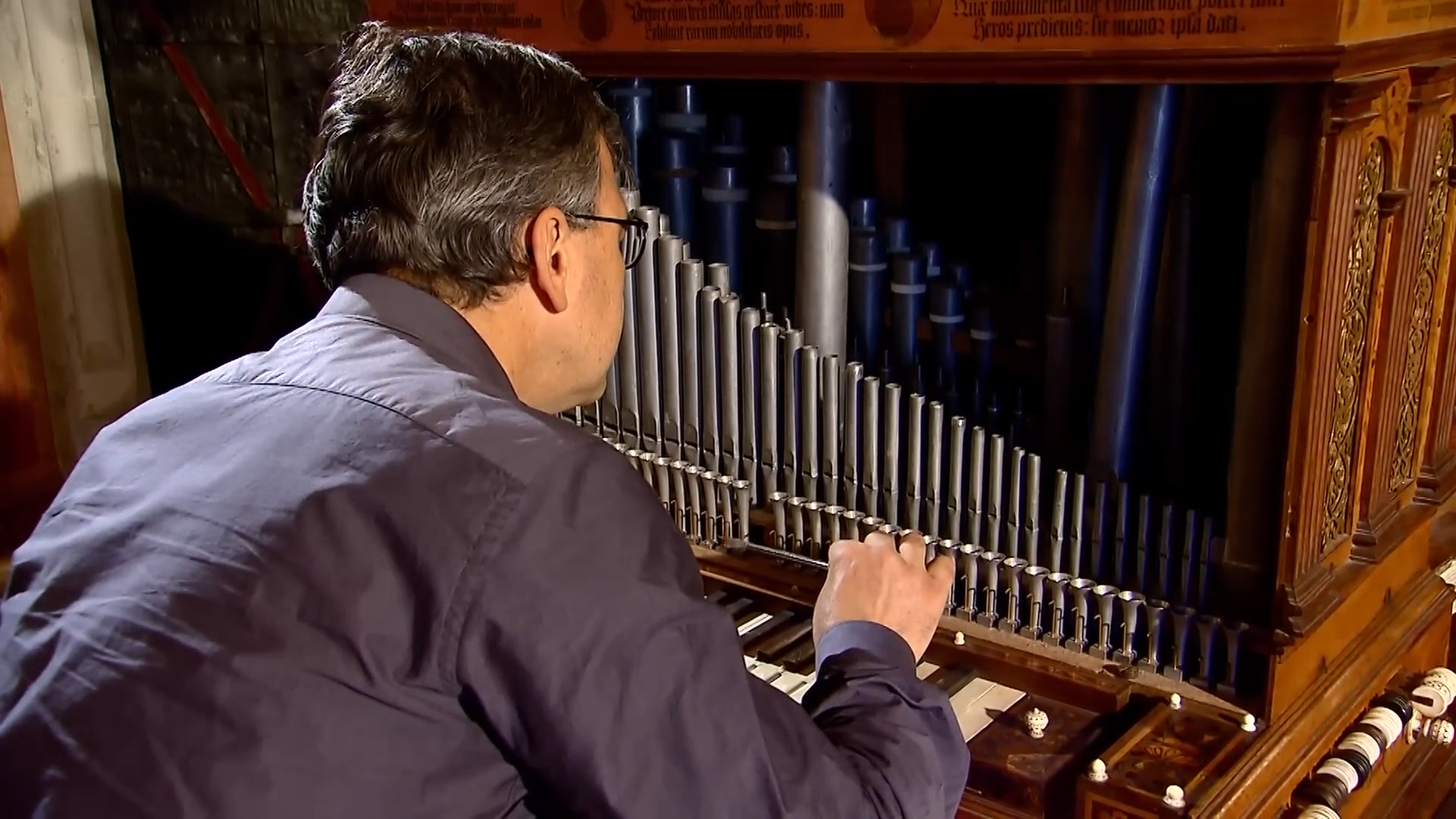
Reeds, all about reeds
Click here to read all about reeds. We discuss scaling, voicing, how to make shallots, history of reeds and how to clean and repair reeds.
Index
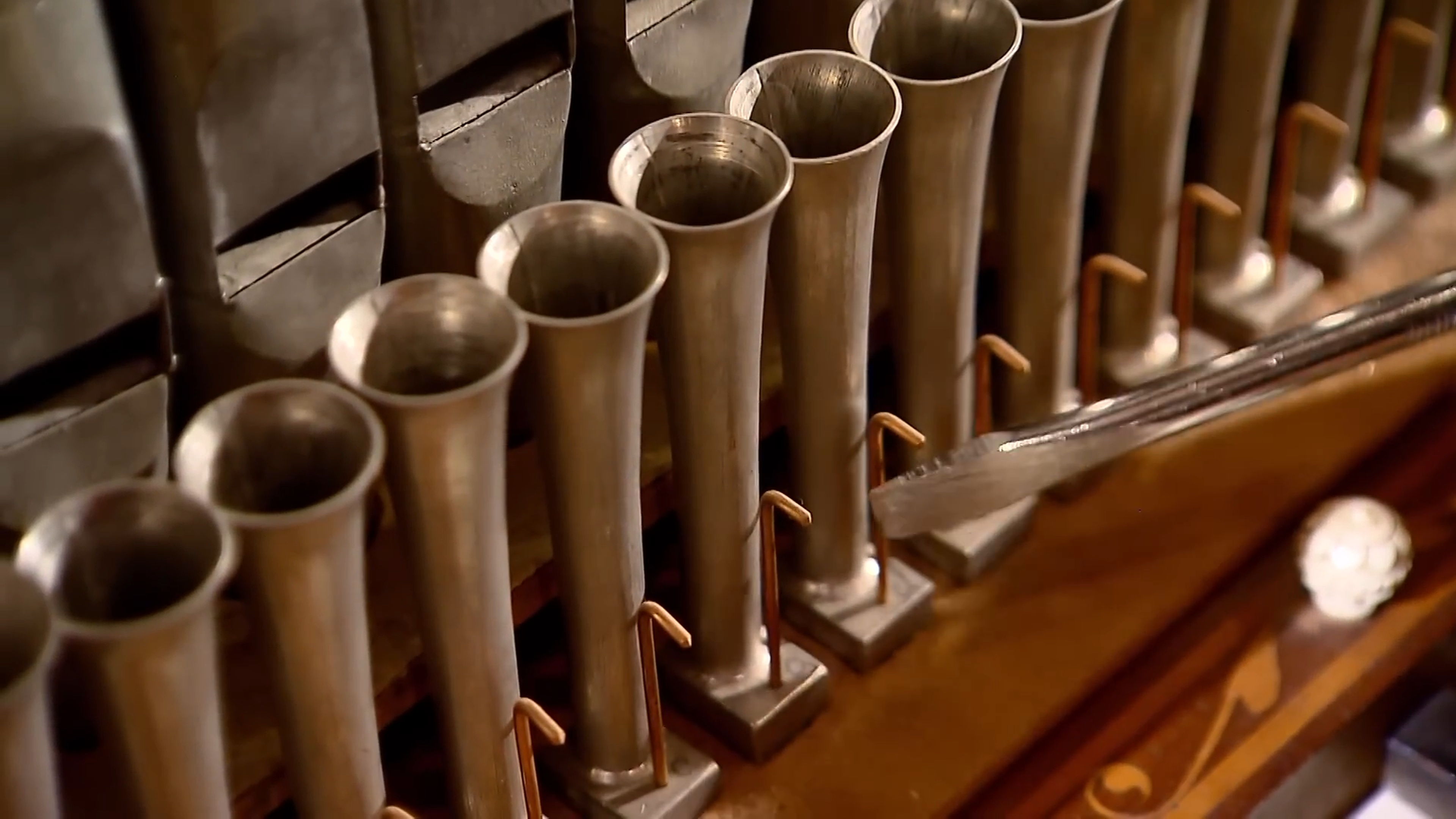
Reeds, a little history
The Gothic blockwerk organs didn't have reeds. The regal is a small, portable pipe organ that was popular from the 15th to the 17th centuries. Unlike larger organs, it uses beating reeds (thin brass tongues) inside short pipes to produce a loud, nasal, and buzzing sound . Design and Portability: These instruments were designed for easy transport. Some models, known as "Bible regals," could fold up so the keyboard fit inside the bellows, making the closed case look like a large wooden book . A famous example from the Metropolitan Museum of Art features a keyboard that stores inside the bellows for travel .
Reeds, how they work
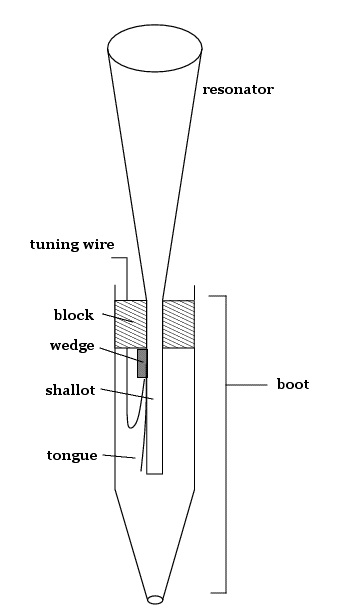
If you have ever buzzed your lips together making a pharting sound, yoou've experianced how reeds work. Your upper lip is the tongue your lower lip the shallot.
If you look at the photo, the block is a round slug of lead that holds a reed pipe together. The block has a hole drilled thru it, top to bottom. The resonator is placed over the block hole, and is soldered to the block. The tongue and shallot slides a little way into the bottom end of the hole, and is held in place by a wedge. A tuning wire slides thru a second, narrow hole in the block. The bottom end of the wire has been bent so it lightly presses against the tongue. By tapping the wire up and down, the wire’s contact point on the tongue moves up and down. This effective makes the free end of the tongue longer and shorter, hence flatter or sharper, respectively. This is how you tune a reed. The shallot is also a tube, with the bottom plugged, but the top open to the resonator. One sid if the shallot is flattened, and there is a slit in that flat the allows the wind to flow from the boot, through the shallot slit, and up into the resonator. The tongue isn’t flat; it has a slight curve to it. Since the top of the tongue is wedged against the flat of the shallot covering the slit, the tongue curving curls the bottom portion on the tongue away, leaving a narrow gap between the tongue and the slit. Look at the drawing. The whole assembly of block, shallot, tongue and wire, fits into a metal tube called a boot, which sits on the windchest. When you play a note, wind from the windchest fills the boot. That wind under chest pressure tries to escape, so it flows through the gap between the tongue and the shallot, through the slit, up the shallot and out resonator. The air flow under the tongue and through the slit causes suction on the tongue (the Venturi effect). This sucks the tongue against the shallot’s flat, plugging the slit. But a plugged slit breaks the suction so the tongue (which is essentially a spring), opens again. Once open, air starts flowing, suction, plugging the slit, springing open, the cycle keeps repeating. This oscillation sends a periodic string of pulses into the resonator which we hear as a note. The faster the string of pulses, the higher the pitch is. You can tune it by making the tongue longer or shorter; you can do that by moving the tuning wire up or down. The Resonator Just like a flue pipe, the reed resonator acts as the filter for those tongue pulses, selectively reinforcing the fundamental frequency, harmonics and eigenfrequencies of the body. The loudness of the fundamental frequency of the resonator is determined by scale, (diameter of the big end of the resonator). Trompette (Trumpet) Reed Tongue: Belongs to the "chorus reed" type of curvature, with the design goal of producing a bright, brilliant sound rich in overtones. Trompette (Trumpet) Reed Tongue: Belongs to the "chorus reed" type of curvature, with the design goal of producing a bright, brilliant sound rich in overtones. Clarinet Reed Tongue: Belongs to the "smooth-toned" type of curvature, with the design goal of producing a soft, smooth sound suitable for solo playing. If the curvature is too great, the reed will be sluggish
It's actually very simple: The tongue and shallot oscillates under the wind pressure and generates periodic pulses, which are blown into the resonator. The resonator amplifies the fundamental and harmonics that are in phase with the tongue/shallot. The length and shape (scale) of the resonator tunes the phase. What matters is the amplitude and shape of the pulse. Bigger the pulse, louder the pipe. A pulse shaped like a sine waveform has no harmonics = dull tone A pulse shaped like a sawtooth waveform is rich in harmonics = bright tone. Thick tongue, heavy pressure, Vincent shallots, tongue weights (so the tongue moves smoothly) = sine wave pulses Thin tongue, low pressure, french shallots, unweighted (so the tongue snaps) = sawtooth waveform The voicer controls the tuning and tone of the resonator (pitch and phase relation to the tongue/shallot) by opening the tuning slot at the resonator top, or by trimming the resonator if dead-length. The voicer can control the amplitude and shape of the pulse, by changing the tongue curve.
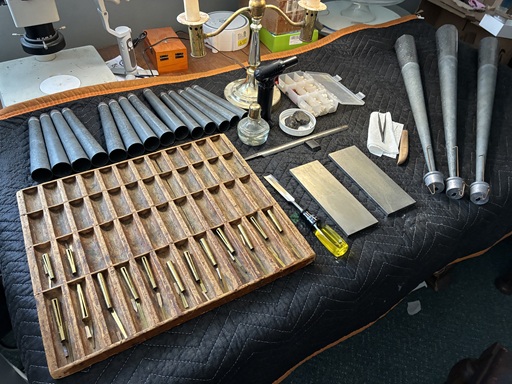
Reeds, how to Clean and Restore
Dirty reed pipes speak badly, and refuse to hold their tuning. In time, they accumulate dust, dirt and grease, which gums up the tongue. Grease comes from burning candles and perhaps an oil furnace. But careful cleaning and regulating can make the pipes like new.
Cleaning reed pipes requires delicate handling, and I've seen many stops damaged by inexperianced or careless cleaning. This article goes thru the steps to properly clean and repair a reed stop.
Reeds, making shallots
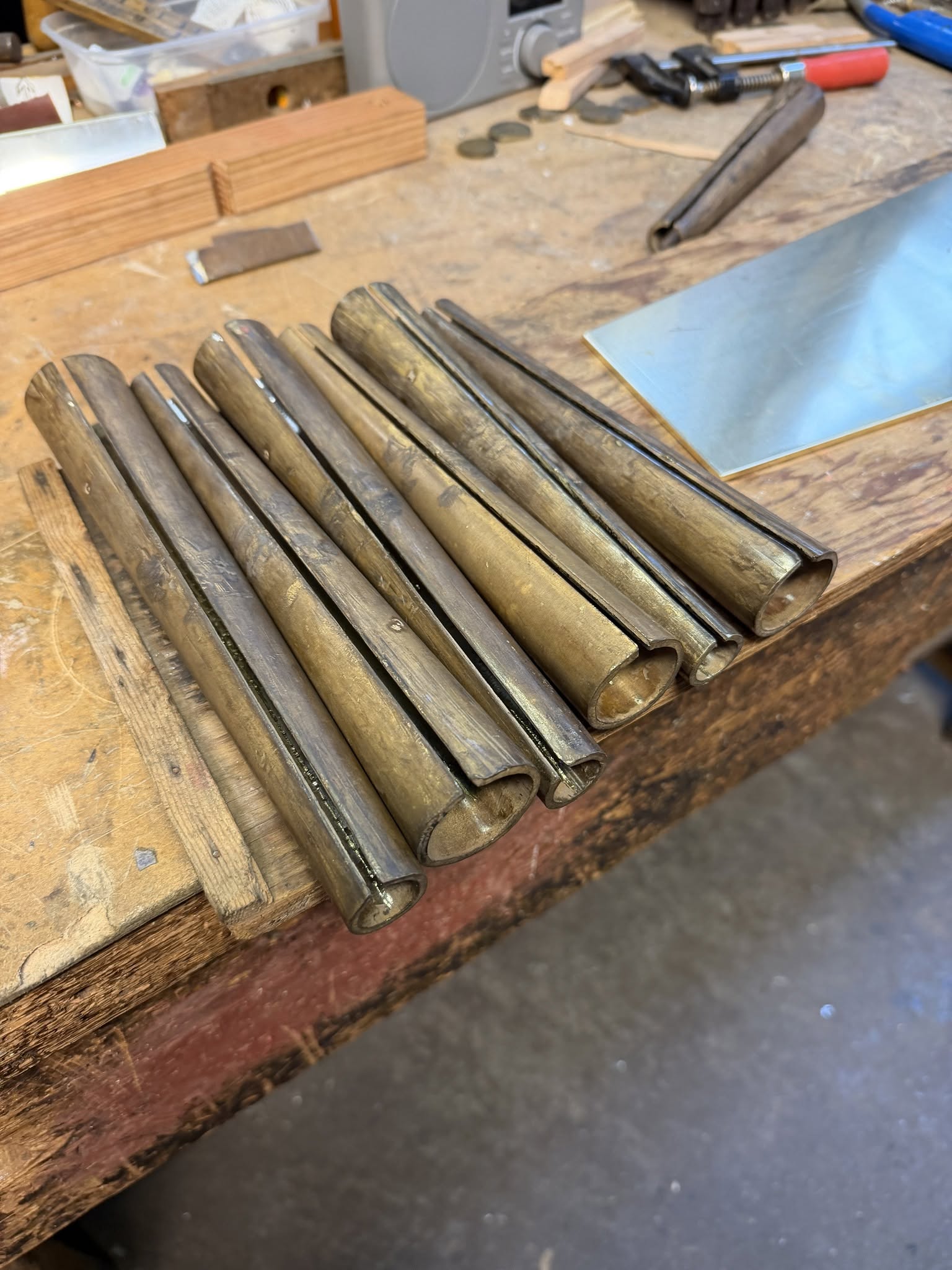
Making reed shallots is a trade in itself, that takes careful training and practice. There are several different kinds of shallots, and different techniques you can use to make them.
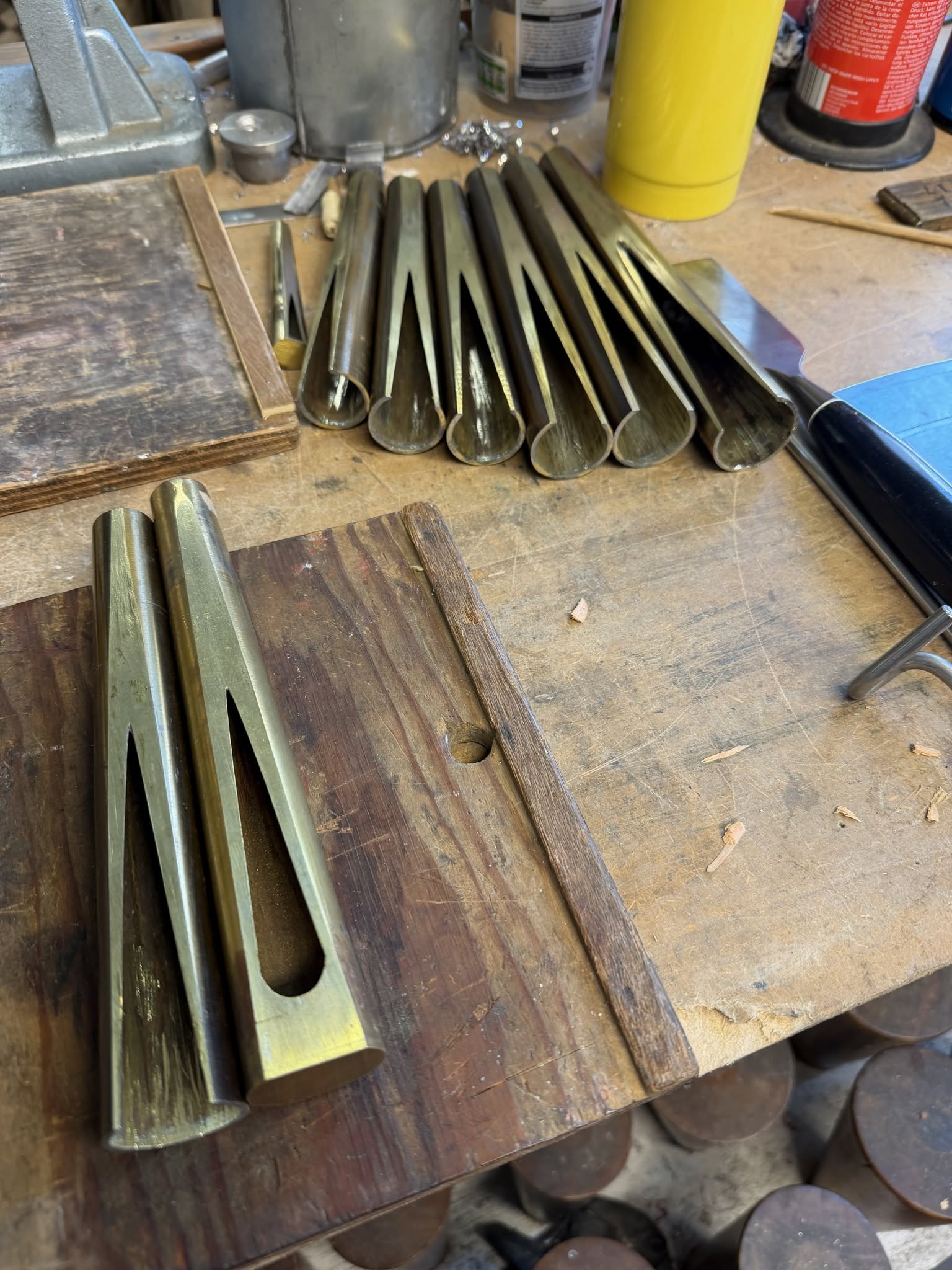
Recently, Henry Willis & Sons Ltd was restoring the 1926 Contra Trombone 32', from the organ of Liverpool Cathedral. The shallots had been vandalized by others, when they attempted to revoice the Trombone. The Willis company has kindly given me photos documenting the making of new, (original-style) shallots.
Willis Shallots, a little history
By the 19th century, the Victorians where building huge churches with large congregations. The 18th century English organ was inadaquate to support massed, hymn singing voices. A mere rebuild wouldn't do. Among other things, they just weren't loud enough. Much to his dismay, Wm Hill discovered that it didn't work to just make the pipes fatter. Fortunately, imported organs of Edmund Schulze of Paulinzelle (1850's) from Saxony showed how to scale and voice powerful, new "orchestral" instruments, which were suited to the repertoire of Victorian and Edwardian England.
But reeds were a problem. The 18th century trumpets lacked power. French reeds were loud enough, but much too bright, brash and noisy. Fortunately, about 1850, Father Willis developed new voicing and reed designs, that were powerful, brilliant, and characterful, yet they could also blend seamlessly into the full ensemble.
One of Willis's key innovations was a new design of shallot, as shown in the accompanying photo. (Actually, the photo is a Casavant shallot, I don't have a Willis sample). Willis's shallot was so successful that variations were copied by most of the English builders, as well as all of North America.
Willis Shallots, Vincent Shallot
By the 20th century, the powerful, "orchestral" instruments moved to higher wind pressures. Standard Willis shallots that worked well on 7" wind, tended to "choke" under higher pressures, because the overwhelming force of air prevented the tongue from opening and closing cleanly.
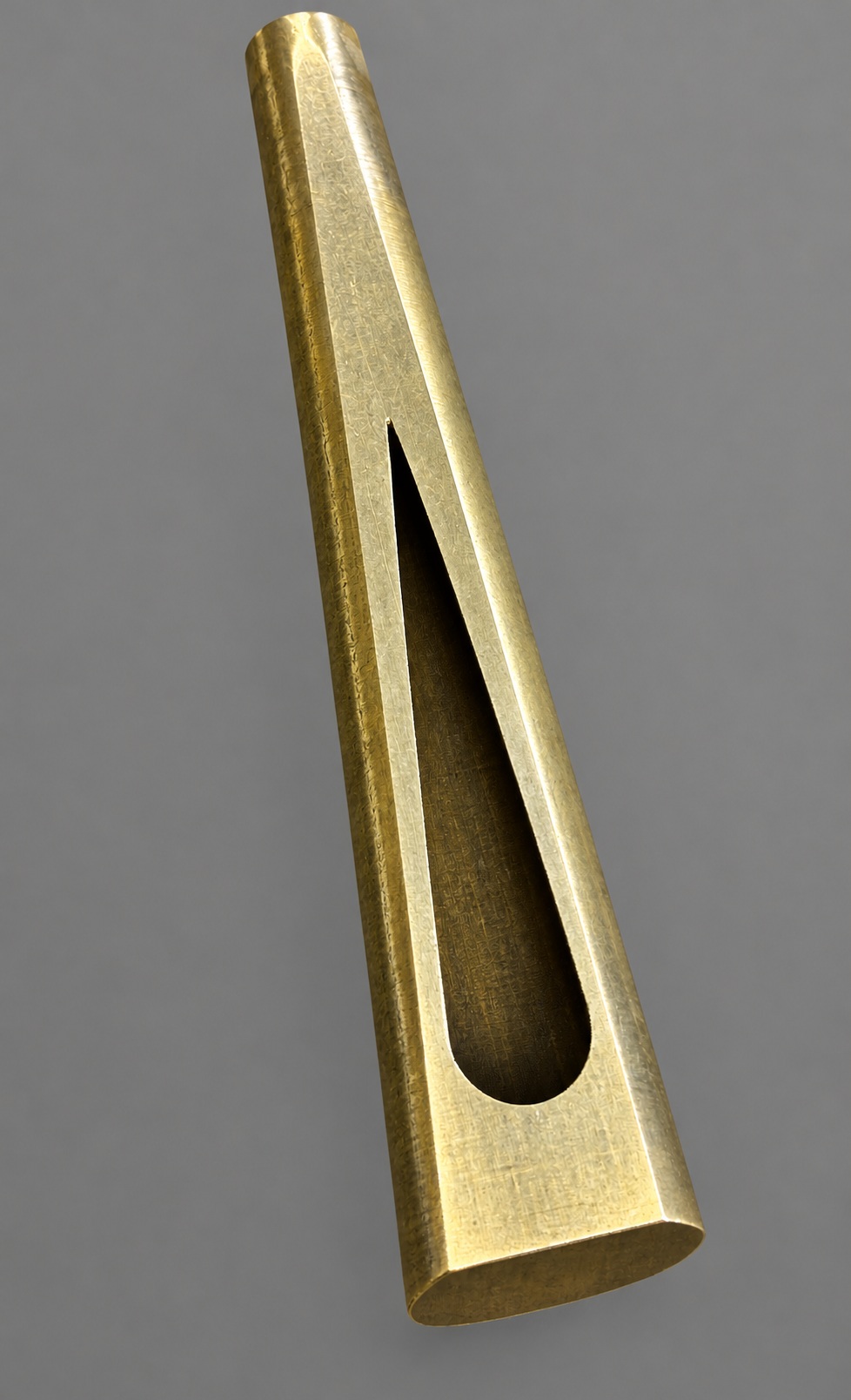
About 1900, Vincent Willis developed a new high pressure shallot, with a teardrop opening, which avoided choking. The design moved the opening from its usual position and placed it further up the shallot. This resulted in a longer interval between air pulses, allowing for a more equal and full development of both the fundamental "ground tone" and the crucial overtones that give a reed its character and richness.
The remaining photos show the Contra Trombone 32' Vincent shallots. This reed is on 17-1/2" wind.